Claudius Jacquand 肖像

31 幅最著名的 Claudius Jacquand 作品,每一件都独一无二

更新于 November 2026 · 基于我们的流行度评分排名(每件作品的搜索量、访问量及订单量) · 31 件 Claudius Jacquand 作品收录于我们的目录中

简而言之

The night of Bartholomew 1572 (1837) 是 Claudius Jacquand 最受瞩目的画作;原作收藏于 斯德哥尔摩 的 国家博物馆。 随后,目光会移向 Laurence attendant Jocelyn (1836) 和 The Bubble Blowers (1844)。 在 Claudius Jacquand 的 31 件作品中,这 31 件最为闻名;每一件都是独一无二的原作,并附有创作年份、馆藏机构及其经久不衰的原因。

1803 – 1878, Lyon 藏品最多:Petit Palais

画廊视角下的 Claudius Jacquand 十大名作

1
The night of Bartholomew 1572 (1837) 作 Claudius Jacquand

The night of Bartholomew 1572

1837 · Oil On Canvas · 国家博物馆, 斯德哥尔摩

In The night of Bartholomew 1572, Claudius Jacquand captures a moment of profound tension. Painted about 1837, this work by the French artist Claudius Jacquand focuses on a specific, violent confrontation during the St. Bartholomew's Day massacre. The scene is set within a dark, enclosed architectural space, where the weight of history is felt through the immediate presence of conflict.

Claudius Jacquand 的名画,第 11 至 31 幅

令 Claudius Jacquand 驻足的创作主题

这些原作中反复出现的四个主题,各有一个最杰出的范例。

收藏有 Claudius Jacquand 原作的博物馆

收藏了本页大部分画作的 8 家博物馆。

博物馆 城市 Claudius Jacquand 的作品 此列表中的画作
Petit Palais, 巴黎Petit Palais 巴黎 3 Well-shaped model for the Chapel of the Virgin of the church Saint-Philippe-du-Roule (first sketch): "Mirror of Justice" - "The Assumption of the Virgin" - "Help of the Infirm" (upper register); "The Education of the Virgin" - "The Death of the..., Shaped model for the Chapel of the Virgin of the church Saint-Philippe-du-Roule (second sketch): "Angel" - "The Coronation of the Virgin" - "Angel" (upper register); "The Education of the Virgin" - "The Death of the Virgin" (lower register), Model in shape for the Chapel of the Virgin of the church Saint-Philippe-du-Roule (third sketch): "The Coronation of the Virgin"
里昂美术博物馆, 里昂里昂美术博物馆 里昂 2 Les Adieux de Cinq-Mars à Marie d'Entraigues or le Baiser du départ, Thomas More, Lord High Chancellor of England
国家博物馆, 斯德哥尔摩国家博物馆 斯德哥尔摩 1 The night of Bartholomew 1572
浪漫主义生活博物馆, 巴黎浪漫主义生活博物馆 巴黎 1 Laurence attendant Jocelyn
阿姆斯特丹博物馆, 阿姆斯特丹阿姆斯特丹博物馆 阿姆斯特丹 1 The Bubble Blowers
Musée des Beaux-Arts de Dijon, 第戎Musée des Beaux-Arts de Dijon 第戎 1 Perugino Painting for Monks in Perugia
Musée de Picardie, 阿眠斯Musée de Picardie 阿眠斯 1 Galilée avant son abjuration
Musee National du Chateau de Compiegne, 孔皮涅Musee National du Chateau de Compiegne 孔皮涅 1 The Bachelor Samson Carasio Defeated by Don Quixote

跨越数十载的 Claudius Jacquand:每一件皆为独一无二的原作

各年代作品统计

选择一个年代,探索定义该时代的原创杰作。

Claudius Jacquand 的画作:画廊常见问题

Claudius Jacquand 最著名的代表作是什么?揭晓答案

The night of Bartholomew 1572 (1837),国家博物馆, 斯德哥尔摩。紧随其后的是 Laurence attendant Jocelyn (1836) 和 The Bubble Blowers (1844)。

Claudius Jacquand 是在多少岁时创作了 The night of Bartholomew 1572?揭晓答案

34岁:The night of Bartholomew 1572创作于1837年,Claudius Jacquand出生于1803年。

Claudius Jacquand 最著名的十幅画作是哪些?揭晓答案

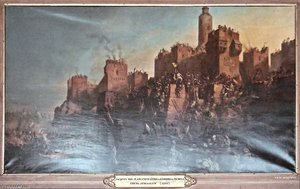
The night of Bartholomew 1572, Laurence attendant Jocelyn, The Bubble Blowers, The Honorable Apology in a Convent of the Brother Knights, Hermits of Saint Maurice, Perugino Painting for Monks in Perugia, Well-shaped model for the Chapel of the Virgin of the church Saint-Philippe-du-Roule (first sketch): "Mirror of Justice" - "The Assumption of the Virgin" - "Help of the Infirm" (upper register); "The Education of the Virgin" - "The Death of the..., Shaped model for the Chapel of the Virgin of the church Saint-Philippe-du-Roule (second sketch): "Angel" - "The Coronation of the Virgin" - "Angel" (upper register); "The Education of the Virgin" - "The Death of the Virgin" (lower register), Galilée avant son abjuration, Jacques Molay Prend Jérusalem 及 Model in shape for the Chapel of the Virgin of the church Saint-Philippe-du-Roule (third sketch): "The Coronation of the Virgin"。上方排名显示了每件作品的创作年份及馆藏机构。

已知 Claudius Jacquand 有多少件作品?揭晓答案

我们的目录收录了 31 件 Claudius Jacquand 的作品,创作年代从 1828 年至 1867 年。

在哪里可以欣赏到最著名的 Claudius Jacquand 原作?揭晓答案

多见于 Petit Palais (巴黎), 里昂美术博物馆 (里昂) 及 国家博物馆 (斯德哥尔摩)。上方的博物馆列表列出了所有相关机构。

Claudius Jacquand 的代表作创作于哪个时期?揭晓答案

在 1830s 期间:本页 31 件作品中有 7 件创作于该时期,其中包含 The night of Bartholomew 1572 件作品。

哪幅 Claudius Jacquand 的名作创作年代最早,哪幅最晚?揭晓答案

在本页面中,最早的作品创作于 Thomas More, Lord High Chancellor of England (1828),最晚的创作于 Galilée avant son abjuration (1867)。

在 Petit Palais 可以看到哪些 Claudius Jacquand 的原作?揭晓答案

Well-shaped model for the Chapel of the Virgin of the church Saint-Philippe-du-Roule (first sketch): "Mirror of Justice" - "The Assumption of the Virgin" - "Help of the Infirm" (upper register); "The Education of the Virgin" - "The Death of the..., Shaped model for the Chapel of the Virgin of the church Saint-Philippe-du-Roule (second sketch): "Angel" - "The Coronation of the Virgin" - "Angel" (upper register); "The Education of the Virgin" - "The Death of the Virgin" (lower register) 及 Model in shape for the Chapel of the Virgin of the church Saint-Philippe-du-Roule (third sketch): "The Coronation of the Virgin":Petit Palais, 巴黎收藏了本页中 3 件作品。

Claudius Jacquand:艺术家肖像

The Artisan's Legacy: The Life and Art of Claude Jacquand

Born into a world of meticulous craftsmanship in Lyon, France, on December 11, 1803, Claude Jacquand—often referred to as Claudius Jacquand—carried the precision of his lineage into the grand halls of French art. The son of a comb-maker, Jacquand’s early years were steeped in an appreciation for fine detail and manual dexterity, qualities that would later define his brushwork. His journey began at the École nationale des beaux-arts de Lyon under the guidance of Fleury François Richard, where he mastered the foundational rigors of academic painting. This period of intense training instilled in him a profound respect for anatomical accuracy and tonal modulation, preparing him for the dramatic shifts that would characterize his later career.

The trajectory of Jacquand’s life took a transformative turn following the death of his mother in 1836. Drawn by the magnetic pull of the art capital, he moved to Paris, a transition that served as the catalyst for his professional ascent. It was in this vibrant, often turbulent era of French history that Jacquand began to carve out a reputation for excellence. His talent did not go unnoticed by the prestigious institutions of his time; by 1839, he had been knighted in the Legion d'Honneur, and within a year, he was receiving international acclaim, including a Gold Medal at an exposition in Brussels and the Order of Leopold following another triumph in The Hague. These accolades placed him among the respected figures of the Romantic era, even as he navigated the complexities of a changing social landscape.

A Tapestry of History and Emotion

Jacquand’s oeuvre is a captivating exploration of historical narratives, religious devotion, and the intimate nuances of genre scenes. He possessed a rare ability to breathe life into the past, transforming static historical tableaus into breathing, emotional experiences. His works often functioned as windows into bygone eras, utilizing chiaroscuro lighting and rich, textured palettes to evoke the atmosphere of the Renaissance and the Baroque periods. Whether depicting the intellectual gravity of an 18th-century gathering or the dramatic tension of a royal encounter, Jacquand’s compositions were marked by a profound sense of storytelling.

His thematic range was remarkably broad, encompassing:

  • Historical Tableaus: Grand narratives such as Louis XI of France Surprising the Queen, which utilized dramatic lighting to capture moments of intense political and personal intrigue.
  • Religious Subjects: Devotional works that showcased his ability to handle sacred themes with both reverence and technical mastery.
  • Genre Scenes: Intimate glimpses into daily life, such as the Guard Room Scene, which offered viewers a sense of camaraderie and historical authenticity.
  • Intellectual Portraits: Capturing the essence of Enlightenment figures like Voltaire, where he focused on the psychological depth and contemplative nature of his subjects.

Evolution and Enduring Influence

As the art world shifted from the strictures of Classicism toward the emotional volatility of Romanticism and eventually the light-drenched experiments of Impressionism, Jacquand demonstrated a remarkable stylistic fluidity. While his roots remained firmly planted in the academic tradition—characterized by smooth surfaces and balanced compositions—his later works began to embrace more subtle color harmonies and atmospheric effects. This evolution reflects an artist who was not merely a chronicler of the past, but a participant in the living, breathing progression of French art history.

Despite the financial hardships that shadowed his later years following the French Revolution of 1848, Jacquand’s commitment to his craft never wavered. He lived through a period of immense social upheaval, yet he continued to exhibit regularly, maintaining a standard of excellence that earned him the respect of critics like Charles Baudelaire. Though history sometimes remembers his contemporaries more vividly, the legacy of Claude Jacquand remains etched in the meticulous detail and emotional resonance of his canvases. His life stands as a testament to the power of craftsmanship, representing a bridge between the disciplined traditions of the old masters and the expressive freedom of the modern age.