


1

圣埃米迪乌斯与受胎告知
这幅名为《圣埃米迪乌斯与受胎告知》的祭坛画,出自艺术家卡罗·克里韦利之手。创作于1486年的这部杰作,通过细致入微的笔触,捕捉了一个神圣的宗教时刻。这件作品最初是为位于马尔凯大区的阿斯科利·皮切诺的圣母领报教堂(Church of SS. Annunziata)所创作。这次特定的委任带有鲜明的公民意义,旨在庆祝教皇西斯都四世于1482年授予阿斯科利·皮切诺镇的自治权。

更新于 November 2026 · 基于我们的流行度评分排名(每件作品的搜索量、访问量及订单量) · 227 件 卡罗·克里韦利 作品收录于我们的目录中
简而言之
在画廊看来,卡罗·克里韦利 最著名的作品是 圣埃米迪乌斯与受胎告知 (1486),其原作现收藏于 伦敦 的 国家美术馆。 Pietà 与 Virgin and Child (1482) 共同构成了那组令人过目不忘的艺术三部曲。 在我们的目录中,卡罗·克里韦利 共有 227 件作品,画廊为您精选了以下 100 件最著名的原作,并详细列出了每件作品的创作年份、馆藏机构及其独特之处。
这幅名为《圣埃米迪乌斯与受胎告知》的祭坛画,出自艺术家卡罗·克里韦利之手。创作于1486年的这部杰作,通过细致入微的笔触,捕捉了一个神圣的宗教时刻。这件作品最初是为位于马尔凯大区的阿斯科利·皮切诺的圣母领报教堂(Church of SS. Annunziata)所创作。这次特定的委任带有鲜明的公民意义,旨在庆祝教皇西斯都四世于1482年授予阿斯科利·皮切诺镇的自治权。

To stand before Carlo Crivelli’s depiction of the Pietà is to be enveloped by an atmosphere of exquisite, sorrowful beauty. This masterpiece transcends a mere representation of tragedy; it is a meditation on devotion, loss, and enduring love. The scene centers upon the Virgin Mary, her posture conveying both profound grief and serene acceptance, as she cradles the lifeless body of Jesus Christ. Crivelli, working in the late 15th century…

To gaze upon this magnificent depiction of the Virgin Mary cradling the Christ Child is to step directly into the luminous, devotional world of the Italian Renaissance. Carlo Crivelli’s Virgin and Child, dating from 1482, is far more than a mere portrait; it is a carefully constructed moment of divine intimacy rendered with breathtaking technical skill. The composition immediately draws the eye to the tender connection between mother and son,…

In the quiet corners of art history, few works capture the breathtaking intersection of the divine and the terrestrial as exquisitely as Carlo Crivelli’s Annunciation with Saint Emidius. This masterpiece, a jewel of the Venetian Gothic tradition, invites the viewer into a sacred space where every brushstroke serves a higher purpose. At its heart, the painting depicts the profound moment of the Annunciation—the celestial announcement of Christ's incarnation to the…

This work presents Saint Lucy, a figure rendered with the distinctive, meticulous hand of Carlo Crivelli. Created about 1476, the painting emerged from a larger, cohesive program. It was originally part of the Four Panels from an Altarpiece, Ascoli Piceno. This grouping was designed to inhabit a specific sacred space, serving the devotional needs of its original setting.

The figure of Saint Catherine of Alexandria is presented within a shallow architectural niche, her presence defined by a vertical composition and a sense of quiet dignity. She is rendered in tempera on panel, a medium that allows for the meticulous layering of translucent glazes to build depth and luminosity. Her attire consists of a deep blue gown adorned with shimmering gold embroidery, a vibrant red cloak, and a striking…

Carlo Crivelli's "Saint Michael," painted around 1476, isn’t merely a depiction of an angel battling a demon; it’s a meticulously crafted tableau of spiritual warfare, brimming with Renaissance artistry and profound symbolism. This panel, once part of a larger altarpiece intended for the church of San Domenico in Ascoli Piceno, Italy, immediately draws the eye into a dynamic scene where youthful Michael, radiating aristocratic beauty yet possessing an undeniable ferocity,…

The Virgin Mary sits enveloped in a deep red background, a color that holds the weight of both royalty and sacrifice. She cradles her child with a steady, nurturing grace, her form defined by sharp, linear precision. A crown rests upon her head, catching the light and marking her status within this sacred space. Two apples appear in the composition—one near the bottom right and another toward the top left—resting…

The scene is a dense knot of grief, a tight arrangement of figures pressed against a luminous, gold-over-gesso background. At the center, the pale, sculptural flesh of Christ rests heavily, his torso rendered with anatomical precision. The Virgin Mary cradles him, her blue garment edged in reddish gold, her face marked by three large, distinct teardrops. Beside her, the figures of Mary Magdalene and another mourning companion overlap in a…

Created in 1482, this panel captures a pivotal moment of celestial intervention. The angel, poised in a state of graceful movement, holds a scroll, signaling the weight of the message being delivered to Mary. The scene unfolds within a structured architectural setting, where a brick wall provides a sense of tangible depth and permanence. A single bird flies above the angel, a subtle detail that punctuates the stillness of the…
 圣母玛利亚怀抱耶稣基督1493 · 布雷拉畫廊
12
 The Dead Christ between the Virgin and Saint John the Evangelist1475 · 哈佛艺术博物馆
13
 Saint Lucy1450 · Musée du Petit Palais
14
 Saint Augustine1450 · Musée du Petit Palais
15
 Saint Nicholas1450 · Musée du Petit Palais
16
 Saint Catherine of Siena1450 · Musée du Petit Palais
17
 Man of Sorrow1468
18
 Resurrection1482 · Abegg Foundation
19
 Saints Bernardino and Clare1480 · 伍斯特艺术博物馆
20
 Madonna and Child1476 · 国家美术馆
21
 Saint Jerome1473
22
 Saint Jerome1476 · 国家美术馆
23
 Saint Ursula1473
24
 Enthroned Madonna1473
25
 Saint Nicolas1480
26
 Saint Benedict1488 · 柏林国家美术馆
27
 Saint Augustine1490 · Palazzo Colonna
28
 Bonaventure1490 · 柏林国家美术馆
29
 St Antony of Padua1487 · Bonnefanten Museum
30
 St Dominic1487 · Bonnefanten Museum
31
 St Ambrose1487 · Bonnefanten Museum
32
 Madonna1489
33
 Saint Roch1490
34
 Saint Catherine of Alexandria1476 · 国家美术馆
35
 Apostles1473
36
 Coronation of the Virgin1493 · 布雷拉畫廊
37
 St Roch1493 · 威廉斯收藏馆
38
 Enthroned Madonna1473 · 国家美术馆
39
 St Jerome and St Augustine (detail)1490 · 威尼斯学院美术馆
40
 Polittico di Ascoli Piceno
41
 Saint Bartholomew1475 · 布雷拉畫廊
42
 Lamentation of Christ1473
43
 Madonna and Child Enthroned1477 · 布达佩斯美术博物馆
44
 Triptych of Camerino1482 · 布雷拉畫廊
45
 Enthroned Madonna (Enthroned Maria lactans)1473
46
 Saint George1472
47
 Madonna and Child St Francis of Assisi1471 · Musées Royaux des Beaux-Arts
48
 Saint Anthony, Saint Jerome, Saint Andrew1482 · 布雷拉畫廊
49
 Annunciation angel Gabriel1468
50
 Virgin Annunciation1468
51
 Saint John the Baptist1468
52
 Saint Laurenzius1468
53
 Madonna and Child enthroned with donor1470
54
 Saint Catherine of Alexandria1473
55
 Saints Anthony and Lucia1470
56
 Madonna and Child Enthroned1476
57
 Saint Jerome1473
58
 Saint Dominic1476
59
 Saint1480
60
 Saint Catherine of Alexandria1476
61
 Saint John the Baptist1476
62
 Saint Roch1480 · 威廉斯收藏馆
63
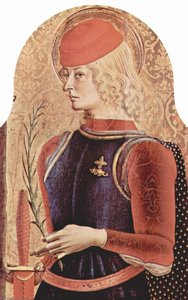 Saint George1473
64
 Two Apostles1475
65
 Saint Peter1470
66
 Saint John the Baptist1473
67
 Saint Catherine of Alexandria1470
68
 Saint Peter1473
69
 Saint Peter Martyr and Saint Venetianus of Camerino1482
70
 Saint Paul1473
71
 Saint Emidius1473
72
 Saint Louis of Toulouse Saint Jerome Saint Peter and1493 · Musée Jacquemart-André
73
 Madonna and Child, before -1490
74
 Madonna and Child, before -1490
75
 Madonna and Child, before -1490
76
 Madonna and Child, before -1490
77
 Saint Paul, Saint John Chrysostom and Saint Basil1493
78
 Enthroned Madonna, St. Jerome and St. Sebastian1490
79
 Saint Sebastian1490
80
 Saint George and the dragon1490
81
 María Magdalena 1
82
 St John the Baptist1488 · 阿什莫利博物馆
83
 Virgin and Child Enthroned1476 · 布达佩斯美术博物馆
84
 Saint James1473
85
 Saint Francis1470
86
 Apostles1473
87
 Saint Bartholomew1473
88
 Virgin proclamation1482 · 施泰德美术馆
89
 Saint Francis1470
90
 Flagellation of Christ1468
91
 Virgin and Child Enthroned with Saints1488 · 柏林州立博物馆
92
 St Peter and St Paul (detail)1490 · 威尼斯学院美术馆
93
 Christ's prayer on Oelber1468
94
 Portrait of a Man
95
 Saint Thomas Aquinas1476
96
 Saint Louis of Toulouse1470
97
 St. Anthony
98
 Christ in the grave with saints柏林国家美术馆
99
 untitled (7477)
100
 San Doménico国家美术馆
这些原作中反复出现的四个主题,各有一个最杰出的范例。
收藏了本页中大部分画作的 8 家博物馆。
| 博物馆 | 城市 | 卡罗·克里韦利 的作品 | 此列表中的画作 |
|---|---|---|---|
 国家美术馆 |
伦敦 | 27 | 圣埃米迪乌斯与受胎告知, Annunciation with St Emidius (detail), Saint Lucy |
 布雷拉畫廊 |
米蘭 | 10 | Virgin and Child, 圣母玛利亚怀抱耶稣基督, Coronation of the Virgin |
 Musée du Petit Palais |
阿维尼翁 | 4 | Saint Lucy, Saint Augustine, Saint Nicholas |
 柏林国家美术馆 |
柏林 | 4 | Saint Benedict, Bonaventure, Christ in the grave with saints |
 Bonnefanten Museum |
马斯特里赫特 | 3 | St Antony of Padua, St Dominic, St Ambrose |
 威尼斯学院美术馆 |
威尼斯 | 4 | St Jerome and St Augustine (detail), St Peter and St Paul (detail) |
 施泰德美术馆 |
法兰克福 | 2 | Annunciation angel, Virgin proclamation |
 威廉斯收藏馆 |
伦敦 | 2 | St Roch, Saint Roch |
选择一个年代,探索定义该时代的原创杰作。

The figure of Saint Lucy emerges from a dark, shadowed background, her presence defined by a sharp, sculptural clarity that feels almost tangible. She stands in profile, facing left, her gaze directed toward an unseen horizon. Her form is draped in heavy, flowing garments that fall in deep, rhythmic folds, suggesting the weight and texture of thick textile. A delicate halo, rendered with fine, radiating lines, encircles her head, catching…

In "Man of Sorrow" by Carlo Crivelli, the viewer encounters a close-up depiction of the Deposition of Christ. The composition focuses intently on the body of Jesus as he is lowered from the cross. This central figure, marked by vulnerability and suffering, occupies the immediate foreground. Around him, the presence of Mary and other figures is felt through partial visibility, their forms emerging from the shadows to witness the descent.…
This work presents Saint Lucy, a figure rendered with the distinctive, meticulous hand of Carlo Crivelli. Created about 1476, the painting emerged from a larger, cohesive program. It was originally part of the Four Panels from an Altarpiece, Ascoli Piceno. This grouping was designed to inhabit a specific sacred space, serving the devotional needs of its original setting.
这幅名为《圣埃米迪乌斯与受胎告知》的祭坛画,出自艺术家卡罗·克里韦利之手。创作于1486年的这部杰作,通过细致入微的笔触,捕捉了一个神圣的宗教时刻。这件作品最初是为位于马尔凯大区的阿斯科利·皮切诺的圣母领报教堂(Church of SS. Annunziata)所创作。这次特定的委任带有鲜明的公民意义,旨在庆祝教皇西斯都四世于1482年授予阿斯科利·皮切诺镇的自治权。
The figure of Saint Catherine of Alexandria is presented within a shallow architectural niche, her presence defined by a vertical composition and a sense of quiet dignity. She is rendered in tempera on panel, a medium that allows for the meticulous layering of translucent glazes to build depth and luminosity. Her attire consists of a deep blue gown adorned with shimmering gold embroidery, a vibrant red cloak, and a striking…
圣埃米迪乌斯与受胎告知 (1486),国家美术馆, 伦敦。紧随其后的是 Pietà 和 Virgin and Child (1482)。
51岁:圣埃米迪乌斯与受胎告知创作于1486年,卡罗·克里韦利出生于1435年。
圣埃米迪乌斯与受胎告知, Pietà, Virgin and Child, Annunciation with St Emidius (detail), Saint Lucy, Saint Catherine of Alexandria, Saint Michael, Madonna and Child, Pietà 及 Annunciation angel。上方排名显示了每件作品的创作年份及馆藏机构。
我们的目录收录了 227 件 卡罗·克里韦利 的作品,创作年代从 1450 年至 1493 年。
多见于 国家美术馆 (伦敦), 布雷拉畫廊 (米蘭) 及 Musée du Petit Palais (阿维尼翁)。上方的博物馆列表列出了所有相关机构。
在 1470s 期间:本页 100 件作品中有 42 件创作于该时期,其中包含 Saint Lucy 件作品。
在本页面中,最早的作品创作于 Saint Lucy (1450),最晚的创作于 圣母玛利亚怀抱耶稣基督 (1493)。
Religious (27), Saints (23) 及 Virgin mary (19),共计 100 件作品。
Tempera On Panel,共计 36 件(本页共有 100 件作品)。
根据本页面的原作,早期文艺复兴
圣埃米迪乌斯与受胎告知, Annunciation with St Emidius (detail) 及 Saint Lucy:国家美术馆, 伦敦收藏了本页中 10 件作品。
卡罗·克里韦利出生于威尼斯的一个画家世家,这种血脉传承或许在潜移默化中塑造了他对绘画技艺的早期认知。在艺术成长的关键时期,他沉浸在威尼托地区的艺术潮流中,从维瓦里尼画派中汲取养分,并深受帕多瓦传统中那种线条精准性的影响。他是一个拥有独特、甚至可以说有些固执的审美情趣的人。当他的同辈艺术家们正纷纷转向早期文艺复兴的自然主义风格时,卡罗·克里韦利却始终对晚期哥特式那种繁复华丽的装饰美感保持着一种近乎虔诚的执着。这种选择使他成为了15世纪艺术界一个极其特殊的个体——在旧时代的传统与新时代的变革之间,他以一种高度个人化、甚至带有某种矫饰主义色彩的表现主义,在两者间的张力中开辟了自己的艺术路径。
他的生命轨迹中有一个突如其来的转折,即离开威尼斯艺术中心。1457年,因卷入一起涉及诱惑已婚女性的法律纠纷,他被迫离开了威尼斯。这段流亡岁月将他引向了意大利东部的马尔凯大区,特别是阿斯科利·皮切诺一带。在这些意大利东部领土上,他找到了另一种形式的成功,成为了一位高产的祭坛画创作者。他从未盲从于当时的流行趋势;相反,他精心培育出一种强调清晰度与锐利线条轮廓的风格,在意大利各大艺术中心发生剧烈变革之际,他往往在一种相对孤立的状态中,坚守着自己的艺术领地。
卡罗·克里韦利的作品以其卓越的技艺而著称,这种技艺试图在神圣性与物质真实感之间架起一座桥梁。他是“错视画”(trompe l'oeil)的大师,能够以惊人的准确度利用色彩来模拟现实世界。他不仅仅是在描绘物体,他更试图让物体仿佛占据了与观者相同的空间。在他的画作中,画面往往被模拟的大理石建筑、悬挂的水果花环以及仿佛从画板上跃然而出的羊皮纸小卡片(cartellini)所填满。这种对物质质感的痴迷是他宗教虔诚心的核心体现,为站在祭坛画前的信徒创造出一种直抵眼前的临场感。
他在色彩与光影的处理上既瑰丽又深思熟虑。他巧妙地运用金箔,并常以复杂的图案进行压印,营造出一种超凡脱俗的光辉,与丝绸、珠宝和石材那写实的质感形成鲜明对比。他的人物形象往往呈现出一种近乎过度的苍白与无瑕的肤色,通过锐利的轮廓线来强调其雕塑般的立体感。这种高度装饰性与极致写实主义的结合,创造出一种独一无二的视觉语言,其特征表现为:
卡罗·克里韦利留下的艺术瑰宝,其中许多现存于 布雷拉美术馆 和 国家美术馆 等重要馆藏中,无不展示出他高超的绘画造诣。他的圣母像与圣徒画像带有某种不寻常的表现主义色彩,通过夸张的手势来传达深沉的情感。他是一位细节的雕琢者,从骑士盔甲上的点点寒光,到圣母衣褶间细腻的纹理,无不尽收眼底。即便随着文艺复兴向透视法与比例学的全新理想演进,卡罗·克里韦利依然坚守着他那细致入微、极尽繁复的艺术愿景,从而确保了他在那个时代作为最独特艺术声音之一的地位。


