The brush and the shadow
Antoni Caba lived his life within the light and dark of Barcelona. His early years in the 1850s were spent at the Escola de la Llotja, sitting before the lessons of Pau Milà i Fontanals and Claudi Lorenzale. He later moved to Madrid to study at the Real Academia de Bellas Artes de San Fernando, where Federico de Madrazo guided his hand. A period in Paris brought him under the direction of Charles Gleyre at the Académie des Beaux-Arts, a time that helped shape how he handled the weight of oil on canvas.
His work often rests in the quiet space between light and deep shadow. He used chiaroscuro to pull figures out from dark backgrounds, a technique that earned him the nickname fotográficos among those who saw his portraits of the Catalan middle class. His brush moved through different phases, moving from flamigere and neo-greek styles toward more anecdotal, hard, and photographic approaches. In these works, one sees the careful placement of color and composition.
A life in the academy
Caba did not only paint; he taught the next generation how to see. From 1874, he held the position of Professor of Color and Composition at the Escola de la Llotja. Later, from 1887 to 1901, he served as the Director of the school. His presence in the halls of the academy was marked by a commitment to the realistic style.
His achievements were recognized through specific honors and public displays:
- A Gold Medal won at the 1888 Universal Exposition of Barcelona.
- The acquisition of his work by the government for the collection of the Museo del Prado.
- The creation of decorative murals within the Gran Teatro del Liceo and various private homes.
Faces and figures
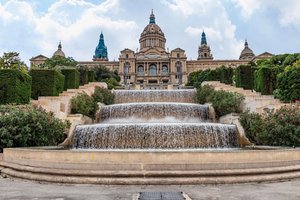
The faces he captured remain in collections like the Museu Nacional d'Art de Catalunya and the Museo del Prado. He painted many individuals, from the painter Joaquim Vayreda to Queen Maria Cristina of Spain and her son Alfonso XIII. Some of his portraits, such as those of Lluïsa Dulce i Tresserra or Ramon Padró, show a focus on the sitter's presence through strong contrasts.
Beyond the human face, he worked on larger compositions like The Triumph of Day over Night Preceded by Dawn. He also left behind smaller studies, such as a study of a hand or his own self-portraits. These pieces show a man deeply involved in the technicalities of his craft, from the way light hits a straw hat to the precise rendering of a blue bow.