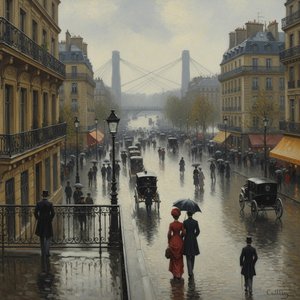
Introduction
Born in the vibrant atmosphere of late 19th-century France, the Impressionist movement emerged as a radical departure from the rigid, polished standards of the traditional Academy. Rather than retreating into the controlled lighting of a studio to depict historical or mythological scenes, these artists stepped outdoors to capture the fleeting, ephemeral qualities of light and atmosphere. They sought to document the immediate sensory experience of a single moment, using rapid, broken brushstrokes to translate the shifting dance of sunlight across water, the haze of a Parisian street, or the soft textures of a garden.
This revolution was more than a change in technique; it was a cultural shift that embraced the modernity of a changing France. By prioritizing the perception of color and the movement of light over precise anatomical lines, these painters challenged the very definition of what art could represent. Their work captured the essence of a world in transition, from the bustling boulevards of Paris to the tranquil landscapes of the French countryside, forever changing the trajectory of Western art history.
Today, the legacy of this movement remains profoundly influential, continuing to resonate through its emotional honesty and its celebration of the beauty found in the everyday. The following artists represent the core of this luminous revolution, each offering a unique perspective on the interplay between light, color, and the human experience.
Claude Monet
 Water Lilies (or Nympheas) - Claude Monet
Born in Paris in 1840, Claude Monet’s journey toward becoming a cornerstone of the Impressionist movement began with a profound shift from urban life to the salt-misted coast of Normandy. Following the loss of his mother in 1857, the unpredictable elements of Le Havre provided the raw environmental data that would eventually define his revolutionary approach to light and atmosphere. His technical foundation, built through practical observation at the Le Havre secondary school of the arts, allowed him to move beyond academic theory toward a radical new way of seeing.
Monet is a definitive figure among French impressionist painters because of his lifelong commitment to capturing the ephemeral qualities of a single moment. Rather than seeking precise, smooth representation, he prioritized the sensory experience of light and color. This is most masterfully realized in his iconic Water Lilies series. Created during his time at Giverny, these works utilize a thick impasto technique, where broken brushstrokes and layered oils allow the viewer's eye to optically mix vibrant colors. Through this method, he transformed a simple garden pond into a profound meditation on the shimmering, fleeting nature of the natural world.
Pierre-Auguste Renoir
 The Great Bathers (The Nymphs) - Pierre-Auguste Renoir
In his late masterpiece, The Great Bathers (The Nymphs), Pierre-Auguste Renoir captures a luminous celebration of light and form that defines his enduring legacy. This work, painted in 1919, showcases a serene intimacy through five nude female figures immersed in a tranquil river landscape. As a leading figure of the French Impressionism movement, Renoir moved away from the rigid confines of the studio to embrace the fleeting, shimmering effects of natural light, a core tenet of the movement.
Renoir’s journey from a working-class background in Limoges to the heart of the Parisian art scene allowed him to develop a unique visual language. His early training as a porcelain painter instilled a sensitivity to fine detail and texture that would later evolve into his signature fluid brushwork. He was a master of the impasto technique, applying oil paints in short, broken strokes to create a tactile surface that mimics the play of sunlight on skin and water. His palette often utilized vibrant complementary colors—such as soft pinks against lush greens—to evoke the warmth of the human experience. Whether depicting joyful social gatherings or the classical grace of nymphs, Renoir’s work remains a testament to the beauty of the moment.
Édouard Manet
 The Luncheon on the Grass - Édouard Manet
Édouard Manet (1832–1883) stands as a pivotal figure who bridged the gap between Realism and the burgeoning Impressionist movement. Born in Paris into an affluent family, his path toward the arts was a hard-won victory after failing to enter the naval academy. Under the guidance of Thomas Couture, he mastered the technical foundations of academic painting, yet his spirit was fundamentally restless. He spent countless hours in the Louvre, absorbing the light and form of the Old Masters, only to eventually use that knowledge to dismantle traditional conventions.
Manet’s inclusion in the group of French impressionist painters stems from his radical departure from the polished, invisible finish of the Salon. He embraced a visible, energetic application of pigment and the alla prima technique, prioritizing the physical reality of paint to capture the immediacy of light. His masterpiece, The Luncheon on the Grass, serves as a revolutionary testament to this shift. By rejecting meticulous detail in favor of loose brushwork and flattened perspective, he challenged the social and artistic norms of his era, paving the way for the spontaneous, atmospheric explorations of his successors.
Camille Pissarro
 The Boulevard Montmartre at Night - Camille Pissarro
Often revered as the "dean of the Impressionist painters," Camille Pissarro was a foundational figure who bridged the gap between academic tradition and the radical innovations of the late 19th century. Born in 1830 in Saint Thomas to a family of Portuguese Jewish and French-Jewish descent, his journey led him from the Savary Academy to the prestigious École des Beaux-Arts. He refined his craft under the guidance of masters such as Gustave Courbet and Jean-Baptiste-Camille Corot, absorbing the essential lessons of realism before ultimately breaking away from the stifling constraints of the studio.
Pissarro’s commitment to the plein air method—painting directly from nature—solidified his place within the French Impressionist movement. He abandoned smooth, polished finishes in favor of a textured, impasto technique, using unmixed pigments and visible, energetic brushstrokes to capture the fleeting nuances of light. His ability to translate the immediate sensations of the landscape and the pulse of urban life is masterfully realized in The Boulevard Montmartre at Night. In this work, he utilizes a dynamic composition and a sophisticated palette of deep blues contrasted against the warm, glowing oranges of gas lamps to evoke the transient, atmospheric essence of a Parisian night.
Edgar Degas
 Dancers in Pink - Edgar Degas
Born in Paris in 1834, Edgar Degas was a central figure among the French impressionist painters, though he often preferred the label of a realist. While many of his contemporaries sought the fleeting effects of sunlight in the open air, Degas found his inspiration within the controlled, artificial light of the theater and the studio. His work is defined by an obsession with movement and the transient nature of modern life, a core tenet of the Impressionist movement.
Degas’s mastery is most evident in his ability to capture the physical toll and the effortless grace of his subjects. He moved away from the structured academic paths of his youth to focus on the rhythmic energy of ballet dancers, laundresses, and racehorses. His representative work, Dancers in Pink (1885), exemplifies this fascination, utilizing expressive brushstrokes and a vibrant palette to depict the swirling motion of tutus and the bustling atmosphere of a dance scene.
Through works like The Dancing Class and The Absinthe Drinker, he transformed the observations of Parisian life into studies of light and form, securing his legacy as a master of capturing the fleeting moments of human movement.
Alfred Sisley
 The Saint Martin Canal in Paris - Alfred Sisley
Born in Paris in 1839 to British expatriate parents, Alfred Sisley navigated a bilingual upbringing that shaped his unique perspective as a French impressionist painter. Although his father initially intended for him to enter the family commerce business in London, the pull of the visual arts led him back to Paris in 1861. It was here, while studying under Marc-Charles-Gabriel Gleyre at the École des Beaux-Arts, that he began to break away from rigid academic traditions. He formed a vital creative circle with contemporaries such as Claude Monet and Pierre-Auguste Renoir, united by a desire to capture the fleeting nuances of nature.
Sisley’s contribution to the Impressionism movement is defined by his devotion to en plein air painting, focusing on the tranquil and atmospheric qualities of the landscape. His masterpiece, The Saint Martin Canal in Paris (1870), serves as a quintessential example of this approach. In this work, he utilizes loose, visible brushstrokes and a sophisticated handling of light to transform a Parisian waterway into a serene, shimmering vista. By prioritizing the transient effects of light and color over sharp outlines, Sisley solidified his reputation as a master of atmospheric landscape painting.
Gustave Caillebotte
 Paris street, Rainy Day - Gustave Caillebotte
Gustave Caillebotte (1848–1894) holds a singular position among French impressionist painters due to his ability to bridge the gap between rigorous realism and the movement's fascination with fleeting light. While many of his peers embraced spontaneous, loose brushwork, Caillebotte maintained a disciplined technical foundation acquired under the teacher Léon Bonnat and through his studies at the École des Beaux-Arts. This academic precision allowed him to capture the modern urban landscape with a structural clarity that felt both contemporary and grounded.
His masterpiece, Paris street, Rainy Day (1877), serves as a definitive example of his unique contribution to the movement. In this work, he utilizes a sophisticated, almost cinematic perspective that reflects the influence of photography. Rather than relying solely on the vibrant, broken color typical of his contemporaries, Caillebotte employs a more subdued palette and precise draftsmanship to depict the wet cobblestones and the grand Haussmann-style boulevards. By capturing the atmospheric essence of a rainy afternoon while maintaining a firm sense of form and depth, he successfully translated the ephemeral spirit of Impressionism into a structured, realistic vision of Parisian life.
Eugène Louis Boudin
 Etretat: Le Falaise d'Aval - Eugène Louis Boudin
In Etretat: Le Falaise d'Aval, the raw power of the Normandy coast is distilled into a fleeting moment of atmospheric brilliance. This work exemplifies the essence of Eugène Louis Boudin, a foundational figure in the French impressionist painters movement. By championing plein air painting, Boudin moved beyond the confines of the studio to capture the immediate, shifting qualities of light and tide, a practice that would become a cornerstone for the next generation of masters.
Born in 1824 in the port town of Honfleur, Boudin’s connection to the sea was deeply personal; his father was a harbor pilot, and his youth was spent observing the rhythmic movement of vessels. This maritime upbringing informed his signature subject matter: the vast, unpredictable ocean. His technique is characterized by a spontaneous, loose brushwork that conveys the energy of crashing waves and billowing clouds. Rather than focusing on rigid structure, he sought to translate the very feeling of the salt air and the ephemeral glow of sunlight on water. Through his mastery of light and his dedication to painting outdoors, Boudin paved the way for the Impressionist revolution, turning the coastal landscapes of France into profound studies of movement and light.
Berthe Morisot
 A Corner of the Rose Garden - Berthe Morisot
Berthe Morisot stands as a foundational pillar of the French Impressionist movement, having participated in nearly all the landmark Impressionist exhibitions held in Paris between 1874 and 1886. Her work is instantly recognizable through its luminous, airy quality and a distinctive, rapid brushwork that captures the fleeting nuances of light. Unlike the structured compositions of the Academy, Morisot’s style favors a sense of immediacy and emotional intimacy, often focusing on domestic spheres and the natural world.
Born in 1841 in Bourges, her artistic lineage was deeply rooted in French tradition, influenced by her connection to the Rococo style through her mother's family. After studying the Old Masters at the Louvre and receiving guidance from masters like Jean-Baptiste-Camille Corot, she developed a technique that prioritized the ephemeral over the permanent. In her 1885 masterpiece, A Corner of the Rose Garden, this essence is captured through a vibrant palette of pinks, yellows, and verdant greens. The painting exemplifies the Impressionist desire to seize a single, tranquil moment, using bold, visible strokes to translate the warmth of a sunset into a tactile, living experience of nature.
Jacques-Émile Blanche
 Miss Winny MacEwan - Jacques-Émile Blanche
Born in Paris in 1861, Jacques-Émile Blanche captured the sophisticated essence of the Belle Époque through a lens of refined Impressionism. While he received guidance from masters like Pierre-Auguste Renoir and Henri Gervex, Blanche carved a unique path by prioritizing atmosphere and emotional resonance over the rigid, polished finish of academic tradition. His work belongs to the Impressionist movement through its rejection of meticulous realism in favor of loose, visible brushwork and a focus on the transient qualities of light and character.
In his evocative work, Miss Winny MacEwan, Blanche demonstrates this mastery of light and texture. Rather than relying on high-contrast colors, he utilizes a sophisticated, muted palette of creams, deep browns, and velvety blacks to create a luminous, sculptural depth. The painting transcends simple portraiture, using soft, diffused light to capture a sense of contemplative grace and psychological intimacy. Through his purposeful, textured application of paint, Blanche transforms a seated figure into a profound study of dignity, immortalizing the quiet prestige of Parisian high society with a distinctly Impressionistic sensibility.
Conclusion
The legacy of these masters lies in their shared rebellion against the rigid constraints of the studio, opting instead to capture the fleeting essence of light, atmosphere, and modern life. From the ethereal water lilies of Monet to the intimate, delicate brushwork of Berthe Morisot, each artist contributed a unique lens through which we view the world—whether it be through the vibrant social scenes of Renoir or the structural, urban perspectives of Caillebotte. Together, they transformed the canvas into a living record of a single, unrepeatable moment in time.
At OriginalUniqueArt.com, we invite you to bring this luminous era into your own living space. Our artisans specialize in creating museum-quality, hand-painted oil reproductions that preserve the tactile soul and visible brushstrokes of these Impressionist treasures. You can explore our full collection to find the perfect masterpiece and experience the brilliance of French Impressionism through art that breathes with life and texture.