Kawanabe Kyōsai 肖像

72 幅最著名的 Kawanabe Kyōsai 作品,每一件都独一无二

更新于 November 2026 · 基于我们的流行度评分排名(每件作品的搜索量、访问量及订单量) · 72 件 Kawanabe Kyōsai 作品收录于我们的目录中

简而言之

Three Kyōgen Dancers (801) 是 Kawanabe Kyōsai 最受瞩目的画作;原作收藏于 纽约 的 大都会艺术博物馆。 随后,目光会移向 Sketches of East Asian Legendary Figures (801) 和 Yang Guifei Adjusting her Hair (1850)。 在 Kawanabe Kyōsai 的 72 件作品中,这 72 件最为闻名;每一件都是独一无二的原作,并附有创作年份、馆藏机构及其经久不衰的原因。

1831 – 1889, 古河 Ukiyo-e 藏品最多:大都会艺术博物馆

画廊视角下的 Kawanabe Kyōsai 十大名作

1
Three Kyōgen Dancers (801) 由 Kawanabe Kyōsai

Three Kyōgen Dancers

801 · Ink · 大都会艺术博物馆, 纽约

A preliminary ink drawing captures three performers in the midst of a kyōgen dance. These figures, rendered with a fluid and spontaneous energy, embody the comedic essence of traditional Japanese theater. Each dancer is frozen in a distinct, expressive pose that suggests movement and rhythmic timing. One figure holds a drum, another a fan, and the third a bag, marking the specific roles and props essential to the performance. The…

2
Sketches of East Asian Legendary Figures (801) 由 Kawanabe Kyōsai

Sketches of East Asian Legendary Figures

801 · Ink · 大都会艺术博物馆, 纽约

The ink flows across the paper, capturing a moment of quietude and myth. In this black and white drawing, figures from the realm of legend emerge from the shadows of the everyday. We see Japanese figures like Daikoku and Urashima Tarō sharing space with Chinese immortals and the Twenty-Four Paragons of Filial Piety. There is a strange, casual intimacy to the scene, as if these divine and legendary beings have…

3
Yang Guifei Adjusting her Hair (1850) 由 Kawanabe Kyōsai

Yang Guifei Adjusting her Hair

1850 · Ink On Paper · 洛杉矶县立艺术博物馆, 洛杉矶

In "Yang Guifei Adjusting her Hair" by Kawanabe Kyōsai, the brush captures a moment of quiet preparation. The subject is Yang Guifei, a woman known to history as Lady Yang. She was the beloved consort of Emperor Xuanzong of Tang and remains celebrated as one of the Four Beauties of ancient China. Here, she is a figure of grace, focused on the delicate task of arranging her hair.

4
Yamauba and Kintarō (1850) 由 Kawanabe Kyōsai

Yamauba and Kintarō

1850 · Ink On Paper · 洛杉矶县立艺术博物馆, 洛杉矶

In this vertical composition, Kawanabe Kyōsai presents a dynamic encounter between two figures from Japanese folklore. The work, created about 1850, centers on the mountain hag Yamauba and the superhuman child Kintarō. A large, standing female figure dominates the space, her presence defined by the voluminous folds of her robes. Beside her, a smaller, crouching male figure provides a sense of scale and tension. The arrangement of these two bodies…
5
Hell Courtesan (1870) 由 Kawanabe Kyōsai

Hell Courtesan

1870 · 克利夫兰艺术博物馆, 克利夫兰

The scene unfolds within the delicate confines of a hanging scroll, where the figure of the Hell Courtesan, known in Japanese as Jigoku Tayū, emerges from the silk. This work, titled Hell Courtesan, captures a moment of profound stillness and spiritual weight. The artist, Kawanabe Kyōsai, brings this legendary character to life through a composition that balances the elegance of a high-ranking courtesan with the unsettling imagery of the afterlife.…

6
Frolicking Figures and Animals (1870) 由 Kawanabe Kyōsai

Frolicking Figures and Animals

1870 · Ink On Paper · 大都会艺术博物馆, 纽约

In this horizontal handscroll from 1870, we find a quiet, almost whispered dialogue between human presence and the natural world. The composition relies heavily on the use of negative space, a deliberate emptiness that allows the viewer to focus entirely on the gestural energy of the brushstrokes. It is a work of profound restraint, where the absence of color speaks more loudly than a full palette could. The monochromatic shades…

7
Calligraphy and Painting Party (1877) 由 Kawanabe Kyōsai

Calligraphy and Painting Party

1877 · Ink On Paper

Calligraphy and Painting Party is a hanging scroll created by the Japanese painter and caricaturist Kawanabe Kyōsai. Born in 1831 in Koga, Japan, the artist navigated the shifting tides of the Edo and Meiji periods. This work dates to 1880, a moment when his brush captured the restless energy of a changing nation. His hand moved with the precision of a trained scholar and the wit of a satirist.

8
Wisteria Maiden and Demon Priest (1872) 由 Kawanabe Kyōsai

Wisteria Maiden and Demon Priest

1872 · Ink · 明尼阿波利斯艺术学院, 明尼阿波利斯

In this work, Wisteria Maiden and Demon Priest, Kawanabe Kyōsai presents a dramatic encounter between a maiden and a demon priest. The composition is centered on a woman dressed in an ornate, multi-colored kimono featuring red, blue, and white patterns. She appears to dance or float gracefully above a crouching, monstrous figure. This figure, the demon priest, is depicted with a weathered, muscular, and grotesque face, wearing dark, heavy robes…

9
Painting Party (1880) 由 Kawanabe Kyōsai

Painting Party

1880 · Woodblock Print · 克利夫兰艺术博物馆, 克利夫兰

Painting Party is a traditional Japanese ukiyo-e woodblock print by Kawanabe Kyōsai. The artist, born in 1831 in Koga, Japan, lived until 1889. This work emerged from a life defined by the shifting currents of the Meiji era. It captures a specific moment of social gathering through the precision of the woodblock medium.

10
Night Procession of One Hundred Demons (1880) 由 Kawanabe Kyōsai

Night Procession of One Hundred Demons

1880 · Ink

Kawanabe Kyōsai painted Night Procession of One Hundred Demons about 1880. The work captures a Hyakki Yagyō, a traditional Japanese Night Parade of One Hundred Demons. This supernatural event brings a chaotic procession of various yokai into the light of the viewer's gaze. It is a rhythmic movement of spirits passing through the dark.

Kawanabe Kyōsai 的名画,第 11 至 72 幅

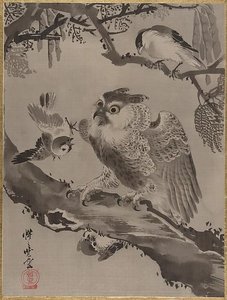
11Hell Courtesan (1880) 由 Kawanabe KyōsaiHell Courtesan1880 12Jurōjin [center of a triptych] (1884) 由 Kawanabe KyōsaiJurōjin [center of a triptych]1884 · 明尼阿波利斯艺术学院 13Theatre Curtain of Shintomi-za, with an Impromputu Sketch Monster (1880) 由 Kawanabe KyōsaiTheatre Curtain of Shintomi-za, with an Impromputu Sketch Monster1880 14Squirrels Eating Chestnuts (1886) 由 Kawanabe KyōsaiSquirrels Eating Chestnuts1886 · 洛杉矶县立艺术博物馆 15A Beauty in Front of King Enma's Mirror (1887) 由 Kawanabe KyōsaiA Beauty in Front of King Enma's Mirror1887 16Urashima Tarō Riding on a Tortoise (1888) 由 Kawanabe KyōsaiUrashima Tarō Riding on a Tortoise1888 · 大都会艺术博物馆 17Two Children Playing with Goldfish (1887) 由 Kawanabe KyōsaiTwo Children Playing with Goldfish1887 · 大都会艺术博物馆 18Two Birds on a Branch (1887) 由 Kawanabe KyōsaiTwo Birds on a Branch1887 · 大都会艺术博物馆 19Singing Bird on a Branch (1887) 由 Kawanabe KyōsaiSinging Bird on a Branch1887 · 大都会艺术博物馆 20滝に燕図 Swallows by a Waterfall (1887) 由 Kawanabe Kyōsai滝に燕図 Swallows by a Waterfall1887 · 大都会艺术博物馆 21Tale of the Tongue-cut Sparrow (1800) 由 Kawanabe KyōsaiTale of the Tongue-cut Sparrow1800 · 洛杉矶县立艺术博物馆 22Sketches of Birds and Animals (1870) 由 Kawanabe KyōsaiSketches of Birds and Animals1870 · 大都会艺术博物馆 23Three Crossbills on a Leafless Tree (1878) 由 Kawanabe KyōsaiThree Crossbills on a Leafless Tree1878 · 明尼阿波利斯艺术学院 24Chinese-style Landscape with Man Fishing from a Boat by Moonlight [right of a triptych] (1884) 由 Kawanabe KyōsaiChinese-style Landscape with Man Fishing from a Boat by Moonlight [right of a triptych]1884 · 明尼阿波利斯艺术学院 25Landscape with River in Mountainous Country [left of a triptych] (1884) 由 Kawanabe KyōsaiLandscape with River in Mountainous Country [left of a triptych]1884 · 明尼阿波利斯艺术学院 26猿を襲う鷲図 Eagle Attacking a Monkey (1885) 由 Kawanabe Kyōsai猿を襲う鷲図 Eagle Attacking a Monkey1885 · 大都会艺术博物馆 27兎を追う鷲図 Eagle Pursuing Rabbit (1885) 由 Kawanabe Kyōsai兎を追う鷲図 Eagle Pursuing Rabbit1885 · 大都会艺术博物馆 28Eagle Attacking a Mountain Lion (1885) 由 Kawanabe KyōsaiEagle Attacking a Mountain Lion1885 · 大都会艺术博物馆 29White Eagle Eyeing a Mountain Lion (1885) 由 Kawanabe KyōsaiWhite Eagle Eyeing a Mountain Lion1885 · 大都会艺术博物馆 30Rocky Landscape (1887) 由 Kawanabe KyōsaiRocky Landscape1887 · 大都会艺术博物馆 31Crow on a Branch (1887) 由 Kawanabe KyōsaiCrow on a Branch1887 · 大都会艺术博物馆 32Untitled (D2X7KF) (1887) 由 Kawanabe KyōsaiUntitled (D2X7KF)1887 · 大都会艺术博物馆 33Fox Catching Bird (1887) 由 Kawanabe KyōsaiFox Catching Bird1887 · 大都会艺术博物馆 34Bird and Frog (1887) 由 Kawanabe KyōsaiBird and Frog1887 · 大都会艺术博物馆 35松に鴉図 Two Crows on a Pine Branch (1887) 由 Kawanabe Kyōsai松に鴉図 Two Crows on a Pine Branch1887 · 大都会艺术博物馆 36Cranes in Marsh (1887) 由 Kawanabe KyōsaiCranes in Marsh1887 · 大都会艺术博物馆 37Buffalo and Herdsman (1887) 由 Kawanabe KyōsaiBuffalo and Herdsman1887 · 大都会艺术博物馆 38柳に鴉図 Crow and Willow Tree (1887) 由 Kawanabe Kyōsai柳に鴉図 Crow and Willow Tree1887 · 大都会艺术博物馆 39岩に鴉図 Crow on a Rock (1887) 由 Kawanabe Kyōsai岩に鴉図 Crow on a Rock1887 · 大都会艺术博物馆 40Owl Mocked by Small Birds (1887) 由 Kawanabe KyōsaiOwl Mocked by Small Birds1887 · 大都会艺术博物馆 41木に鴉図 Crow on a Branch (1887) 由 Kawanabe Kyōsai木に鴉図 Crow on a Branch1887 · 大都会艺术博物馆 42竹に鴉図 Crow on a Bamboo Branch (1887) 由 Kawanabe Kyōsai竹に鴉図 Crow on a Bamboo Branch1887 · 大都会艺术博物馆 43旭に群鴉図 Flock of Crows at Dawn (1887) 由 Kawanabe Kyōsai旭に群鴉図 Flock of Crows at Dawn1887 · 大都会艺术博物馆 44ムクドリ図 Starlings on a Branch (1887) 由 Kawanabe Kyōsaiムクドリ図 Starlings on a Branch1887 · 大都会艺术博物馆 45Fish in a Whirlpool (1887) 由 Kawanabe KyōsaiFish in a Whirlpool1887 · 大都会艺术博物馆 46富士図 Mount Fuji (1887) 由 Kawanabe Kyōsai富士図 Mount Fuji1887 · 大都会艺术博物馆 47Rocky Landscape (1887) 由 Kawanabe KyōsaiRocky Landscape1887 · 大都会艺术博物馆 48瓜に鼠図 Mice in a Melon (1887) 由 Kawanabe Kyōsai瓜に鼠図 Mice in a Melon1887 49Eagle Attacking Fish (1887) 由 Kawanabe KyōsaiEagle Attacking Fish1887 · 大都会艺术博物馆 50Squirrels Gathering Chestnuts (1887) 由 Kawanabe KyōsaiSquirrels Gathering Chestnuts1887 · 大都会艺术博物馆 51Monkey Hanging from Grapevines (1887) 由 Kawanabe KyōsaiMonkey Hanging from Grapevines1887 · 大都会艺术博物馆 52雪中鴉図 Crow Flying in the Snow (1887) 由 Kawanabe Kyōsai雪中鴉図 Crow Flying in the Snow1887 · 大都会艺术博物馆 53Waterfall, Eagle and Monkey (1887) 由 Kawanabe KyōsaiWaterfall, Eagle and Monkey1887 · 大都会艺术博物馆 54月に鴉図 Crow and the Moon (1887) 由 Kawanabe Kyōsai月に鴉図 Crow and the Moon1887 · 大都会艺术博物馆 55Pheasant Caught by a Snake (1887) 由 Kawanabe KyōsaiPheasant Caught by a Snake1887 · 大都会艺术博物馆 56Shakyamuni Conquering the Demons (Shaka Gōma zu) (1888) 由 Kawanabe KyōsaiShakyamuni Conquering the Demons (Shaka Gōma zu)1888 · 大都会艺术博物馆 57Eagle Holding Small Bird (1887) 由 Kawanabe KyōsaiEagle Holding Small Bird1887 · 大都会艺术博物馆 58Monkeys (1888) 由 Kawanabe KyōsaiMonkeys1888 · 大都会艺术博物馆 59Deer and Monkeys (1887) 由 Kawanabe KyōsaiDeer and Monkeys1887 · 大都会艺术博物馆 60Rabbits (1887) 由 Kawanabe KyōsaiRabbits1887 · 大都会艺术博物馆 61Cat Catching a Frog (1887) 由 Kawanabe KyōsaiCat Catching a Frog1887 · 大都会艺术博物馆 62水辺に鴉図 Crow and Reeds by a Stream (1887) 由 Kawanabe Kyōsai水辺に鴉図 Crow and Reeds by a Stream1887 · 大都会艺术博物馆 63白衣観音図 White Robed Kannon (1887) 由 Kawanabe Kyōsai白衣観音図 White Robed Kannon1887 · 大都会艺术博物馆 64Playful Demon 由 Kawanabe KyōsaiPlayful Demon耶鲁大学艺术馆 65Frolicking Animals, Nekomata and Tanuki Badger 由 Kawanabe KyōsaiFrolicking Animals, Nekomata and Tanuki Badger 66Long Arms [right of a pair of Long Legs and Long Arms] 由 Kawanabe KyōsaiLong Arms [right of a pair of Long Legs and Long Arms]明尼阿波利斯艺术学院 67Long Legs [left of a pair of Long Legs and Long Arms] 由 Kawanabe KyōsaiLong Legs [left of a pair of Long Legs and Long Arms]明尼阿波利斯艺术学院 68Seven Otafukus 由 Kawanabe KyōsaiSeven Otafukus明尼阿波利斯艺术学院 69Tanuki (Racoon Dog) Viewing Its Reflection in Water (801) 由 Kawanabe KyōsaiTanuki (Racoon Dog) Viewing Its Reflection in Water801 · 大都会艺术博物馆 70Boy’s Day Carp Streamer and Shōki Banner (1870) 由 Kawanabe KyōsaiBoy’s Day Carp Streamer and Shōki Banner1870 · 大都会艺术博物馆 71Figure Sketches 由 Kawanabe KyōsaiFigure Sketches 72Frolicking Figures and Animals 由 Kawanabe KyōsaiFrolicking Figures and Animals

Kawanabe Kyōsai 的传世名作,按时期分类

令 Kawanabe Kyōsai 驻足的创作主题

这些原作中反复出现的四个主题,各有一个最杰出的范例。

收藏有 Kawanabe Kyōsai 原作的博物馆

收藏了本页中大部分画作的 5 家博物馆。

博物馆 城市 Kawanabe Kyōsai 的作品 此列表中的画作
大都会艺术博物馆, 纽约大都会艺术博物馆 纽约 48 Three Kyōgen Dancers, Sketches of East Asian Legendary Figures, Frolicking Figures and Animals
明尼阿波利斯艺术学院, 明尼阿波利斯明尼阿波利斯艺术学院 明尼阿波利斯 8 Wisteria Maiden and Demon Priest, Jurōjin [center of a triptych], Three Crossbills on a Leafless Tree
洛杉矶县立艺术博物馆, 洛杉矶洛杉矶县立艺术博物馆 洛杉矶 4 Yang Guifei Adjusting her Hair, Yamauba and Kintarō, Squirrels Eating Chestnuts
克利夫兰艺术博物馆, 克利夫兰克利夫兰艺术博物馆 克利夫兰 2 Hell Courtesan, Painting Party
耶鲁大学艺术馆, 纽黑文耶鲁大学艺术馆 纽黑文 1 Playful Demon

跨越数十载的 Kawanabe Kyōsai:每一件皆为独一无二的原作

各年代作品数量

选择一个年代,探索定义该时代的原创杰作。

Kawanabe Kyōsai 的画作:画廊常见问题

Kawanabe Kyōsai 最著名的代表作是什么?揭晓答案

Three Kyōgen Dancers (801),大都会艺术博物馆, 纽约。紧随其后的是 Sketches of East Asian Legendary Figures (801) 和 Yang Guifei Adjusting her Hair (1850)。

Kawanabe Kyōsai 最著名的十幅画作是哪些?揭晓答案

Three Kyōgen Dancers, Sketches of East Asian Legendary Figures, Yang Guifei Adjusting her Hair, Yamauba and Kintarō, Hell Courtesan, Frolicking Figures and Animals, Calligraphy and Painting Party, Wisteria Maiden and Demon Priest, Painting Party 及 Night Procession of One Hundred Demons。上方排名显示了每件作品的创作年份及馆藏机构。

已知 Kawanabe Kyōsai 有多少件作品?揭晓答案

我们的目录收录了 72 件 Kawanabe Kyōsai 的作品,创作年代从 1850 年至 1888 年。

在哪里可以欣赏到最著名的 Kawanabe Kyōsai 原作?揭晓答案

多见于 大都会艺术博物馆 (纽约), 明尼阿波利斯艺术学院 (明尼阿波利斯) 及 洛杉矶县立艺术博物馆 (洛杉矶)。上方的博物馆列表列出了所有相关机构。

Kawanabe Kyōsai 的代表作创作于哪个时期?揭晓答案

在 1880s 期间:本页 72 件作品中有 52 件创作于该时期,其中包含 Painting Party 件作品。

哪幅 Kawanabe Kyōsai 的名作创作年代最早,哪幅最晚?揭晓答案

在本页面中,最早的作品创作于 Yang Guifei Adjusting her Hair (1850),最晚的创作于 Urashima Tarō Riding on a Tortoise (1888)。

Kawanabe Kyōsai 偏好哪些题材?揭晓答案

Animals (8), Woman (6) 及 Black ink (6),共计 72 件作品。

Kawanabe Kyōsai 最常使用哪些材料进行创作?揭晓答案

Ink,共计 8 件(本页共有 72 件作品)。

Kawanabe Kyōsai 的作品属于哪种艺术流派?揭晓答案

根据本页面的原作,Ukiyo-e

在 大都会艺术博物馆 可以看到哪些 Kawanabe Kyōsai 的原作?揭晓答案

Three Kyōgen Dancers, Sketches of East Asian Legendary Figures 及 Frolicking Figures and Animals:大都会艺术博物馆, 纽约收藏了本页中 48 件作品。

Kawanabe Kyōsai:艺术家肖像

墨色与反叛的一生

Kawanabe Kyōsai 于 1831 年出生于日本古河,出身于一个武士家庭。他的童年经历了一场突如其来且震撼心灵的死亡洗礼:九岁那年,他在神田川中发现了一颗与尸体分离的人头。这次早年的冲击,成为了他正式投身艺术生涯的前奏,随后他师从狩野派大师以及 歌川国芳。尽管他精通传统绘画所需的严谨笔法,但他的灵魂却更倾向于民间画派中那种更为自由奔放的风格。他随后移居江户,他的父亲当时加入了幕府的官方消防队,正是在这里,Kyōsai 开始塑造那份将定义他整个艺术生涯的独特人格。

他的道路从未与平庸的顺从重合。在从 江户时代 向明治时代转型的政治动荡中,他成为了一个既令人着迷又充满争议的人物。他曾三次被幕府当局逮捕,原因往往在于其作品中蕴含的讽刺意味——他通过画作嘲弄政府官员并批判当时的政策。这些与法律的交锋并未削弱他的创作热情;相反,它们强化了他作为独立思想家的名声。他的艺术,正是那个从封建国家向现代强国转型之国度动荡缩影的写照。

画中之魔

Kyōsai 精湛的技艺与其狂野、不羁的生命力相得益彰。他赢得了“画中鬼” (Shuchu gaki) 的绰号,并通过在作品中使用各种印章来拥抱这一称号。他的题材极其广泛且往往离奇诡谲,从宗教题材到怪诞图景无所不包。他在画布上填充着恶魔、骷髅、青蛙和各种动物,并常常赋予它们类人的幽默感或政治隐喻。在他那幅著名的长卷作品《放屁之战》中,他通过纯粹的漫画式夸张,捕捉到了那个时代激烈的政治骚动。

他的 创作过程 与他的创作主题一样充满传奇色彩。据说,他可以在彻夜狂饮后开始作画,进入一种笔触随本能飞速流动的境界。这种自发的风格有时被称为“狂画” (kyōga),它赋予了线条一种灵动且充满生命力的笔触。虽然他拥有狩野派的深厚技术功底,但他的作品更倾向于混沌与喜剧,而非静穆的崇敬。他也是一位出色的 木版画 艺术家,创作了如《Kyōsai hyakuzu》以及各种深受大众欢迎的“鯰絵” (namazu-e) 版画。

线条中的传承

除了个人绘画作品,Kyōsai 还为视觉叙事的演进做出了贡献。1874 年,他与金字塔文(Kanagaki Robun)共同协助创办了被视为第一本漫画杂志的《艺书闻日本地》 (Eshinbun Nipponchi)。尽管该刊物仅发行了三期,但它代表了对新型图形媒体的早期尝试。他的影响力远超日本本土,其作品被收入大英博物馆和巴黎 吉美博物馆 等重要馆藏中。甚至包括建筑师约瑟夫·康德在内的西方访客,也曾对他的非凡才华留下记载。

这位艺术家于 1889 年因胃癌逝世。他留下了极其庞大的艺术遗产,估计超过一万件作品,涵盖了版画、素描和画册。他的一生正是他所处时代的镜子——动荡、转型且极其复杂。通过他的墨迹,从中世纪向现代工业社会的转型,找到了它最富有表现力的声音。