


1

维克拜杜尔斯特德的风车
《维克拜杜尔斯特德的风车》是艺术家 雅各布·伊萨克松·范·鲁伊斯代尔 的传世之作,采用 布面油画 创作。这件作品诞生于1670年,彼时 荷兰黄金时代 正在定义着荷兰的视觉语言。这位出生于哈勒姆的艺术家,以一种静谧而深沉的视角,捕捉了 荷兰风景 中极具代表性的瞬间。

更新于 November 2026 · 基于我们的流行度评分排名(每件作品的搜索量、访问量及订单量) · 530 件 雅各布·伊萨克松·范勒伊斯达尔 作品收录于我们的目录中
简而言之
在画廊看来,雅各布·伊萨克松·范勒伊斯达尔 最著名的作品是 维克拜杜尔斯特德的风车,其原作现收藏于 阿姆斯特丹 的 国家博物馆。 巨型森林 (Jùxíng Sēnlín) 与 The Windmill at Wijk bij Duurstede (detail) (1670) 共同构成了那组令人过目不忘的艺术三部曲。 在我们的目录中,雅各布·伊萨克松·范勒伊斯达尔 共有 530 件作品,画廊为您精选了以下 100 件最著名的原作,并详细列出了每件作品的创作年份、馆藏机构及其独特之处。
《维克拜杜尔斯特德的风车》是艺术家 雅各布·伊萨克松·范·鲁伊斯代尔 的传世之作,采用 布面油画 创作。这件作品诞生于1670年,彼时 荷兰黄金时代 正在定义着荷兰的视觉语言。这位出生于哈勒姆的艺术家,以一种静谧而深沉的视角,捕捉了 荷兰风景 中极具代表性的瞬间。

《巨林森》:荷兰黄金时代的自然之声 Jacob Isaakszoon van Ruisdael 的这幅作品,是一曲来自17世纪荷兰的自然之歌。它描绘了一片茂密森林的景象,在阴沉的天空下,以一种令人叹为观止的方式展现了光影、空间和自然的和谐。Ruisdael 是一位对光线和色彩有着深刻理解的艺术家,他用细腻的笔触和精妙的构图,创造了一个既充满力量又令人心生敬畏的画面。这幅画不仅仅是一幅风景画,更是一种对自然精神的探索,以及对人类在自然面前渺小与伟大之感。 大师的技艺:光影与细节的完美融合 Ruisdael 的作品以其精湛的技巧而闻名。他运用了“层叠透色”的绘画手法,通过多层薄涂颜料,营造出一种朦胧、深邃的光影效果。画面中的树木、岩石和地面,都呈现出逼真的质感,仿佛触手可及。尤其值得注意的是他对光线的处理:阳光透过树冠洒下斑驳的光影,在地面上形成复杂的图案,赋予了画面动感和活力。这种对细节的极致追求,是 Ruisdael 艺术风格的核心特征,也体现了他对自然观察的敏锐洞察力。他用细致的笔触捕捉了每一片树叶、每一块石头,以及光线在它们表面投射出的微妙变化,最终将这些元素融合成一个和谐统一的整体。 油画技法: 精细的笔触和多层透色处理 光影效果: 逼真的光影表现,营造出深邃的空间感 细节刻画: 对树木、岩石等元素的精细描绘 历史的沉淀:荷兰黄金时代的自然主义 Ruisdael 的作品创作于荷兰黄金时代,这是一个艺术和文化繁荣的时期。当时,荷兰人对自然充满热爱,并将其视为精神的源泉。风景画成为这一时期的重要题材,艺术家们致力于捕捉自然的真实面貌,表达对大自然的敬畏之情。Ruisdael 的作品是该时期自然主义绘画的代表作之一,它不仅展现了荷兰乡村的壮丽景色,也反映了当时社会对自然和谐关系的追求。他的画作与同期的Rembrandt 和 Vermeer 风格相呼应,共同构成了荷兰黄金时代风景画的辉煌篇章。 象征意义:孤独、力量与敬畏 画面中的孤立树木,象征着人类在自然面前的渺小和脆弱,同时也体现了人类对自然的敬畏之情。这棵树仿佛是自然界的化身,它坚韧不拔,傲然挺立,展现出一种强大的生命力。同时,这幅画也引发了人们对孤独、思考和反思的思考。在广袤的森林中,人与自然之间的距离变得更加遥远,从而促使人们去审视自己的存在,并重新认识自身与自然的联系。 完美之选:为您的空间注入自然之美 无论是收藏家、艺术爱好者还是室内设计师,这幅《巨林森》的精美复制品都是一个理想的选择。它不仅能提升空间的艺术品味,更能带来一份宁静与祥和。将这幅画挂在客厅、书房或办公室,都能营造出一种轻松舒适的氛围,让您感受到大自然的魅力。作为一件高品质的艺术品复制品,它能够为您提供最真实的视觉体验,并让您在繁忙的生活中找到片刻的宁静与放松。

Jacob Isaackszoon van Ruysdael’s “The Windmill at Wijk bij Duurstede” isn't merely a depiction of a rural scene; it’s a profound meditation on light, space, and the enduring spirit of the Netherlands. Painted around 1670 during the height of the Dutch Golden Age, this iconic work transcends its subject matter to become a timeless emblem of tranquility, industry, and the subtle beauty of the natural world. It's a painting that…

In the heart of the seventeenth century, during the zenith of the Dutch Golden Age, Jacob van Ruisdael captured a moment of profound tranquility and industrious grace in his seminal work, “Two Watermills and an Open Sluice near Singraven.” This painting is far more than a mere topographical record of the Netherlands; it is a poetic meditation on the harmony between human endeavor and the untamed rhythms of nature. As…

To gaze upon Jacob Isaackszoon van Ruisdael's "Landscape with a Village in the Distance" is to step directly into the heart of the Dutch Golden Age. This painting, executed in 1646, is more than just a depiction of rolling hills and distant structures; it is a profound meditation on nature’s enduring tranquility set against the backdrop of burgeoning human civilization. Van Ruisdael, the pre-eminent landscape painter of his era, possessed…
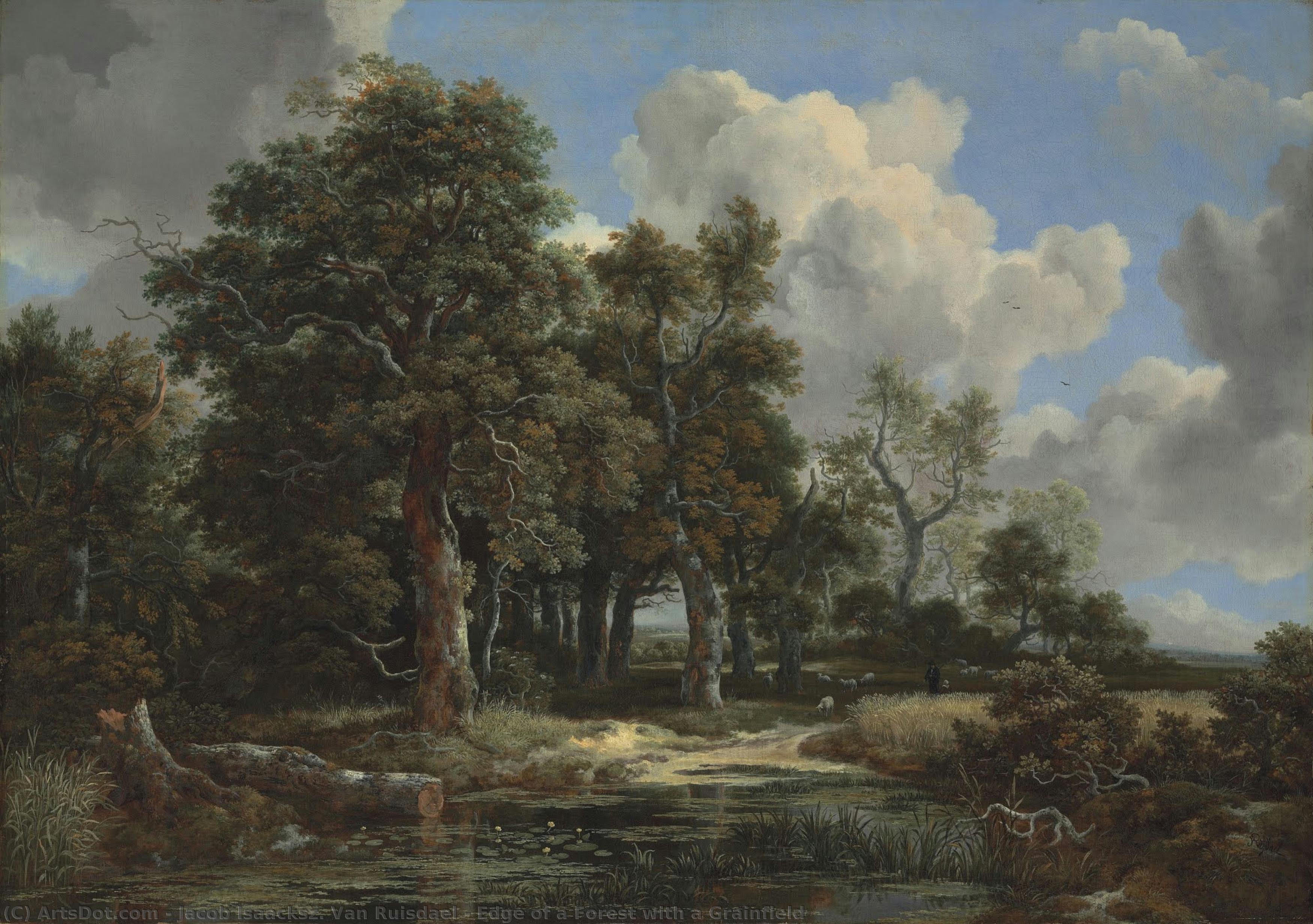
A Symphony of Light and Shadow: Exploring Jacob van Ruisdael’s “Edge of a Forest with a Grainfield” Jacob van Ruisdael's "Edge of a Forest with a Grainfield," painted around 1656, isn’t merely a landscape; it’s an immersive experience. Born in Haarlem and flourishing during the Dutch Golden Age, Ruisdael possessed a singular ability to capture not just the visual appearance of nature, but its very essence – its quiet power,…

Jacob Isaackszoon van Ruisdael produced Beach View about 1675. This oil on canvas work is categorized as marine art, focusing on a coastal landscape. The composition centers on a beach scene where the shoreline meets the sea under an overcast sky.

The sky occupies the majority of the canvas, a vast vault of white, gray, and soft blue. Voluminous clouds, rendered with thick, impasto-like textures, suggest a weather pattern in constant flux. Below this heavy atmosphere, a windmill rises with vertical strength, its white sails cutting sharp, diagonal lines against the shifting light. The farmhouse sits low to the earth, its reddish-brown roof providing a grounded contrast to the airy expanse…

To gaze upon Van Ruisdael's View of Haarlem with Bleaching Grounds is to step directly into the heart of the Dutch Golden Age, a time when the very land itself became a subject worthy of profound artistic contemplation. This painting is far more than a mere depiction of a town and its surrounding fields; it is an atmospheric meditation on light, industry, and the enduring relationship between humanity and nature.…

In this oil on wood composition from approximately 1655, we find ourselves standing before a scene of profound quietude and slow decay. The landscape is dominated by a sense of melancholy, where the natural world has begun to reclaim what was once built by human hands. On the left, a ruined, roofless nave—likely once a church—sits nestled at the foot of a hill. Its stone walls are broken, and gravestones…
 Landscape with Shepherds and Peasants1660 · 乌菲兹美术馆
12
 The Cloister1650 · Gemäldegalerie
13
 A Waterfall1670 · 达尔威奇画廊
14
 Rocky landscape1660 · 国家博物馆
15
 The Forest Stream1660 · 大都会艺术博物馆
16
 Glade in a Wood1646 · 维也纳美术学院
17
 Norwegian Landscape with Waterfall1650 · Residenzgalerie
18
 Winter Landscape1670 · 国家博物馆
19
 Landscape with a Waterfall1660 · 费城艺术博物馆
20
 Landscape with Ruined Castle and Church1670 · 国家美术馆
21
 犹太公墓(细节)底特律艺术学院
22
 Castle on a Mountain with a Waterfall and Pine trees1660 · 里昂美术博物馆
23
 The Jewish Cemetery1
24
 Landscape with Church and Village1665 · 老皮那科特美术馆
25
 Marine, oil on wood, Metropolitan Museum of A1650
26
 Wheat Fields1670 · 大都会艺术博物馆
27
 Waterfall in a Rocky and Mountainous LandscapeMuseum of Fine Arts
28
 The Windmill at Wijk bij Duurstede1670 · 国家博物馆
29
 Storm on the Dunes1648 · 费城艺术博物馆
30
 Sloping Field1660 · 费城艺术博物馆
31
 Ford in Wooded Landscape1655 · 卡洛斯特·古尔本基亚基金会
32
 Hilly wooded landscape with a half-timbered house by a water fall1655 · 施泰德美术馆
33
 Landscape with a Hunting Scene1670 · 斯泰恩斯博物馆艺术馆
34
 A Pool surrounded by Trees1665 · 国家美术馆
35
 Landscape with Waterfall1
36
 View of a Forest1647 · 博伊曼斯·范·本宁根博物馆
37
 Landscape with Waterfall (St. Louis)1665 · 圣路易斯艺术博物馆
38
 Landscape with a Waterfall and a Hut1660 · 斯泰恩斯博物馆艺术馆
39
 Road through a Grove1660 · 国家博物馆
40
 A Rocky Hill with Three Cottages, a Stream at its Foot1655 · 国家美术馆
41
 Small Woodland Landscape1660 · 维也纳艺术史博物馆
42
 The Dam Square in Amsterdam (detail)1670 · 柏林州立博物馆
43
 Landscape with Dunes1649 · 洛杉矶县立艺术博物馆
44
 Ruins of Brederode1655 · 费城艺术博物馆
45
 Ruins in a Dune Landscape1652 · 国家美术馆
46
 Mountain Landscape with Waterfall1670 · 维也纳艺术史博物馆
47
 Village in Winter by Moonlight斯图加特州立美术馆
48
 Landscape with Waterfall1665 · 巴尔的摩艺术博物馆
49
 A Road leading into a Wood1657 · 国家美术馆
50
 Sandy Road between Trees1662 · 博伊曼斯·范·本宁根博物馆
51
 Landscape of a Forest with a Wooden Bridge1670 · 费城艺术博物馆
52
 Wild Duck Shooting1655 · 威廉斯收藏馆
53
 Landscape with river and cellar entrance1649 · 维也纳艺术史博物馆
54
 Dunes1650 · 费城艺术博物馆
55
 A road through a wood1660 · 德累斯顿国家艺术收藏馆
56
 Winter Landscape with a Dead Tree1670 · 冬宫博物馆
57
 Landscape with a Waterfall1655 · 阿什莫林博物馆
58
 The Old Oak1648 · Musée Cognacq-Jay
59
 Dune Landscape with Fence, ca. 16471647 · 施泰德美术馆
60
 The Watermill at the Edge of the Wood1650 · 托莱多艺术博物馆
61
 Forest scene1653 · 国家博物馆
62
 A waterfall with a wooden bridge1670 · 德累斯顿国家艺术收藏馆
63
 Landscape with Tall Trees1670 · 汉堡美术馆
64
 Landscape with Mountain Stream1670 · 维也纳艺术史博物馆
65
 A Cottage and a Hayrick by a River国家美术馆
66
 Wooded Landscape1660 · 博伊曼斯·范·本宁根博物馆
67
 A Mountain Landscape with a Chapel1655 · 汉堡美术馆
68
 Rocky Landscape1650 · 威廉斯收藏馆
69
 Ideal Landscape1655 · 巴伐利亚州绘画收藏馆
70
 Landscape with a Church by a Torrent1670 · 克利夫兰艺术博物馆
71
 Winter Landscape with Houses and Frozen Canal1670 · 汉堡美术馆
72
 Winter landscape with a harbour1660 · 玛乌里诗博物馆
73
 Landscape, ca. 16461646 · 底特律艺术学院
74
 A hill with an oak wood and a little waterfall1654 · 德累斯顿国家艺术收藏馆
75
 Wooded mountainous landscape with fishermen and resting travellers near a waterfall1660 · Museum de Lakenhal
76
 Rough Sea at a Jetty1650 · Kimbell Art Museum
77
 Wooded Landscape with a Stream1670 · 底特律艺术学院
78
 Landscape with dead tree and an oncoming storm1649 · 法布尔博物馆
79
 Stormy Sea1650 · 国家博物馆
80
 View Of Ootmarsum
81
 Hilly Landscape
82
 The Waterfall1665 · Staatliche Museen
83
 Farm and Hayrick on a River1640 · 底特律艺术学院
84
 Forest Path with People Strolling1646 · 施泰德美术馆
85
 Landscape with a Blasted Tree near a House1645 · Fitzwilliam Museum
86
 A hunter in a wooded landscape1640
87
 Road in the Dunes1648 · 弗朗斯·哈尔斯博物馆
88
 Wooded Dune Landscape1648
89
 A Landscape with Two Figures on a Rise and a Stream at Right1647
90
 A Wooded Landscape with a Pond1648 · 休斯顿美术馆
91
 Landscape with a Cottage and a Windmill1646
92
 Dune landscape with a man and a boy walking towards a town1647 · 普希金国家美术馆
93
 Dune Landscape near Haarlem1647
94
 Stone Bridge1648 · 费城艺术博物馆
95
 Sandbank1647 · Nivaagaards Malerisamling
96
 Blasted Oak near a Pond1647 · 布达佩斯美术博物馆
97
 Cabin under high oaks1643 · 柏林国家美术馆
98
 Oaks at a lake with Water Lilies1652 · 柏林国家美术馆
99
 Landscape by a Lake1650 · Bratislava City Gallery
100
 Mountain Stream1655 · 巴伐利亚州绘画收藏馆
这些原作中反复出现的四个主题,各有一个最杰出的范例。
收藏了本页中大部分画作的 8 家博物馆。
| 博物馆 | 城市 | 雅各布·伊萨克松·范勒伊斯达尔 的作品 | 此列表中的画作 |
|---|---|---|---|
 国家美术馆 |
伦敦 | 22 | Two Watermills and an Open Sluice near Singraven, A Landscape with a Ruined Building, Landscape with Ruined Castle and Church |
 费城艺术博物馆 |
费城 | 10 | Landscape with a Waterfall, Storm on the Dunes, Sloping Field |
 国家博物馆 |
阿姆斯特丹 | 17 | 维克拜杜尔斯特德的风车, The Windmill at Wijk bij Duurstede (detail), Rocky landscape |
 底特律艺术学院 |
底特律 | 8 | Landscape with a Farm House and Windmill, 犹太公墓(细节), Landscape, ca. 1646 |
 维也纳艺术史博物馆 |
维也纳 | 5 | 巨型森林 (Jùxíng Sēnlín), Small Woodland Landscape, Mountain Landscape with Waterfall |
 博伊曼斯·范·本宁根博物馆 |
鹿特丹 | 11 | View of a Forest, Sandy Road between Trees, Wooded Landscape |
 德累斯顿国家艺术收藏馆 |
德累斯顿 | 8 | A road through a wood, A waterfall with a wooden bridge, A hill with an oak wood and a little waterfall |
 玛乌里诗博物馆 |
海牙 | 7 | Beach View, View of Haarlem with Bleaching Grounds, Winter landscape with a harbour |
选择一个年代,探索定义该时代的原创杰作。
To gaze upon Jacob Isaackszoon van Ruisdael's "Landscape with a Village in the Distance" is to step directly into the heart of the Dutch Golden Age. This painting, executed in 1646, is more than just a depiction of rolling hills and distant structures; it is a profound meditation on nature’s enduring tranquility set against the backdrop of burgeoning human civilization. Van Ruisdael, the pre-eminent landscape painter of his era, possessed…
In the heart of the seventeenth century, during the zenith of the Dutch Golden Age, Jacob van Ruisdael captured a moment of profound tranquility and industrious grace in his seminal work, “Two Watermills and an Open Sluice near Singraven.” This painting is far more than a mere topographical record of the Netherlands; it is a poetic meditation on the harmony between human endeavor and the untamed rhythms of nature. As…

In this scene from 1660, we find ourselves observing a landscape that feels deeply settled, almost still. A solitary tree dominates the foreground, its branches bare and skeletal against the sky, suggesting a season of dormancy or perhaps the quiet transition of late autumn. Scattered throughout the composition, figures move with a slow, unhurried purpose. Some shepherds linger near the base of the tree, while peasants are positioned further into…
Jacob Isaackszoon van Ruysdael’s “The Windmill at Wijk bij Duurstede” isn't merely a depiction of a rural scene; it’s a profound meditation on light, space, and the enduring spirit of the Netherlands. Painted around 1670 during the height of the Dutch Golden Age, this iconic work transcends its subject matter to become a timeless emblem of tranquility, industry, and the subtle beauty of the natural world. It's a painting that…
The sky occupies the majority of the canvas, a vast vault of white, gray, and soft blue. Voluminous clouds, rendered with thick, impasto-like textures, suggest a weather pattern in constant flux. Below this heavy atmosphere, a windmill rises with vertical strength, its white sails cutting sharp, diagonal lines against the shifting light. The farmhouse sits low to the earth, its reddish-brown roof providing a grounded contrast to the airy expanse…
维克拜杜尔斯特德的风车,国家博物馆, 阿姆斯特丹。紧随其后的是 巨型森林 (Jùxíng Sēnlín) 和 The Windmill at Wijk bij Duurstede (detail) (1670)。
维克拜杜尔斯特德的风车, 巨型森林 (Jùxíng Sēnlín), The Windmill at Wijk bij Duurstede (detail), Two Watermills and an Open Sluice near Singraven, Landscape with a Village in the Distance, Edge of a Forest with a Grainfield, Beach View, Landscape with a Farm House and Windmill, View of Haarlem with Bleaching Grounds 及 A Landscape with a Ruined Building。上方排名显示了每件作品的创作年份及馆藏机构。
我们的目录收录了 530 件 雅各布·伊萨克松·范勒伊斯达尔 的作品,创作年代从 1640 年至 1680 年。
多见于 国家美术馆 (伦敦), 费城艺术博物馆 (费城) 及 国家博物馆 (阿姆斯特丹)。上方的博物馆列表列出了所有相关机构。
在 1650s 期间:本页 100 件作品中有 26 件创作于该时期,其中包含 Two Watermills and an Open Sluice near Singraven 件作品。
在本页面中,最早的作品创作于 Farm and Hayrick on a River (1640),最晚的创作于 Landscape with a Farm House and Windmill (1680)。
Sky (50), Clouds (44) 及 Trees (42),共计 100 件作品。
Oil On Canvas,共计 61 件(本页共有 100 件作品)。
根据本页面的原作,荷兰黄金时代
Two Watermills and an Open Sluice near Singraven, A Landscape with a Ruined Building 及 Landscape with Ruined Castle and Church:国家美术馆, 伦敦收藏了本页中 8 件作品。
1628年,雅各布·伊萨克松·范·鲁伊斯代尔出生于荷兰哈勒姆,那是一个艺术被视为家族传承的时代。作为伊萨克·范·鲁伊斯代尔与梅肯·科内利斯多赫的儿子,他自幼便在充满匠心传承的家庭氛围中成长。他的祖父雅各布·德·戈耶曾是一位家具匠人,这种对工艺精湛程度与技术精准度的极致追求,为他日后投身视觉艺术领域奠定了坚实的生命底色。
他艺术生命的轨迹,很大程度上受到了身边亲人的深刻塑造。作为当时杰出的风景画家萨洛蒙·范·鲁伊斯代尔的侄子,人们普遍认为,雅各布·伊萨克松·范·鲁伊斯代尔是在叔父的悉心指导下接受了正式的艺术训练。通过这种直接的学徒制传承,他不仅吸收了荷兰风景画的细微神韵,更通过这份家族纽带,与哈勒姆画派那深厚的艺术传统建立了直接的血脉联系。
到了1648年,随着正式加入哈勒姆画家协会,他的职业地位得到了官方认可。这一身份的转变,标志着他已从家族手艺的学徒,蜕变为一名拥有独立艺术造诣的实践者。在那个竞争激烈的艺术中心,他度过了建立声望的早期岁月,为日后那段将他带离故土、走向更广阔艺术舞台的辉煌生涯做好了准备。
从哈勒姆的宁静转向阿姆斯特丹的繁华,标志着雅各布·伊萨克松·范·鲁伊斯代尔人生中一个决定性的转折点。大约在1656年或1657年间,为了追寻荷兰共和国商业心脏所提供的更广阔的市场,他移居到了这座城市。这段迁徙岁月也伴随着他个人生命中的重要时刻,例如1657年6月17日在纳尔登附近的安克维恩接受洗礼。定居之后,他余生都留在了阿姆斯特丹,并在这座他日后频繁描绘的城市景观中,逐渐确立了自己的地位。
他在城市中的职业生涯以持续不断的创作为特征,题材极其丰富,从宏大的城市全景到达姆河(Damrak)错综复杂的细节,无所不包。随着岁月的沉淀,他的兴趣似乎逐渐超越了画布的边界。据说在晚年,他曾从事医生工作,这一追求暗示了他在进行视觉观察之余,还拥有着丰富多样的智力生活。这种在城市中的双重生活,折射出一位深植于荷兰黄金时代社会与职业结构中的艺术家的多面特质。
雅各布·伊萨克松·范·鲁伊斯代尔对画布的驾驭,展现出一种永不满足的变幻万千。他从未止步于单一的创作模式,而是以极其丰硕的产出,在静谧的乡村风光与宏大壮阔的英雄式景观之间游走。他的技法极其精准,这在很大程度上归功于他对薄层油彩罩染法的精妙运用。通过这种层层叠加的技法,他能够实现色彩与色调之间极其细腻的过渡,从而营造出一种仿佛具有生命力、真实存在而非仅仅是笔墨堆砌的深度感。凭借这种耐心的笔触,他完美掌握了大气透视法,利用空气中朦胧的质感,将远处的山峦与森林推向一片柔和而银亮的深远意境之中。
他作品中的情感基调往往拥有一种超越单纯地形描绘的厚重感。他拥有一种天赋,能将诗意、忧郁甚至悲剧性的特质注入构图之中。这种情感的传达,得益于他对光影近乎大师级的掌控。他并不依赖于那种生硬、刺眼的对比,而是巧妙地利用光线来塑造场景的情感温度。他的构图往往极具戏剧性,常以浩瀚无垠的天空来衬托下方渺小的尘世元素。在他许多晚期的作品中,天空占据了画面的极大比例,成为了驱动作品内在张力与氛围的核心力量。
《岩石景观中的瀑布》 Waterfall in a Rocky Landscape
《一缕阳光》 The Ray of Sunlight
《山间激流》 Mountain Torrent
在艺术生涯的早期,雅各布·伊萨克松·范·鲁伊斯代尔的作品便已展现出他对荷兰乡村肌理的深刻洞察。1646年,他创作了《林中空地》与《远处的村庄风景》,这些杰作确立了他将自然元素有机整合为连贯且富有氛围感的场景的能力。到了1649年,他的创作重心开始转向家乡特有的地形地貌,正如《灌木丛(哈勒姆沙丘小径)》所展现的那样。在这些早期的岁月里,他对于茂密植被与开阔视野中光影交织的掌控力,正随着创作的深入而日益精进。
随着技艺的日臻成熟,他的创作题材也随之扩展,开始涉足更为戏剧化且多变的自然环境。1650年无疑是他创作的高产期,诞生了如《修道院》以及更具动感与波澜的《码头边的汹涌海浪》等作品。在这一时期,他还在《辛格拉文附近的两个水磨坊与一个开闸》中,探索了人类工业与自然力量的交汇点,并在《有旅人的风景》中捕捉到了景观中那份静谧的孤独感。这些构图展现了他对空间尺度精妙的理解,以及如何利用光线来定义特定的瞬间。
而在他后期的构图创作中,往往更加强调自然界内在的结构之美。1656年的《森林边缘与麦田》,完美展示了他平衡森林厚重感与农田开阔感的高超技巧。他这种描绘多变透视关系的能力,不仅丰富了艺术的表现力,更在很大程度上定义了荷兰黄金时代的视觉语言。
雅各布·伊萨克松·范·鲁伊斯代尔的艺术视野远超荷兰国境,其深远的触角深入到了后世风景画传统的根基之中。在浪漫主义运动兴起之前,他便已是一位“浪漫主义者”,他赋予自然界一种道德上的厚重感,以及一种忧郁而富有诗意的氛围,这种情感的张力预示了数个世纪后艺术表现的高度。这种为画面注入特定心理氛围的能力,使得他的作品在逝世多年后,依然能与各种艺术运动产生共鸣。他的影响力不仅塑造了英国浪漫主义和法国巴比松画派,其精神甚至跨越了大西洋,深刻影响了美国的哈德逊河画派。
在荷兰本土,他激励了一代又一代的荷兰风景画家,为如何通过光影来诠释乡村风光树立了典范。他对环境的描绘从未仅仅停留在地形的记录;他更致力于捕捉土地的本质,常通过戏剧性的天空和厚重的肌理来传达一种“崇高”的意境。这种对自然大气特质的专注,确保了他的艺术风格成为了后来者追随其足迹时不可或缺的基石。
雅各布·伊萨克松·范·鲁伊斯代尔的画布如今散落在欧洲与美洲各大艺术殿堂之中,静静诉说着往昔的辉煌。在荷兰本土,坐落于阿姆斯特丹的国立博物馆珍藏了大量他的作品,为人们提供了一个深度审视其艺术演进历程的绝佳窗口。而在海牙,著名的莫里茨皇家美术馆亦收藏有数幅其代表作,让我们得以窥见那些定义了他艺术生涯的壮丽景观。他的艺术影响力跨越国界,延伸至伦敦的国家美术馆,在那里,他的杰作与众多荷兰黄金时代的艺术大师并列,共同构筑起艺术史的丰碑。
目光投向荷兰之外,在多家国际顶尖机构的永久馆藏中,依然能感受到这位大师留下的深刻印记。巴黎的卢浮宫与圣彼得堡的冬宫博物馆均珍藏有他的画作,确保了他的视觉语言能够作为全球艺术经典的一部分,在时空中永存。而在大洋彼岸的美国,纽约的大都会艺术博物馆悉心保存着他的绘画作品,让后世学者得以不断深入研究他对于光影与大气氛围那近乎神迹的掌控力。


