Eldzier Cortor 肖像

15 幅最著名的 Eldzier Cortor 作品,每一件都独一无二

更新于 November 2026 · 基于我们的流行度评分排名(每件作品的搜索量、访问量及订单量) · 15 件 Eldzier Cortor 作品收录于我们的目录中

简而言之

Figure Composition No. II (1982) 是Eldzier Cortor最受瞩目的画作。 随后,目光会移向 In These Troubled Times (1937) 和 Compositional Study No. III, from the portfolio Impressions Our World, Volume I (1974)。 在 Eldzier Cortor 的 15 件作品中,这 15 件最为闻名;每一件都是独一无二的原作,并附有创作年份、馆藏机构及其经久不衰的原因。

1916 – 2015, Richmond Surrealism 藏品最多:SCAD Museum of Art

画廊视角下的 Eldzier Cortor 十大名作

4
The Night Letter (1938) 由 Eldzier Cortor

The Night Letter

1938 · Oil · SCAD Museum of Art, 萨凡纳

The painting depicts a quiet, indoor scene centered around a dining table. Two female figures occupy the space. On the left, an older woman sits in a chair, her attention directed toward a book held in her hands. Opposite her, a younger girl is seated, her gaze turned away from the reader and toward the periphery of the frame. A lamp sits upon the table, casting light across the surface…

Eldzier Cortor 的名画,第 11 至 15 幅

令 Eldzier Cortor 驻足的创作主题

这些原作中反复出现的四个主题,各有一个最杰出的范例。

收藏有 Eldzier Cortor 原作的博物馆

收藏了本页中大部分画作的 2 家博物馆。

博物馆 城市 Eldzier Cortor 的作品 此列表中的画作
SCAD Museum of Art, 萨凡纳SCAD Museum of Art 萨凡纳 2 The Night Letter, Composition with Three Women
以色列博物馆, 耶路撒冷以色列博物馆 耶路撒冷 1 Dance Composition No. 31

跨越数十载的 Eldzier Cortor:每一件皆为独一无二的原作

各年代作品数量

选择一个年代,探索定义该时代的原创杰作。

Eldzier Cortor 的画作:画廊常见问题

Eldzier Cortor 最著名的代表作是什么?揭晓答案

Figure Composition No. II (1982)。紧随其后的是 In These Troubled Times (1937) 和 Compositional Study No. III, from the portfolio Impressions Our World, Volume I (1974)。

Eldzier Cortor 是在多少岁时创作了 Figure Composition No. II?揭晓答案

66岁:Figure Composition No. II创作于1982年,Eldzier Cortor出生于1916年。

Eldzier Cortor 最著名的十幅画作是哪些?揭晓答案

Figure Composition No. II, In These Troubled Times, Compositional Study No. III, from the portfolio Impressions Our World, Volume I, The Night Letter, Dance Composition No. 31, Trio Assemblage 1 Composition III, L'Abbatoire I, Figure Assemblage I, L'Abbatoire No. VI 及 Classical Study No. 34。上方排名显示了每件作品的创作年份及馆藏机构。

已知 Eldzier Cortor 有多少件作品?揭晓答案

我们的目录收录了 15 件 Eldzier Cortor 的作品,创作年代从 1937 年至 1982 年。

在哪里可以欣赏到最著名的 Eldzier Cortor 原作?揭晓答案

多见于 SCAD Museum of Art (萨凡纳) 及 以色列博物馆 (耶路撒冷)。上方的博物馆列表列出了所有相关机构。

Eldzier Cortor 的代表作创作于哪个时期?揭晓答案

在 1960s 期间:本页 15 件作品中有 4 件创作于该时期,其中包含 L'Abbatoire I 件作品。

哪幅 Eldzier Cortor 的名作创作年代最早,哪幅最晚?揭晓答案

在本页面中,最早的作品创作于 In These Troubled Times (1937),最晚的创作于 Figure Composition No. II (1982)。

Eldzier Cortor 的作品属于哪种艺术流派?揭晓答案

根据本页面的原作,Surrealism

在 SCAD Museum of Art 可以看到哪些 Eldzier Cortor 的原作?揭晓答案

The Night Letter 及 Composition with Three Women:SCAD Museum of Art, 萨凡纳收藏了本页中 2 件作品。
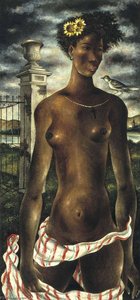
Eldzier Cortor:艺术家肖像

A Life Immersed in Form and Identity

Eldzier Cortor, born in Richmond, Virginia, in 1916, emerged as a pivotal figure in American art, dedicated to portraying the richness and complexity of Black life with both profound sensitivity and innovative artistic vision. His journey began with the Great Migration, his family relocating to Chicago seeking opportunity—a move that indelibly shaped his perspective and fueled his commitment to representing urban African American experiences. Cortor’s early education at Englewood High School in Chicago brought him into contact with fellow artists like Charles Wilbert White and Margaret Burroughs, fostering a creative community that would nurture his developing talent. He continued his studies at the Art Institute of Chicago, graduating in 1936, where he absorbed European artistic traditions but found himself profoundly moved by an encounter with African sculptures at the Field Museum. This discovery proved transformative, instilling within him a fascination with the cylindrical forms and lyrical qualities that would become hallmarks of his style.

The WPA Years and the Gullah Influence

The 1940s marked a crucial period in Cortor’s artistic development. His involvement with the Works Progress Administration (WPA) provided him with invaluable experience documenting scenes of Bronzeville, a vibrant Black neighborhood in Chicago during the Depression era. This work wasn't merely documentation; it was an act of affirmation, capturing the dignity and resilience of a community often overlooked or misrepresented. Simultaneously, Cortor’s dedication to positive portrayals of African Americans was nurtured by his avid readership of *The Chicago Defender*, a newspaper dedicated to celebrating Black achievements. However, it was through two Rosenwald Foundation Fellowships in 1944 and 1945 that Cortor embarked on an experience that would profoundly alter the course of his art. These fellowships allowed him to live among the Gullah people on the Sea Islands of Georgia and South Carolina—a relatively isolated African diasporic culture retaining strong ties to its ancestral roots. Immersing himself in their traditions, Cortor found a powerful source of inspiration, incorporating elements of traditional African aesthetics into his work and deepening his exploration of Black identity.

Blending Surrealism with Ancestral Echoes

Cortor’s artistic style was characterized by a compelling fusion of realism and surrealist influences. He often distorted perspective not as an end in itself, but to emphasize the subject's role within society and to imbue his work with a sense of fantasy and symbolic depth. Central to his oeuvre was the representation of the Black female figure—a motif he considered embodying the essence of the Black race, conveying a feeling of eternity and continuity. He challenged prevailing beauty standards by portraying Black women with dignity, strength, and an unapologetic celebration of their unique features and cultural significance. This wasn’t simply portraiture; it was an act of reclaiming representation and asserting the inherent beauty within the Black community. His exploration extended beyond painting to encompass printmaking—lithography and etching becoming favored mediums—and assemblage, demonstrating a remarkable versatility in his artistic practice. The 1949 Guggenheim Fellowship further broadened his horizons, enabling him to travel to Jamaica, Cuba, and Haiti, where he studied Caribbean art and culture and taught at the Centre d’Art in Port-au-Prince.

Legacy of Representation and Resilience

Throughout his long and distinguished career, Eldzier Cortor received significant recognition for his contributions to American art. His work has been exhibited extensively, including solo shows at the Boston Psychoanalytic Society and Institute and the Indiana University Art Museum. Today, his paintings and prints are held in prestigious collections such as the Howard University Gallery of Art, the Smithsonian American Art Museum, and The Art Institute of Chicago—testaments to his enduring artistic legacy. Cortor’s historical significance lies not only in his technical skill but also in his pioneering role in challenging stereotypes and celebrating Black identity. He was among the first African American artists to consistently depict nude Black women as central subjects, a bold act that defied societal norms and paved the way for subsequent generations of artists exploring themes of race, gender, and cultural heritage. His ability to synthesize European surrealism with African artistic traditions created a unique aesthetic—a powerful visual language that continues to resonate today, reminding us of the enduring strength, beauty, and resilience of the Black spirit.