Меню

Жюль Юльевич Скальберт

1851 - 1928

Короткі факти

  • Art period: — XIX століття
  • Top 3 works:
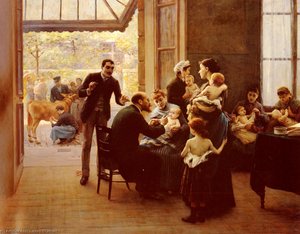
    • Hommage a louis pasteur
    • The boatmen
    • Naked beauty
  • Works on APS: 4
  • Copyright status: Public domain
  • Also known as: Жюль Бастиен Лепаж
  • Розгорнути…
  • Born: 1851, Доуай, Франція
  • Top-ranked work: Hommage a louis pasteur
  • Died: 1928
  • Lifespan: 77 years
  • Nationality: Франція

Jules Scalbert: A Quiet Master of French Realism

Jules Scalbert (1851 – 1928) emerged from the artistic landscape of Douai, France, a city steeped in industrial heritage yet harboring a rich tradition of artistic patronage. His formative years were marked by instruction under Isidore Pils and Henri Lehmann, establishing him firmly within the influential École Supérieure des Beaux-Arts movement—a bastion of Academic Realism that championed meticulous observation and idealized representation. This stylistic grounding would profoundly shape his oeuvre, resulting in captivating depictions of historical narratives alongside poignant explorations of genre scenes and serene floral compositions executed with masterful pastel technique.

Early Career & Salon Exhibitions

Scalbert’s artistic journey commenced with appearances at the Paris Salon in 1876, swiftly gaining recognition for his talent. He joined the Salon des Artistes Francais in 1883, cementing his position within the Parisian art world and fostering connections with fellow artists of distinction. These early exhibitions served as crucial stepping stones toward establishing his reputation and securing commissions—a hallmark of success for aspiring painters during the Belle Époque. The Salon’s discerning judges acknowledged Scalbert's skill and dedication to capturing the essence of his subjects, propelling him into the orbit of artistic discourse and furthering his professional trajectory.

Honorary Awards & Recognition

Demonstrating exceptional artistic merit, Scalbert was awarded an honorary medal at the Exposition Universelle Internationale de Paris in 1889—a testament to his contribution to French culture—and subsequently honored with medals in 1891 and 1901 by the Société Nationale des Beaux-Arts. These accolades underscored the esteem accorded to Scalbert’s artistic vision and reaffirmed the importance of upholding classical ideals within the realm of art education. The Société Nationale des Beaux-Arts, renowned for its rigorous standards and commitment to fostering artistic excellence, recognized Scalbert's unwavering devotion to mastering his craft—a virtue celebrated throughout French intellectual circles during this period.

Notable Achievements & Auction Prices

Scalbert’s works achieved considerable acclaim during his lifetime, garnering impressive prices at international auctions – reaching upwards of US$80,000—reflecting the enduring value placed upon his artistic vision and technical prowess. His paintings commanded respect among collectors and connoisseurs alike, securing his legacy as a pivotal figure in 19th-century French art history. The substantial sums realized at auction underscored Scalbert’s ability to transcend stylistic trends and resonate with audiences across generations—a testament to the timeless beauty of his pastel renderings and their capacity for evoking profound emotional responses.

Style & Technique: Pastel Perfection

Scalbert’s distinctive style revolved around meticulous realism combined with a sensitivity to emotional nuance. He skillfully employed pastel technique, favoring soft hues and delicate blending to convey atmospheric depth and textural richness. This approach allowed him to capture the subtleties of light and shadow, imbuing his subjects—ranging from historical figures to everyday scenes—with palpable vitality. His compositions often prioritized clarity and balance, reflecting the principles of Academic Realism’s pursuit of “belle âme”—a concept emphasizing beauty of spirit and moral virtue—a cornerstone of artistic education during his era. Pastel was not merely a medium for Scalbert; it represented an aesthetic philosophy—a deliberate choice to prioritize luminosity and tonal gradation over harsh outlines, mirroring the Impressionists' fascination with capturing fleeting moments of visual experience.

Influences & Legacy

Scalbert’s artistic sensibilities were profoundly shaped by the precedents established by artists such as Gustave Courbet and Jean-François Millet—figures who championed unflinching honesty in portraying reality while simultaneously elevating it to a realm of aesthetic contemplation. Like these masters, Scalbert sought to embody “belle âme”—a virtue celebrated throughout French intellectual circles during his time—demonstrating an unwavering commitment to upholding classical ideals and fostering artistic excellence. His enduring popularity testifies to the timeless appeal of his masterful pastel renderings and their ability to evoke both visual splendor and intellectual contemplation—a legacy that continues to inspire artists and scholars alike today. Jules Scalbert’s paintings stand as a poignant reminder of France's artistic heritage during the Belle Époque, securing his place as a quiet yet influential voice within the annals of art history.

Тест на знання мистецтва

У кожному запитанні лише одна правильна відповідь.

Запитання 1:
Де народився Жюль Скальберт?
Запитання 2:
Під керівництвом якого художника навчався Жюль Скальберт?
Запитання 3:
Який Salon Жюль Скальберт почав відвідувати?
Запитання 4:
Яка техніка була основною для Жюля Скальберта?
Запитання 5:
У якому році Жюль Скальберт отримав почесний медаль на Salon des Beaux-Arts?