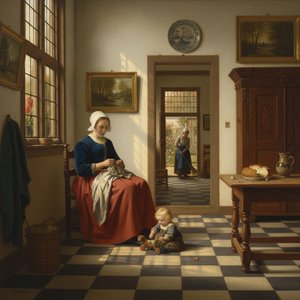
A Life in Perspective: The World of Emanuel de Witte
Emanuel de Witte, a name perhaps less instantly recognizable than some of his Dutch Golden Age contemporaries, nevertheless occupies a significant and fascinating niche within the pantheon of 17th-century masters. Born in Alkmaar in 1617, De Witte’s artistic journey was one marked by both remarkable talent and considerable personal turmoil – a duality that seems to subtly infuse itself into the very atmosphere of his paintings. He wasn't driven by meticulous architectural documentation like Pieter Saenredam; instead, he sought to capture the *feeling* of space, the quality of light, and the subtle drama unfolding within sacred interiors. His canvases aren’t merely representations of churches; they are immersive experiences, inviting viewers into a world of quiet contemplation and spiritual resonance.From Delft Training to Amsterdam's Embrace
De Witte’s early life provided a solid foundation for his artistic pursuits. His father, a schoolmaster, instilled in him an appreciation for learning and intellectual curiosity – qualities that would later manifest in his careful observation of perspective and light. He formally entered the art world by joining the Guild of St Luke in Alkmaar in 1636, but it was his subsequent apprenticeship with Evert van Aelst in Delft that proved particularly formative. Van Aelst, a renowned still-life painter, imparted to De Witte a keen eye for detail and a masterful command of light and shadow – skills that would become hallmarks of his mature style. Initially, De Witte explored various genres—portraits, mythological scenes, religious narratives—but it was upon relocating to Amsterdam in 1651 that he truly found his calling. The city’s wealth of magnificent churches provided an inexhaustible source of inspiration, and he began to specialize in depicting their awe-inspiring interiors. The scale and grandeur of these spaces, combined with the play of light filtering through stained glass windows, presented a unique challenge – one De Witte embraced with remarkable skill.Master of Atmosphere and Imaginary Spaces
Amsterdam proved pivotal for De Witte's artistic development. He didn’t simply replicate existing church interiors; rather, he skillfully synthesized elements from different buildings, creating idealized spaces that felt both familiar and subtly otherworldly. The Oude Kerk in Amsterdam became a frequent subject on his canvases, appearing repeatedly from various vantage points – sometimes elevated to emphasize its imposing height, other times viewed from the bustling streets below. But these weren’t straightforward depictions. De Witte manipulated perspective, played with light and shadow, and populated the spaces with carefully arranged figures—often depicting worshippers in prayer or contemplation—to evoke a specific mood or atmosphere. He wasn't interested in photographic accuracy; he was striving to capture the *essence* of sacred space – its sense of reverence, tranquility, and spiritual depth. As Walter Liedtke noted, his primary interest lay not in the architecture itself but in “the space itself – its light, color, sheer extent, and mood.” This emphasis on atmospheric effect distinguishes him from more rigidly topographical painters of the era. He wasn’t concerned with precise measurements or architectural details; he was interested in creating a *feeling*—a sense of awe, peace, and connection to something greater than oneself.A Life Marked by Shadows
Despite his artistic success, De Witte's personal life was plagued by hardship. The death of his first wife brought profound grief, and subsequent legal troubles involving his second wife and daughter cast a long shadow over his later years. Financial difficulties led him to the humiliating position of indentured servitude to an art dealer, Joris de Wijs, a situation he ultimately breached, leading to further complications. Contemporary accounts paint a picture of a volatile temperament – a man prone to shouting at clients and engaging in disputes. This inner turmoil perhaps contributed to the unevenness of his later work, but it also adds another layer of complexity to our understanding of the artist and his creations. Tragically, De Witte’s life came to a devastating end in 1692 when he reportedly attempted suicide by hanging himself from a canal bridge; the rope broke, and he drowned. It was a grim finale for a man who had dedicated his life to capturing the beauty and serenity of sacred spaces.Legacy and Enduring Influence
Emanuel de Witte stands as an important figure in the last phase of architectural painting in the Netherlands, bridging the gap between meticulous documentation and atmospheric interpretation. His innovative use of light and perspective influenced subsequent generations of artists, and his paintings continue to offer valuable insights into 17th-century Dutch religious life and social customs. Today, works by De Witte are held in prestigious collections worldwide – at the Metropolitan Museum of Art in New York, the National Gallery of Art in Washington, D.C., and the Rijksmuseum in Amsterdam—testifying to his enduring legacy as a master of perspective, atmosphere, and emotional resonance. He reminds us that art is not merely about what we see but how we *feel* when we look.Питання та відповіді
Як мені знайти всі роботи Емануель Де Віттє у певній техніці виконання?
Роботи Емануель Де Віттє можна переглянути за технікою виконання на сторінці митця За технікою виконання.
Чи є повний список творів Емануель Де Віттє?
З усіма роботами Емануель Де Віттє на цей сайт можна ознайомитися на сторінці Усі роботи митця митця.
Де можна переглянути роботи Емануель Де Віттє, розподілені за тематикою?
Атлас тематик для Емануель Де Віттє — це сторінка, на якій твори художника систематизовані за їхньою тематикою.