Портрет Wolfgang Laib

7 найвідоміших картин Wolfgang Laib: добірка галереї

Оновлено Листопад 2026 · за рейтингом нашої популярності (кількість пошукових запитів, переглядів та замовлень для кожної роботи) · 7 робіт Wolfgang Laib у нашому каталозі

Коротко кажучи

З усіх оригінальних робіт, які залишив Wolfgang Laib, найвідомішою є Milkstone (1987) із колекції Музей сучасного мистецтва (MoMA), Нью-Йорк. Слідом за ними йдуть Milk Stone (1978) та Untitled (1983). Наш каталог містить 7 робіт Wolfgang Laib; галерея зберегла 7 найвідоміших у світі творів, кожен із яких представлений із датою створення, назвою музею та своєю історією.

народився 1950, Metzingen Minimalism Найбільше робіт: Музей сучасного мистецтва (MoMA)

10 найкращих картин Wolfgang Laib: вибір галереї

1
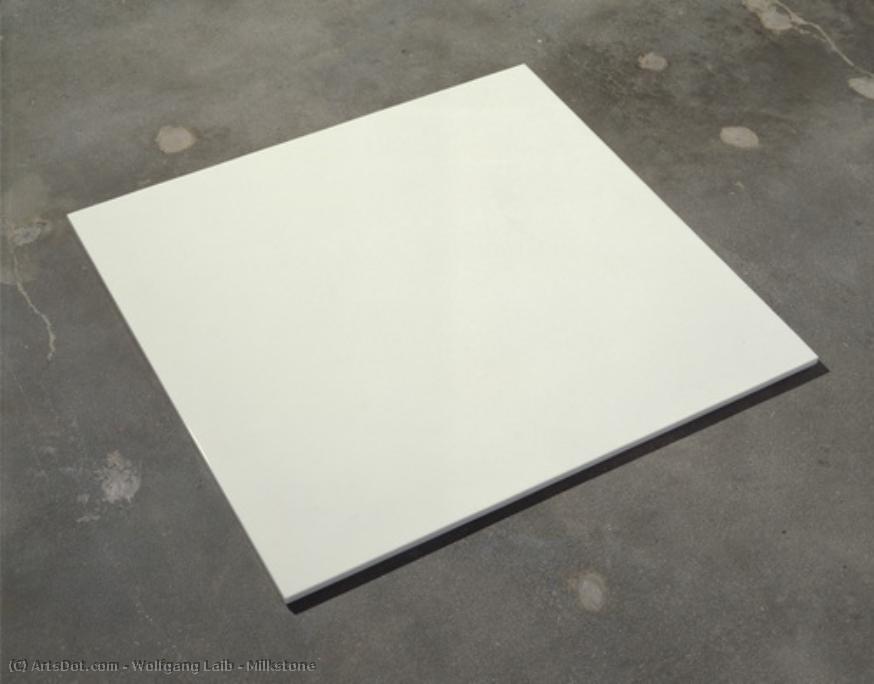
Milkstone (1987) авторства Wolfgang Laib

Milkstone

1987 · Photography · Музей сучасного мистецтва (MoMA), Нью-Йорк

In the quietude of a darkened gallery space, Wolfgang Laib’s Milkstone emerges not merely as an object, but as a profound encounter with the elemental. Created in 1987, this sculptural installation—captured here through a striking photographic lens—commands the viewer's attention through its stark, minimalist presence. At first glance, one is met with a monolithic rectangular prism of luminous white, a crystalline form that seems to glow against the deep, obsidian…

2
Milk Stone (1978) авторства Wolfgang Laib

Milk Stone

1978 · Photography · Музей сучасного мистецтва (MoMA), Нью-Йорк

To stand before Wolfgang Laib’s Milk Stone is not merely to observe an object; it is to enter a state of quiet contemplation. This piece, dating from 1978, strips away the superfluous until only the essential remains: a perfect square of luminous white resting upon the warm, grounding expanse of aged wood. The composition itself is deceptively simple, yet its power lies in the profound dialogue between its constituent parts.…

3
Untitled (1983) авторства Wolfgang Laib

Untitled

1983 · Ink On Paper · Музей сучасного мистецтва (MoMA), Нью-Йорк

To stand before this untitled work by Wolfgang Laib is to enter a space of profound stillness. It is not an image that shouts for attention; rather, it whispers secrets drawn from the quiet corners of nature and deep contemplation. The composition itself—a delicate interplay of reddish-orange markings against a vast expanse of white—immediately draws the eye into its minimalist embrace. One perceives not merely pigment on paper, but the…

Теми, що привертали увагу Wolfgang Laib

Чотири сюжети, які найчастіше зустрічаються в цих оригіналах, кожен із найкращим прикладом.

Музеї, у яких зберігаються оригінали Wolfgang Laib

1 музеїв, у яких зберігається більшість картин на цій сторінці.

Музей Місто Твори Wolfgang Laib Картини зі цього списку
Музей сучасного мистецтва (MoMA), Нью-ЙоркМузей сучасного мистецтва (MoMA) Нью-Йорк 6 Milkstone, Milk Stone, Untitled

Wolfgang Laib десятиліття за десятиліттям: оригінали, що визначають кожне з них

Роботи за десятиліттями

Оберіть десятиліття, щоб побачити оригінальний твір, який його визначає.

Запитання колекціонерів про картини Wolfgang Laib

Яка робота Wolfgang Laib є найвідомішою?Дізнатися відповідь

Milkstone (1987), Музей сучасного мистецтва (MoMA), Нью-Йорк. Далі йдуть Milk Stone (1978) та Untitled (1983).

Скільки років було Wolfgang Laib, коли було створено Milkstone?Дізнатися відповідь

37 років: Milkstone датована 1987 роком, а Wolfgang Laib народився(-лася) у 1950.

Скільки картин залишив Wolfgang Laib?Дізнатися відповідь

Наш каталог містить 7 робіт Wolfgang Laib, датованих періодом з 1978 по 2008.

У яких музеях виставляються шедеври Wolfgang Laib?Дізнатися відповідь

Переважно в Музей сучасного мистецтва (MoMA) (Нью-Йорк). У таблиці музеїв вище наведено їхній повний перелік.

У які роки Wolfgang Laib створив свої найвідоміші роботи?Дізнатися відповідь

У 1980s: 2 із 7 робіт на цій сторінці були створені тоді, серед них Milkstone.

Які перша та остання відомі оригінальні роботи Wolfgang Laib?Дізнатися відповідь

На цій сторінці найдавніша робота датована Milk Stone (1978), а найновіша — Rice House (2008).

Які сюжети Wolfgang Laib обирав найчастіше?Дізнатися відповідь

Geometry (3), Silence (3) та Geometric (3), у 7 роботах на цій сторінці.

Яку техніку найчастіше використовував(ла) Wolfgang Laib?Дізнатися відповідь

Photography, для 3 із 7 робіт на цій сторінці.

До якого художнього напряму належить Wolfgang Laib?Дізнатися відповідь

Minimalism, судячи з оригіналів на цій сторінці.

Які роботи Wolfgang Laib виставлені в Музей сучасного мистецтва (MoMA)?Дізнатися відповідь

Milkstone, Milk Stone та Untitled: Музей сучасного мистецтва (MoMA), Нью-Йорк зберігає 6 робіт із цієї сторінки.

Wolfgang Laib: життя та творчість

The Sculptor of Silence and Elemental Essence

Born in Metzingen, Germany, in 1950, Wolfgang Laib has cultivated an artistic practice that transcends the boundaries of traditional sculpture, moving instead into the realm of pure, meditative experience. His work does not merely occupy space; it breathes with the rhythms of the natural world. Operating from a tranquil village in southern Germany while maintaining studios in New York City and South India, Laib’s life is a testament to the pursuit of stillness. This unique geographical duality—the structured precision of Europe meeting the spiritual depth of India—informs an aesthetic that seeks to find the eternal within the ephemeral.

Laib’s artistic journey was profoundly shaped by his early immersion in the philosophies of Taoism and Zen Buddhism. These ancient traditions provided him with a lens through which to view the universe, emphasizing simplicity, the beauty of natural forms, and the profound power of emptiness. Rather than imposing a human will upon his materials, Laib seeks a state of harmony, where the artist acts as a facilitator for the inherent qualities of the earth itself. This spiritual foundation is evident in every meticulously placed grain of pollen and every drop of milk that graces his monumental works.

Materiality and the Poetry of Nature

The hallmark of Laib’s oeuvre is his radical use of elemental, organic materials that challenge the conventional permanence of sculpture. He is perhaps most celebrated for his milkstones—monumental blocks of white marble that serve as a canvas for a single, delicate drop of milk. In these pieces, the cold, enduring weight of the stone meets the fragile, life-giving essence of the liquid, creating an evocative juxtaposition of purity and vulnerability. This subtle interplay serves as a meditation on nourishment, renewal, and the delicate balance of existence.

Beyond the marble, Laib’s use of pollen has become one of the most iconic expressions of contemporary Land Art. By collecting vast quantities of pollen and arranging them into precise, geometric fields, he creates installations that feel both cosmic and deeply terrestrial. These golden, velvety surfaces possess a luminous quality that seems to vibrate with life. A defining moment in his career was the presentation of his colossal pollen installation at the Museum of Modern Art (MoMA) in 2013, an achievement that showcased his ability to transform a museum's white cube into a sacred, breathing landscape.

Legacy and Global Recognition

Laib’s contribution to the contemporary art canon is marked by his ability to bridge the gap between the physical and the metaphysical. His participation in the prestigious Documenta 7 (1982) and Documenta 8 (1987) established him as a pivotal figure within the German Land Art movement, proving that sculpture could be found not just in earthworks, but in the very substances of life itself. His work has been recognized on the highest international stages, including representing Germany at the Venice Biennale.

The historical significance of Wolfgang Laib lies in his refusal to participate in the noise of the modern era, choosing instead to champion a quiet, profound minimalism. For his immense contributions to the arts, he has been honored with the Praemium Imperiale, one of the highest honors in the art world. His legacy continues to inspire those who seek meaning in the subtle textures of the natural world, reminding us that true greatness often resides in the most delicate and silent of gestures.