The Enigmatic Vision of William Nelson Copley
In the vibrant, often chaotic tapestry of twentieth-century art, few figures loom as multifaceted and intriguing as William Nelson Copley. Known to the art world by his evocative moniker, CPLY, he was far more than a mere painter; he was a bridge between eras, a collector of dreams, and an entrepreneur of the avant-garde. Born in New York City in 1919, Copley’s early life was marked by both profound loss and extraordinary opportunity. Following the tragic death of his biological parents during the Spanish Flu epidemic, he was adopted by the publishing magnate Ira C. Copley. This transition from a vulnerable infancy to a life of academic privilege—marked by scholarships to Phillips Andover and Yale University—provided him with the intellectual scaffolding that would later support his daring explorations into the subconscious.
Copley’s journey through the mid-century was defined by a restless spirit of discovery. His service in the Second World War, though negotiated through his academic standing at Yale, served as a period of intense global engagement that preceded his return to the world of letters and art. Upon returning home, he utilized his journalistic prowess within his father’s newspaper empire, yet his heart was increasingly drawn toward the more surreal corners of human experience. It was through his marriage to Marjorie Doris Wead and subsequent connections with figures like the animator John Poylardt that Cople and the seeds of Surrealism began to germinate. Together, they traversed the landscapes of Mexico and New York, absorbing the dreamlike logic and subversive energy of the movement, which would become the cornerstone of his creative identity.
A Convergence of Surrealism and Pop
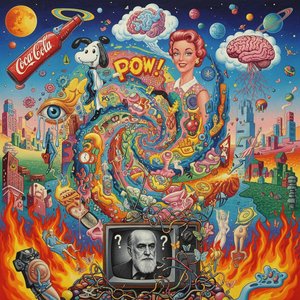
The artistic output of CPLY is characterized by a singular ability to blend the profound with the playful. His work occupies a fascinating historical threshold, acting as a late Surrealist practitioner while simultaneously serving as a vital precursor to the Pop Art movement. Unlike the often heavy or dark psychological weight found in traditional Surrealism, Copley’s canvases frequently embrace a sense of wit, eroticism, and even humor. His figures, though sometimes fragmented or dreamlike, possess a certain graphic immediacy that anticipates the bold, commercial aesthetics of the 1960s. This stylistic duality allowed him to navigate the complexities of the human psyche while remaining tethered to the vibrant, contemporary pulse of American culture.
His role as a gallerist further cemented his influence on the trajectory of modern art. Through the establishment of the Claire Copley Gallery in Los Angeles, he became a crucial patron and platform for emerging voices. His eye was not merely focused on the past; he championed minimalist and conceptual artists such as:
- Bas Jan Ader
- Michael Asher
- Daniel Buren
- Jan Dibbets
Legacy of a Collector and Catalyst
Beyond the brushstrokes on his canvases, Copley’s greatest achievement may lie in his monumental role as a collector and patron. He assembled one of the most significant collections of Dada and Surrealist art in the United States, a repository of cultural memory that highlighted the enduring dialogue between the historical avant-garde and postwar practitioners. His collection was not merely an accumulation of wealth, but a curated testament to the power of the irrational and the subversive. Through his publishing ventures and his gallery, he acted as a catalyst, ensuring that the radical ideas of the early twentieth century would find fertile ground in the burgeoning art scenes of Los Angeles and New York.
When we look upon the works of CPLY today, we see more than just paintings; we see the fingerprints of a man who lived at the intersection of many worlds. He was a writer who understood narrative, a gallerist who understood commerce, and an artist who understood the beautiful, unsettling truth of the dream state. His legacy remains etched in the way we perceive the boundaries between high art and popular culture, reminding us that the most profound truths are often found in the most unexpected, and even humorous, places.