Портрет Вільям Мейсон Браун

44 найвідоміших картин Вільям Мейсон Браун, кожна з яких є унікальною

Оновлено Листопад 2026 · за рейтингом нашої популярності (кількість пошукових запитів, переглядів та замовлень для кожної роботи) · 44 робіт Вільям Мейсон Браун у нашому каталозі

Коротко кажучи

Summer Pastures (1856) — це картина Вільям Мейсон Браун, яка привертає найбільше уваги. Після цього погляд переходить на Still Life (also known as Fruit and Art Objects) (1888) та Landscape with Two Indians (1855). Серед 44 робіт Вільям Мейсон Браун у нашому каталозі ці 44 є найвідомішими: кожна з них — унікальний оригінал із зазначенням року створення, музею та причини її безсмертя.

1823 – 1899, Нью-Йорк Hudson river school Найбільше робіт: Toledo Museum of Art

Топ-10 картин Вільям Мейсон Браун крізь призму галереї

1
Summer Pastures (1856) авторства Вільям Мейсон Браун

Summer Pastures

1856 · Oil On Canvas

The scene unfolds within the quiet expanse of Summer Pastures, a work that captures a specific moment of pastoral peace. Painted in 1856, this piece brings the viewer into a lush, green world where the air feels heavy with the warmth of a midsummer afternoon. The artist, William Brown, also known by his full name William Mason Brown, directs our gaze across a landscape that feels both vast and intimately…

Знамениті картини Вільям Мейсон Браун, з 11 по 44

Знамениті картини Вільям Мейсон Браун за періодами творчості

Теми, що привертали увагу Вільям Мейсон Браун

Чотири сюжети, які найчастіше зустрічаються в цих оригіналах, кожен із найкращим прикладом.

Музеї, у яких зберігаються оригінали Вільям Мейсон Браун

7 музеїв, у яких зберігається найбільша кількість картин із цього списку.

Музей Місто Твори Вільям Мейсон Браун Картини зі цього списку
Toledo Museum of Art, ТоледоToledo Museum of Art Толедо 1 Landscape with Two Indians
Yale Center for British Art, Нью-ХейвенYale Center for British Art Нью-Хейвен 1 Tiptree Hall and Farm, Essex
Crystal Bridges Museum of American Art, БентонілCrystal Bridges Museum of American Art Бентоніл 1 Raspberries in a Wooded Landscape
Клівлендський музей мистецтва, КлівлендКлівлендський музей мистецтва Клівленд 1 Still Life with Cantaloupe
Birmingham Museum of Art, БірмінгемBirmingham Museum of Art Бірмінгем 1 Still Life with Cantaloupe
Національна галерея мистецтв, ВашингтонНаціональна галерея мистецтв Вашингтон 1 Mound of Cherries
Fries Museum, ЛьюварденFries Museum Льюварден 1 Still Life with Melon, Peach, Fruit-Filled Compote and Glass of Wine on a Marble Table Top

Вільям Мейсон Браун крізь десятиліття: одна унікальна оригінальна робота для кожного

Роботи за десятиліттями

Оберіть десятиліття, щоб побачити оригінальний твір, який його визначає.

Картини Вільям Мейсон Браун: запитання до галереї

Яка найвідоміша робота Вільям Мейсон Браун?Дізнатися відповідь

Summer Pastures (1856). Далі йдуть Still Life (also known as Fruit and Art Objects) (1888) та Landscape with Two Indians (1855).

У якому віці Вільям Мейсон Браун створив(ла) Summer Pastures?Дізнатися відповідь

33 років: Summer Pastures датована 1856 роком, а Вільям Мейсон Браун народився(-лася) у 1823.

Які десять найвідоміших картин Вільям Мейсон Браун?Дізнатися відповідь

Summer Pastures, Still Life (also known as Fruit and Art Objects), Landscape with Two Indians, Tiptree Hall and Farm, Essex, Untitled (also known as Landscape with Indians), Three Men in a Landscape, Landscape with Two Indians, Raspberries in a Wooded Landscape, Still Life with Watermelon, Grapes, Peaches, Plums and Cantaloupe та Still Life with Melon, Grapes, Peaches, Pears and Black Raspberries. У рейтингу вище вказано рік створення та музей для кожної картини.

Скільки відомих робіт належить Вільям Мейсон Браун?Дізнатися відповідь

Наш каталог містить 44 робіт Вільям Мейсон Браун, датованих періодом з 1850 по 1888.

Де можна побачити найвідоміші оригінали Вільям Мейсон Браун?Дізнатися відповідь

Переважно в Toledo Museum of Art (Толедо), Yale Center for British Art (Нью-Хейвен) та Crystal Bridges Museum of American Art (Бентоніл). У таблиці музеїв вище наведено їхній повний перелік.

У який період Вільям Мейсон Браун створив свої найвідоміші картини?Дізнатися відповідь

У 1850s: 7 із 44 робіт на цій сторінці були створені тоді, серед них Summer Pastures.

Яка з найвідоміших картин Вільям Мейсон Браун була написана найраніше, а яка — найпізніше?Дізнатися відповідь

На цій сторінці найдавніша робота датована Tiptree Hall and Farm, Essex (1850), а найновіша — Still Life (also known as Fruit and Art Objects) (1888).

Яким сюжетам віддавав перевагу Вільям Мейсон Браун?Дізнатися відповідь

Landscape (8), Life (8) та Fruits (6), у 44 роботах на цій сторінці.

До якого напряму належить творчість Вільям Мейсон Браун?Дізнатися відповідь

Hudson river school, судячи з оригіналів на цій сторінці.

Вільям Мейсон Браун: портрет художника

The Meticulous Vision of William Mason Brown

Born in Troy, New York, William Mason Brown emerged as a distinctive voice within the American art landscape, carving out a legacy defined by an extraordinary devotion to detail. His artistic journey began under the tutelage of Abel Buell Moore, the preeminent portraitist of Troy, which laid the foundation for a career that would traverse several captivating genres. While his early training was rooted in the intimate realm of portraiture, Brown’s creative spirit eventually expanded into the sweeping vistas of the landscape and the hyper-realistic precision of still life painting.

As a prominent member of the second generation of the Hudson River School, Brown’s early work reflected the romantic traditions established by masters such as Thomas Cole. During his time in Newark, New Jersey, starting around 1850, he specialized in landscapes that captured the grandeur and serenity of the natural world. These works often featured a striking balance between vast, atmospheric backgrounds—such as distant mountains and flowing rivers—and an exacting, almost photographic precision in the foreground elements. This duality allowed him to evoke both the sublime scale of nature and a profound sense of tranquility.

A Transition to Hyper-Realistic Still Life

A pivotal shift occurred in 1858 when Brown moved to Brooklyn, New York, a transition that saw him move away from the expansive horizons of landscape painting toward the concentrated intensity of still life. This period marked his emergence as a master of trompe-l'œil, a technique designed to deceive the eye into perceiving three-dimensional reality on a flat canvas. Influenced by the Pre-Raphaelite movement and the teachings of John Ruskin, Brown developed a style characterized by an almost obsessive attention to texture and light.

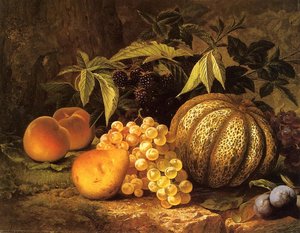
His still lifes became celebrated for their ability to replicate the tactile essence of the subjects they depicted. He possessed a rare talent for textural duplication, capturing the delicate fuzz on a peach or the intricate rind of a cantaloupe with such clarity that his work was often compared to the precision of French academician Jean-Léon Gérôme. In these compositions, Brown avoided visible brushwork, preferring a smooth, seamless finish that allowed the viewer to lose themselves in the luminous highlights and organic weights of fruit, berries, and flowers.

Legacy and Artistic Significance

Throughout his long career, Brown was a consistent and respected presence in the American art community, exhibiting annually at the National Academy of Design for over three decades. His ability to reach a wide audience through chromolithographic reproductions ensured that his meticulous renderings of nature were admired far beyond the gallery walls. His work remains preserved in prestigious institutions, including:

The historical significance of William Mason Brown lies in his unique ability to bridge the gap between the romanticism of the Hudson River School and the rigorous, scientific observation of the Pre-Raphaelite influence. By mastering both the sweeping emotion of the landscape and the quiet, intense reality of the still life, he left behind a body of work that celebrates the profound beauty found in both the vastness of the earth and the smallest details of its bounty.