1


Оновлено Жовтень 2026 · за рейтингом нашої популярності (кількість пошукових запитів, переглядів та замовлень для кожної роботи) · 18 робіт Konrad Klapheck у нашому каталозі
Коротко кажучи
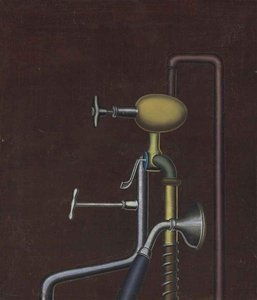
На думку експертів галереї, найвідоміший витвір Konrad Klapheck — це The Night Beauties (Die Schönen der Nacht) (1961), оригінал якого експонується в Ізраїльський музей, Єрусалим. Cruel Night / Bitter Night (Nuit cruelle) (1959) та The Horoscope (1966) доповнюють тріо, яке впізнає кожне око. З 18 робіт Konrad Klapheck у нашому каталозі галерея представляє 18 найвідоміших нижче — кожна з них є оригіналом із зазначенням року створення, музею та унікальних особливостей.


4 музеїв, у яких зберігається більшість картин із цього списку.
| Музеї | Місто | Твори Konrad Klapheck | Картини з цього списку |
|---|---|---|---|
 Ізраїльський музей |
Єрусалим | 3 | The Night Beauties (Die Schönen der Nacht), Cruel Night / Bitter Night (Nuit cruelle), The Female Terrorist (Die Terroristin) |
 Баварські державні художні колекції |
Мюнхен | 2 | The Horoscope, The Show-off |
 Staatliche Kunsthalle Karlsruhe |
Карлсруе | 1 | Life in Society |
 Музей Штадель |
Франкфурт | 1 | Der Gesetzgeber |
Оберіть десятиліття, щоб побачити оригінальний твір, який його визначає.
The Night Beauties (Die Schönen der Nacht) (1961), Ізраїльський музей, Єрусалим. Далі йдуть Cruel Night / Bitter Night (Nuit cruelle) (1959) та The Horoscope (1966).
26 років: The Night Beauties (Die Schönen der Nacht) датована 1961 роком, а Konrad Klapheck народився(-лася) у 1935.
The Night Beauties (Die Schönen der Nacht), Cruel Night / Bitter Night (Nuit cruelle), The Horoscope, The Female Terrorist (Die Terroristin), The Show-off, Life in Society, Der Gesetzgeber, The mistress, The swagger та The fanatic. У рейтингу вище вказано рік створення та музей для кожної картини.
Наш каталог містить 18 робіт Konrad Klapheck, датованих періодом з 1959 по 1971.
Переважно в Ізраїльський музей (Єрусалим), Баварські державні художні колекції (Мюнхен) та Staatliche Kunsthalle Karlsruhe (Карлсруе). У таблиці музеїв вище наведено їхній повний перелік.
У 1960s: 5 із 18 робіт на цій сторінці були створені тоді, серед них The Night Beauties (Die Schönen der Nacht).
На цій сторінці найдавніша робота датована Cruel Night / Bitter Night (Nuit cruelle) (1959), а найновіша — The Female Terrorist (Die Terroristin) (1971).
Pop art, судячи з оригіналів на цій сторінці.
The Night Beauties (Die Schönen der Nacht), Cruel Night / Bitter Night (Nuit cruelle) та The Female Terrorist (Die Terroristin): Ізраїльський музей, Єрусалим зберігає 3 робіт із цієї сторінки.
In the quiet intersection where the precision of industrial machinery meets the irrationality of a dream, lies the singular world of Konrad Klapheck. Born in Düsseldorf on February 10, 1935, to a lineage of esteemed art historians, Klapheck was destined for a life steeped in aesthetic contemplation. His early years at the Kunstakademie Düsseldorf, studying under the guidance of Bruno Goller, provided him with a rigorous foundation in craftsmanship. Yet, beneath this disciplined training, a more subversive spirit was brewing—one that would eventually reject the purely abstract in favor of a hauntingly realistic yet profoundly distorted vision of the everyday.
Klapheck’s artistic evolution is a fascinating journey from magic realism to a highly idiosyncratic blend of Surrealism and Pop Art. While his mid-1950s works adhered to more traditional modes, a transformative shift occurred when he first turned his gaze toward the typewriter. This was not merely a change in subject matter, but a revolution in perception. By isolating these mechanical objects and presenting them with an almost obsessive clarity, he stripped them of their utility and imbued them with a psychological weight. These machines became characters in a silent, surreal drama, bathed in vibrant, often unsettling hues that challenged the viewer's sense of reality.
To look upon a Klapheck painting is to experience a strange sense of alienation within the familiar. He possessed a remarkable ability to take the most utilitarian items—objects we touch and use without thought—and transform them into monumental icons of mystery. His repertoire of subjects expanded from his iconic typewriters to include a parade of mechanical and domestic artifacts:
This technique was never merely about photographic accuracy. Instead, Klapheck utilized a masterful manipulation of color and scale to inject an element of the absurd. His work often carries a subtle, biting wit, layered with political commentary and even sexual innuendo. By enlarging these small, domestic objects to a monumental scale, he forced a confrontation between the viewer and the inanimate, making the mechanical feel alive, and the living feel strangely mechanical.
The historical significance of Konrad Klapheck lies in his ability to bridge the gap between the conceptual provocations of Marcel Duchamp and the vibrant, consumer-driven energy of Pop Art. He drew deep inspiration from the avant-garde masters—Man Ray, Max Ernst, and René Magritte—yet he applied their surrealist logic to a much more modern, industrial landscape. His work mirrors the tension of the mid-20th century: the fascination with technological progress clashing with the underlying anxiety of an increasingly automated world.
Through his precise lines and dreamlike compositions, Klapheck achieved a rare feat in contemporary art: he made the inanimate speak. He left behind a body of work that serves as a profound meditation on alienation, fascination, and the hidden life of objects. Even decades after his passing, his paintings continue to haunt the galleries of the world, reminding us that within the most ordinary machine, there may lie an extraordinary, unsettling truth.