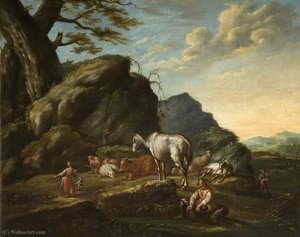
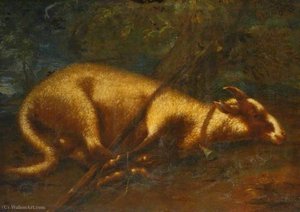
Goats and Flock of Sheep
Goats and Flock of Sheep is an oil painting by Philipp Peter Roos. The artist, who was also known by the moniker Rosa di Tivoli, produced this work about 1681. He was a German Baroque painter born in Sankt Goar, Germany.
Коротко кажучи
З усіх оригінальних робіт, які залишив Філіп Петер Роос, найвідомішою є Goats and Flock of Sheep (1681) із колекції Баварські державні художні колекції, Мюнхен. Слідом за ними йдуть Piece of Livestock (1681) та Landscape with Cattle and Shepherd (1681). Наш каталог містить 93 робіт Філіп Петер Роос; галерея зберегла 92 найвідоміших у світі творів, кожен із яких представлений із датою створення, назвою музею та своєю історією.
Goats and Flock of Sheep is an oil painting by Philipp Peter Roos. The artist, who was also known by the moniker Rosa di Tivoli, produced this work about 1681. He was a German Baroque painter born in Sankt Goar, Germany.
Piece of Livestock is an oil painting by Philipp Peter Roos, executed in 1681. The work originates from the Baroque period, a time when the artist was establishing his presence within the Italianate landscape tradition.
Landscape with Cattle and Shepherd is a work by the German Baroque painter Philipp Peter Roos. Created about 1681, the painting reflects the artist's specialized focus on pastoral scenes and animal subjects. Roos was a significant figure in the development of Italianate landscapes, often characterized by his intimate study of livestock and the natural environment.
In Piece of Livestock, Philipp Peter Roos organizes a pastoral scene through a close-up, ground-level perspective that establishes an immediate intimacy with the subjects. The composition is dominated by a large, seated cow positioned slightly to the right of the center. To the left, a smaller lamb or calf provides a sense of scale, while a woman interacts with a dog in the space behind the primary subject. This arrangement…
Resting Flock with Shepherds is an oil painting by the German Baroque artist Philipp Peter Roos. Created about 1681, this work captures a quiet moment within a rugged landscape. The composition focuses on a group of livestock and a shepherd, rendered with a sense of immediate presence that draws the viewer into the scene.
Resting Flock with Shepherds is an oil painting by Philipp Peter Roos. The canvas captures a heavy stillness among livestock and their guardian. This work was created about 1681. It presents a scene of animals and men gathered in a quiet, layered space under a turbulent sky.
In this Baroque-style oil painting, the mythological drama of the Liberation of Io unfolds with a sudden, heavy intensity. Created by Philipp Peter Roos about 1681, the scene captures a moment of profound tension between the divine and the mortal. A massive, powerful bull dominates the foreground, its muscular form rendered with a weight that feels almost tangible. This central figure looms over the landscape, its presence commanding the space…
This oil on canvas painting, dated 1681, presents a monochromatic scene rendered in various shades of gray. In the foreground, a young woman is positioned amidst a group of livestock, including sheep or goats. The composition is a medium shot, placing the human subject and the animals in the immediate front and middle ground. The terrain is undulating, forming rolling hills that recede into a background of hazy mountains and…
Returning Flock with Shepherds is an oil painting by Philipp Peter Roos. Created about 1681, the work captures a quiet moment of pastoral movement. The artist, a German Baroque painter, was born in Sankt Goar. He would later become known by the moniker Rosa di Tivoli.
The scene unfolds in Shepherd with Cow, Sheep and Goats in Italian Mountain Landscape, a work that captures a quiet moment of pastoral life. This painting, created about 1680, brings together a shepherd and his diverse herd amidst a rugged, mountainous setting. The figures and animals exist within a landscape that feels both immediate and deeply rooted in the natural world.
Чотири сюжети, які найчастіше зустрічаються в цих оригіналах, кожен із найкращим прикладом.
8 музеїв, у яких зберігається найбільша кількість картин із цього списку.
| Музей | Місто | Твори Філіп Петер Роос | Картини зі цього списку |
|---|---|---|---|
| Мюнхен | 15 | Goats and Flock of Sheep, Piece of Livestock, Landscape with Cattle and Shepherd | |
| Копенгаген | 5 | Cattle Piece, Landscape with a Bull, Sheep and Goats, A Shepherd with his Herd | |
| Буенос-Айрес | 4 | Landscape with shepherd and animals, Landscape with figures and animals, Shepherd and animals in a landscape | |
| Братислава | 3 | Goat Herd with a Goatherd, Shepherd's Idyl in a Romantic Landscape with Ruins, Herd by an Ancient Well | |
| Прага | 3 | Ravine with a Stream, a Shepherd and His Herd, Horse and Goats Grazing, Shepherd with a Herd of Sheep and Goats | |
| Відень | 3 | Herd with Sleeping Shepherds, Rider Meeting, Landscape with Flock of Sheep | |
| Санкт-Петербург | 3 | Landscape with a Grotto, Landscape with a Waterfall, Landscape with a Herd | |
| Стокгольм | 3 | Dead Hare, Landskap med hjord, A Goat Resting |
Оберіть десятиліття, щоб побачити оригінальний твір, який його визначає.
This large-scale oil painting, dated 1669, presents a crowded, maximalist composition of diverse animal species. The arrangement is packed, with various animals overlapping to create a sense of density and movement. The color palette relies on deep, earthy tones, including rich browns, blacks, and dark ochres. These dark shades are interrupted by specific highlights of white and cream, alongside splashes of red from a rooster and parrots. The lighting follows…
Goats and Flock of Sheep is an oil painting by Philipp Peter Roos. The artist, who was also known by the moniker Rosa di Tivoli, produced this work about 1681. He was a German Baroque painter born in Sankt Goar, Germany.
A heavy, dark-colored cow anchors the center of this scene, its presence felt in the weight of its silhouette. To the left, two goats rest upon the ground, one a pale contrast of white and light tan against the shadows. A man sits nearby, leaning back in a moment of stillness, his gaze directed toward the animals or perhaps the viewer. The air in the enclosure feels thick and dim,…
In this work, titled Shepherd's Idyl in a Romantic Landscape with Ruins, the artist Philipp Peter Roos presents a quiet moment of rural existence. Created about 1700, the painting captures a shepherd tending to his flock amidst a landscape of rolling hills and weathered stone structures. There is a sense of stillness in the way the figures and animals occupy the space, suggesting a life governed by the rhythms of…
Goats and Flock of Sheep (1681), Баварські державні художні колекції, Мюнхен. Далі йдуть Piece of Livestock (1681) та Landscape with Cattle and Shepherd (1681).
24 років: Goats and Flock of Sheep датована 1681 роком, а Філіп Петер Роос народився(-лася) у 1657.
Goats and Flock of Sheep, Piece of Livestock, Landscape with Cattle and Shepherd, Piece of Livestock, Resting Flock with Shepherds, Resting Flock with Shepherds, Liberation of Io, Piece of Cattle, Returning Flock with Shepherds та Shepherd with Cow, Sheep and Goats in Italian Mountain Landscape. У рейтингу вище вказано рік створення та музей для кожної картини.
Наш каталог містить 93 робіт Філіп Петер Роос, датованих періодом з 1669 по 1700.
Переважно в Баварські державні художні колекції (Мюнхен), Statens Museum For Kunst (Копенгаген) та Національний музей образотворчого мистецтва (Буенос-Айрес). У таблиці музеїв вище наведено їхній повний перелік.
У 1680s: 21 із 92 робіт на цій сторінці були створені тоді, серед них Goats and Flock of Sheep.
На цій сторінці найдавніша робота датована Various animals gathered before Noah's Ark (1669), а найновіша — Shepherd's Idyl in a Romantic Landscape with Ruins (1700).
Landscape (33), Animals (29) та Goats (19), у 92 роботах на цій сторінці.
Oil On Canvas, для 18 із 92 робіт на цій сторінці.
Baroque, судячи з оригіналів на цій сторінці.
Goats and Flock of Sheep, Piece of Livestock та Landscape with Cattle and Shepherd: Баварські державні художні колекції, Мюнхен зберігає 15 робіт із цієї сторінки.
У золотистому світлі італійського бароко мало які імена викликають таку пасторальну безтурботність сільської місцевості, як Філіп Петер Роос. Відомий в історії під своїм виразним прізвиськом, Rosa di Tivoli, цей майстер німецького походження трансформував жанр пейзажу через глибокий, майже вісцеральний зв'язок із природою. Народившись у 1655 році в регіоні Рейнланд — зокрема поблизу Санкт-Гоара — Роос від найперших років був приречений на шлях художника. Він був сином Йоганна Генріха Рооса, поважного пейзажиста, який дав йому основи тональної гармонії та композиційної рівноваги, що згодом визначать зрілий стиль митця. Це раннє навчання було не просто опануванням техніки; це було занурення у спосіб бачення світу крізь призму світла, тіні та тихої гідності землі.
Траєкторія життя Рооса кардинально змінилася у 1677 році завдяки щедрості Карла I, ландграфа Гессен-Кассельського. Помітивши зростаючий талант молодого художника, ландграф надав фінансову можливість для переможної подорожі Рооса до Рима. Ця міграція з германських традицій до серця італійського бароко дозволила Роосу ввібрати в себе життєдайну енергію римського мистецтва. Саме тут він шукав наставництва у видатного Джачінто Бранді, чий вплив допоміг вдосконалити здатність Рооса поєднувати класичну структуру зі спонтанним, атмосферним реалізмом. Цей період у Римі був також глибоко особистим; саме в ці роки Роос закохався в Ізабеллу Бранді, доньку свого наставника. Їхній союз зрештою привів його до поселення в Тівіволі — крок, що назавжди пов'язав його особистість із пейзажем, який він так сильно любив.
Що справді вирізняє творчість Rosa di Tivoli, так це неперевершена автентичність його тваринних сюжетів. На відміну від багатьох сучасників, які використовували тварин лише як декоративні деталі пейзажу, Роос ставився до кожної істоти — від масивного бика до спритного козла — з повагою портретиста. Його резиденція в Тівіволі була відома тим, що була організована за принципом живої студії; він утримував величезну колекцію екзотичних та свійських тварин, фактично перетворюючи своє оточення на безперервне дослідження руху, анатомії та темпераменту. Така інтимна близькість дозволяла йому вловити ледь помітне сіпання вуха або м'язову напругу звіра в момент стресу, надаючи своїм полотнам захопливої вітальності.
Його технічна майстерність очевидна в тому, як він орієнтувався в складнощах естетики бароко. Хоча його композиції часто спираються на спокійні, атмосферні якості нідерландського Золотого віку, вони просякнуті драматичною інтенсивністю, характерною для італійської школи. Його роботи часто демонструють:
Історична важливість Філіпа Петера Рооса полягає в його здатності подолати розрив між структурованими традиціями північноєвропейського пейзажу та емоційною, наповненою світлом драмою Італії. Він з'явився в епоху, коли науковий пошук починав вимагати точніших спостережень за природним світом, навіть коли релігійні та міфологічні теми все ще домінували в художній свідомості. У його картинах можна знайти як ретельну деталізацію натураліста, так і поетичну душу романтика. Документуючи флору та фауну римської сільської місцевості з такою відданістю, він створив візуальний літопис, який є настільки ж відображенням духу епохи, наскільки й самих об'єктів дослідження.
Хоча він пішов з життя у 1706 році, залишивши по собі спадщину, закарбовану в самій землі Тівіволі, його вплив тривав. Він залишається ключовою постаттю для кожного, хто вивчає еволюцію жанру анімалістики та розвиток італізованого пейзажу. Через його очі ми бачимо не просто зграю худоби; ми стаємо свідками глибокого торжества життя в його найбільш фундаментальних, независломніших формах. Його творчість продовжує резонувати як свідчення сили спостереження та незгасної краси пасторального ідеалу.