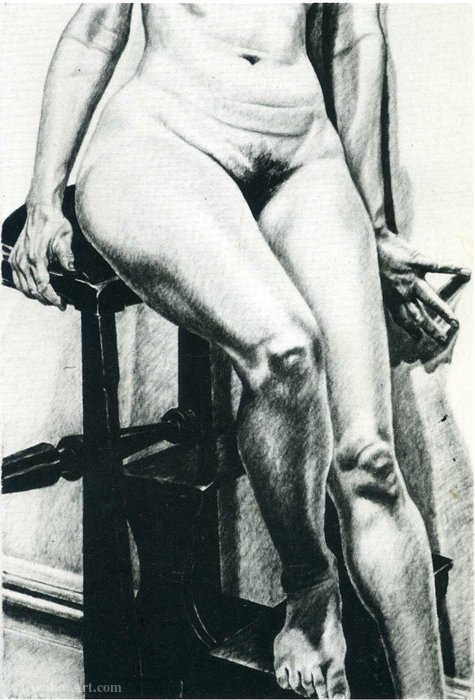
Портрет Філіп Пірлштейн

Картини Філіп Пірлштейн: 29 найвідоміших у погляді галереї

Оновлено Листопад 2026 · за рейтингом нашої популярності (кількість пошукових запитів, переглядів та замовлень для кожної роботи) · 36 робіт Філіп Пірлштейн у нашому каталозі

Коротко кажучи

На думку експертів галереї, найвідоміший витвір Філіп Пірлштейн — це Seated Model (1966). Portrait of Beth Levine (Lady with Red Bow) (1985) та Untitled (685) доповнюють тріо, яке впізнає кожне око. З 36 робіт Філіп Пірлштейн у нашому каталозі галерея представляє 29 найвідоміших нижче — кожна з них є оригіналом із зазначенням року створення, музею та унікальних особливостей.

1924 – 2022, Піттсбург Contemporary realism

Топ 10 картин художника Філіп Пірлштейн у галереї

Картини художника Філіп Пірлштейн, від 11 до 29 місця в рейтингу

Теми, що привертали увагу Філіп Пірлштейн

Чотири сюжети, які найчастіше зустрічаються в цих оригіналах, кожен із найкращим прикладом.

Філіп Пірлштейн, одна фірмова картина за десятиліття

Роботи за десятиліттями

Оберіть десятиліття, щоб побачити оригінальний твір, який його визначає.

Картини Філіп Пірлштейн: відповіді галереї

Яка картина Філіп Пірлштейн є найвідомішою серед усіх?Дізнатися відповідь

Seated Model (1966). Далі йдуть Portrait of Beth Levine (Lady with Red Bow) (1985) та Untitled (685).

Скільки років було Філіп Пірлштейн, коли він/вона завершив/завершила Seated Model?Дізнатися відповідь

42 років: Seated Model датована 1966 роком, а Філіп Пірлштейн народився(-лася) у 1924.

Які 10 найкращих картин Філіп Пірлштейн?Дізнатися відповідь

Seated Model, Portrait of Beth Levine (Lady with Red Bow), Untitled (685), Untitled (336), Untitled (995), Untitled (218), Untitled (309), Untitled (642), Superman та Male and Female Models Sitting on the Floor. У рейтингу вище вказано рік створення та музей для кожної картини.

Скільки творів створив Філіп Пірлштейн?Дізнатися відповідь

Наш каталог містить 36 робіт Філіп Пірлштейн, датованих періодом з 1952 по 2002.

Коли Філіп Пірлштейн створив свої найвідоміші картини?Дізнатися відповідь

У 1970s: 3 із 29 робіт на цій сторінці були створені тоді, серед них Two Models.

Які найранніші та найпізніші відомі роботи Філіп Пірлштейн?Дізнатися відповідь

На цій сторінці найдавніша робота датована Superman (1952), а найновіша — Sir Brian Edward Urquhart (2002).

До яких сюжетів Філіп Пірлштейн звертався найчастіше?Дізнатися відповідь

Portraiture (2), Mirror image (2) та Domestic setting (2), у 29 роботах на цій сторінці.

З яким напрямом пов'язаний Філіп Пірлштейн?Дізнатися відповідь

Contemporary realism, судячи з оригіналів на цій сторінці.

Філіп Пірлштейн: художник

Early Life and Artistic Beginnings

Philip Pearlstein was born on May 24, 1924, in Pittsburgh, Pennsylvania, to David and Libby Kalser Pearlstein—a family rooted in the Depression era where his father sold chickens and eggs to sustain their household. From a young age, his parents fostered his passion for art by enrolling him in Saturday morning classes at Carnegie Museum of Art, an experience that profoundly shaped his artistic sensibilities. This early exposure instilled within him a meticulous observation of detail and form—qualities that would become hallmarks of his distinctive style. Notably, he was awarded first and third prizes in Scholastic Magazine’s 14th National High School Art Exhibition in 1942, securing recognition for his talent at an impressionable age. Two of his paintings won a national competition sponsored by Scholastic Magazine, and were reproduced in color in Life magazine—a testament to the burgeoning interest in realist art during this period.

Formal Education and Wartime Influences

In 1942, he enrolled at Carnegie Institute of Technology’s Art School, where he honed his skills under influential instructors Robert Lepper, Balcomb Green and Samuel Rosenberg. He produced two portraits of his parents now held by the Carnegie Museum of Art—a poignant reflection on familial bonds and a demonstration of early artistic prowess. However, his academic pursuits were interrupted in 1942 when he was drafted into the U.S. Army during World War II. Initially assigned to the Training Aids Unit at Camp Blanding, Florida, Pearlstein’s role involved producing charts, weapon assembly diagrams and signs—tasks that unexpectedly introduced him to printmaking and the screenprinting process. Subsequently stationed in Italy during the war effort, he immersed himself in Renaissance art, visiting Rome, Florence, Venice and Milan—a formative journey that instilled within him a deep appreciation for classical artistic traditions. He also undertook numerous drawings depicting life in the army, capturing the everyday realities of wartime service with unflinching honesty.

Collaboration with Andy Warhol and Early Artistic Style

During his time in Italy, Pearlstein encountered Andy Warhol—a fellow student at Carnegie Institute who was immediately drawn to Pearlstein’s notoriety stemming from Life magazine's feature on him. Together they rented a barn as a summer studio in 1947—a pivotal moment that cemented their artistic partnership and fostered an environment of experimentation and intellectual exchange. Warhol’s influence would become increasingly significant throughout Pearlstein’s career, shaping his aesthetic sensibilities and contributing to the development of his distinctive visual language. In 1950, they moved to New York City, sharing a cramped eighth-floor walkup apartment on St. Mark's Place at Avenue A—a humble beginning for two artists destined to become icons of American art. Warhol was hired immediately illustrating department store catalogs and Pearlstein was hired by Czech designer Ladislav Sutnar mainly doing industrial catalog work.

Academic Career and Recognition

In April 1950, Pearlstein married Dorothy Cantor—with Warhol in the wedding party—establishing a stable domestic life alongside his artistic endeavors. He enrolled in NYU’s Institute of Fine Arts program pursuing his Master’s degree with his thesis on Francis Picabia evaluating cubism, abstract art, dada and surrealism—graduating in 1955. His thesis demonstrated an understanding of the broader artistic landscape of the era and solidified his scholarly credentials. Following graduation he was hired by Life magazine to do page layouts and was awarded a Fulbright Hays fellowship enabling him to return to Italy for a year where he painted a series of landscapes. From 1959 to 1963, Pearlstein served as an instructor at Pratt Institute in Brooklyn NY and subsequently spent a year as a visiting critic at Yale University in New Haven CT. Finally from 1963 to 1988 he was professor and distinguished professor emeritus at Brooklyn College NY. ##Mature Artistic Style and Legacy Pearlstein’s artistic style evolved dramatically throughout his career—beginning with expressive landscape paintings characterized by meticulous detail and a clinical observation of form—he transitioned to figurative realism, notably exploring nude couples based upon his drawings. His groundbreaking approach challenged the prevailing trends of abstraction in the 1960s and 70s—demonstrating that figurative art could regain prominence as a vital artistic expression. Critics lauded Pearlstein’s work for its uncompromising honesty and its ability to capture the essence of human experience—particularly through his iconic studio scenes depicting nude models bathed in stark light—a technique he termed “the mass and weight of the body” emphasized in the unstudied character of pose. His influence extended far beyond his own lifetime, inspiring generations of artists and cementing his place as one of America’s foremost realist painters. He has been recognized in several museum exhibitions among which are: Philip Pearlstein: a Retrospective at Milwaukee Art Museum, which travelled to The Brooklyn Museum, NY, Pennsylvania Academy of Fine Arts, Philadelphia PA, and Toledo Museum, Toledo, OH, 1983-84; The Abstract Landscapes and Other Early Works on Paper, Butler Institute of American Art, Youngstown, OH, 1992; Philip Pearlstein Retrospective Exhibition: Works on Paper 1959-1994, University of Pittsburgh, Frick Fine Arts Building, 1995-96; Philip Pearlstein: World War II Paintings, Carnegie Museum of Art, Pittsburgh, PA, 1998-99; An Economy of Specific Bodies and Particular Objects: Philip Pearlstein Drawings, Frye Art Museum, Seattle, WA, 2005; Philip Pearlstein, The Dispassionate Body, Tweed Museum of Art, Duluth, MN, which travelled to the Michener Art Museum, Doylestown, PA, 2006-08; Philip Pearlstein: Objectifications, Montclair Art Museum, Montclair, NJ, 2008-9; Philip Pearlstein: Recent Works, Lyme Academy College of Fine Arts, Old Lyme, CT, 2009; Philip Pearlstein's People, Places, Things, Museum of Fine Arts, St Petersburg, FL, 2013; Philip Pearlstein: Six Paintings, Six Decades, National Academy of Art, New York, NY, 2014; Pearlstein | Warhol | Cantor : From Pittsburgh to New York ,The Andy Warhol Museum, Pittsburgh, PA, 2015; Philip Pearlstein: Seventy-Five Years of Painting, Susquehanna Art Museum, Harrisburg, PA, 2017 among others.