Портрет Леон Бакст

100 найвідоміших картин Леон Бакст: добірка галереї

Оновлено Листопад 2026 · за рейтингом нашої популярності (кількість пошукових запитів, переглядів та замовлень для кожної роботи) · 154 робіт Леон Бакст у нашому каталозі

Коротко кажучи

З усіх оригінальних робіт, які залишив Леон Бакст, найвідомішою є Дизайн с цветами в сетке із колекції The Baltimore Museum of Art, Балтімор. Слідом за ними йдуть Costume design for the ballet ''Cleopatra'' (1909) та Operatic costume designs (1911). Наш каталог містить 154 робіт Леон Бакст; галерея зберегла 100 найвідоміших у світі творів, кожен із яких представлений із датою створення, назвою музею та своєю історією.

1866 – 1924, Гродно Art nouveau Найбільше робіт: The Baltimore Museum of Art

10 найкращих картин Леон Бакст: вибір галереї

1
Дизайн с цветами в сетке авторства Леон Бакст

Дизайн с цветами в сетке

Живопис · The Baltimore Museum of Art, Балтімор

Фотография демонстрирует крупный план картины с цветами в сетке, что позволяет детально изучить особенности техники исполнения и композицию работы. Использование шелковой крепированной бумаги при печати создало эффектную текстуру и подчеркнуло красоту цветовых оттенков. Этот дизайн является ярким примером искусства начала XX века и продолжает вдохновлять художников и дизайнеров по всему миру.

3
Operatic costume designs (1911) авторства Леон Бакст

Operatic costume designs

1911 · Painting

Operatic costume designs, created by Léon Bakst in 1911, captures a moment of theatrical movement. The work features two women in elaborate attire; one is dressed in a blue garment accented with green circles, while the other wears red. Their poses suggest a choreographed interaction, with one figure appearing to dance while holding the arm of her companion.

4
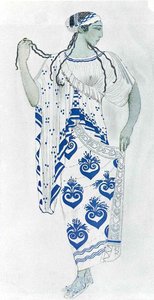
Drawing young divinity Narcisse costume, ballet Diaghilev (1911) авторства Леон Бакст

Drawing young divinity Narcisse costume, ballet Diaghilev

1911 · Watercolor

The scene unfolds through Drawing young divinity Narcisse costume, ballet Diaghilev, a vision conceived by the artist Léon Bakst. This work captures a specific moment of theatrical creation from 1911. It exists as a design for the set of the ballet Narcisse, a production that first met its audience at the Théâtre de Monte Carlo in 1911. The atmosphere of the stage is shaped by the creative energy of the…

6
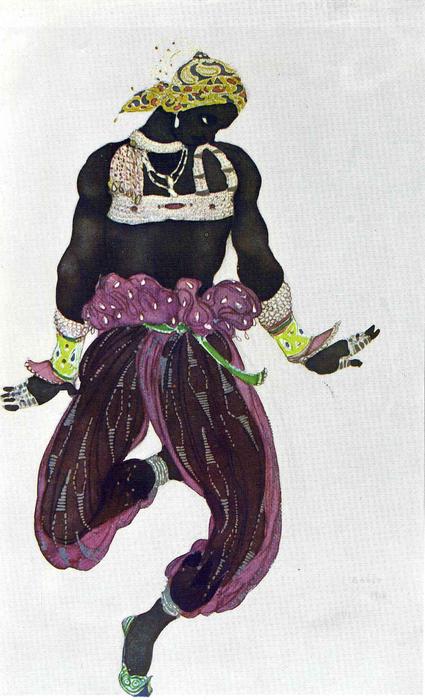
Scheherazade negre argent (1910) авторства Леон Бакст

Scheherazade negre argent

1910 · Watercolor

A solitary male figure commands the space, frozen in a moment of theatrical tension. He leans into a stylized pose, his body elongated to emphasize a sense of rhythmic movement that seems to pulse even in stillness. The silhouette is defined by sharp, geometric lines—the triangular peak of a headpiece and the rectangular weight of his garments—which create a striking contrast against the dark, somber atmosphere. Every muscle and fold…

7
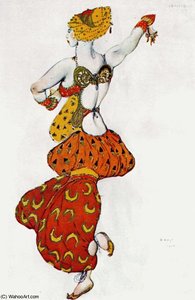
Scheherezade odalisque (1910) авторства Леон Бакст

Scheherezade odalisque

1910 · Watercolor

The artwork titled Scheherezade odalisque was created by the artist Léon Bakst. This specific piece is a watercolor illustration produced in 1910. The work originates from a period when the artist was actively involved in the visual development of the Ballets Russes, contributing to the aesthetic language of theatrical productions such as Scheherazade.

8
The Butterfly (Costume Design for Anna Pavlova) (1913) авторства Леон Бакст

The Butterfly (Costume Design for Anna Pavlova)

1913 · Gouache · Музей образотв мистецтв, Бостон

The Butterfly (Costume Design for Anna Pavlova) is a dynamic costume design illustration created in 1913. The composition features a central female figure captured in a mid-stride or dancing pose. She is surrounded by expansive, swirling fabric elements that suggest the wings of a butterfly. The color palette is dominated by primary colors, specifically bright yellow and deep cobalt blue, accented with orange and white.

9
Portrait of Miss Paoloff (1916) авторства Леон Бакст

Portrait of Miss Paoloff

1916 · Oil

The Portrait of Miss Paoloff by Léon Bakst captures a fleeting moment of grace. In this work, the ballerina Miss Paoloff appears mid-movement, her body caught in a dynamic pose that suggests the energy of a live performance. She wears her performance attire, a tutu that seems to catch the light as she moves through the space. The scene feels suspended in time, as if the dancer has just pivoted…

10
Portrait of the Marchesa Casati (1912) авторства Леон Бакст

Portrait of the Marchesa Casati

1912 · Charcoal

This work, titled Portrait of the Marchesa Casati, is a striking study by the artist Léon Bakst. Created about 1912, the portrait captures the likeness of the Marchesa Casati in a moment of quiet contemplation. It is a piece that reflects the artist's ability to translate a specific presence onto paper through a focused, intimate lens.

Вибірка Леон Бакст триває, від 11 до 100

11Portrait of the Marchesa Casati (1912) авторства Леон БакстPortrait of the Marchesa Casati1912 12fantasy on modern costume (atalanta) (1912) авторства Леон Бакстfantasy on modern costume (atalanta)1912 13The sleeping beauty eastern prince and his page (1916) авторства Леон БакстThe sleeping beauty eastern prince and his page1916 14Portrait of a Lady (1917) авторства Леон БакстPortrait of a Lady1917 15Mme Ida Rubinstein (1917) авторства Леон БакстMme Ida Rubinstein1917 · Метрополітен-музей 16Samarkand Sultan (1922) авторства Леон БакстSamarkand Sultan1922 17russian peasant woman (1922) авторства Леон Бакстrussian peasant woman1922 18Dmitry Filosof portrait (1897) авторства Леон БакстDmitry Filosof portrait1897 19Art open letter of Red Cross (1904) авторства Леон БакстArt open letter of Red Cross1904 20supper (1902) авторства Леон Бакстsupper1902 21cleopatre danse juive (1910) авторства Леон Бакстcleopatre danse juive1910 22helene de sparte ida rubinstein in act iv (1912) авторства Леон Бакстhelene de sparte ida rubinstein in act iv1912 23The Supper (1902) авторства Леон БакстThe Supper1902 24Big Philanthropic Puppet Bazaar, St. Petersburg (1899) авторства Леон БакстBig Philanthropic Puppet Bazaar, St. Petersburg1899 25Medee (Jean Anouilh) авторства Леон БакстMedee (Jean Anouilh) 26Leonid Massine авторства Леон БакстLeonid Massine 27Portrait of Jean Cocteau авторства Леон БакстPortrait of Jean Cocteau 28Ida Rubinstein авторства Леон БакстIda Rubinstein 29untitled (4764) авторства Леон Бакстuntitled (4764) 30untitled (1211) авторства Леон Бакстuntitled (1211) 31untitled (1495) авторства Леон Бакстuntitled (1495) 32Costume Design For 'la Fée De Richesse' авторства Леон БакстCostume Design For 'la Fée De Richesse' 33St. Sebastian, from ''The Martyr of St. Sebastian'' авторства Леон БакстSt. Sebastian, from ''The Martyr of St. Sebastian'' 34helene de sparte costume for ida rubinstein as helene авторства Леон Бакстhelene de sparte costume for ida rubinstein as helene 35Ballet Music - Introduction (Humphrey Searle) авторства Леон БакстBallet Music - Introduction (Humphrey Searle) 36untitled (4724) авторства Леон Бакстuntitled (4724) 37untitled (9134) авторства Леон Бакстuntitled (9134) 38Costume for Nijinsky (1910) авторства Леон БакстCostume for Nijinsky1910 39scheherezade odalisque (1910) авторства Леон Бакстscheherezade odalisque1910 40le dieu bleu a young rajah (1911) авторства Леон Бакстle dieu bleu a young rajah1911 41narcisse the nymph echo (1911) авторства Леон Бакстnarcisse the nymph echo1911 42Le dieu bleu a young rajah (1911) авторства Леон БакстLe dieu bleu a young rajah1911 43fantasie sur le costume moderne (1910) авторства Леон Бакстfantasie sur le costume moderne1910 44Vase (self-portrait) (1906) авторства Леон БакстVase (self-portrait)1906 45Scheherezade odalisque (1910) авторства Леон БакстScheherezade odalisque1910 46Narcisse a youth (1911) авторства Леон БакстNarcisse a youth1911 47Le dieu bleu Nijinsky in title role (1911) авторства Леон БакстLe dieu bleu Nijinsky in title role1911 48loiseau de feu costume pour tamara karsavina (1910) авторства Леон Бакстloiseau de feu costume pour tamara karsavina1910 49Fantasy on modern costume (1910) авторства Леон БакстFantasy on modern costume1910 50scheherazade negre argent (1910) авторства Леон Бакстscheherazade negre argent1910 51The Firebird, the tsarevna (1910) авторства Леон БакстThe Firebird, the tsarevna1910 52loiseau de feu the firebird (1910) авторства Леон Бакстloiseau de feu the firebird1910 53Narcisse -Boeotian (1911) авторства Леон БакстNarcisse -Boeotian1911 54Portrait of Russian painter Filipp Andreevich Maljawin авторства Леон БакстPortrait of Russian painter Filipp Andreevich Maljawin 55scheherezade scenery (1910) авторства Леон Бакстscheherezade scenery1910 56le martyre de saint sebastien ida rubinstein as st sebastian (1911) авторства Леон Бакстle martyre de saint sebastien ida rubinstein as st sebastian1911 57Costume Design for 'Scheherazade' (1910) авторства Леон БакстCostume Design for 'Scheherazade'1910 58The Firebird, costume for Tamara Karsavina (1910) авторства Леон БакстThe Firebird, costume for Tamara Karsavina1910 59scheherazade la sultane bleue (1910) авторства Леон Бакстscheherazade la sultane bleue1910 60narcisse a youth (1911) авторства Леон Бакстnarcisse a youth1911 61Sketch for the ballet 'La Peri', by Paul Dukas (1911) авторства Леон БакстSketch for the ballet 'La Peri', by Paul Dukas1911 62Scheherazade shah shahriar (1910) авторства Леон БакстScheherazade shah shahriar1910 63cleopatre greek dancer (1910) авторства Леон Бакстcleopatre greek dancer1910 64Front cover of Comoedia (1909) авторства Леон БакстFront cover of Comoedia1909 65loiseau de feu michel fokine as tsarevitch (1910) авторства Леон Бакстloiseau de feu michel fokine as tsarevitch1910 66Scheherazade la sultane bleue (1910) авторства Леон БакстScheherazade la sultane bleue1910 67cleopatre syrian dance (1909) авторства Леон Бакстcleopatre syrian dance1909 68narcisse a nymph (1911) авторства Леон Бакстnarcisse a nymph1911 69Le martyre de Saint Sebastien act I set design (1911) авторства Леон БакстLe martyre de Saint Sebastien act I set design1911 70Le martyre de Saint Sebastien act IV set design (1911) авторства Леон БакстLe martyre de Saint Sebastien act IV set design1911 71The carnival Chiarina (1910) авторства Леон БакстThe carnival Chiarina1910 72narcisse bacchante (1911) авторства Леон Бакстnarcisse bacchante1911 73la peri natasha trouhanova as the peri (1911) авторства Леон Бакстla peri natasha trouhanova as the peri1911 74In the artist's studio (1908) авторства Леон БакстIn the artist's studio1908 75la peri iksander (1911) авторства Леон Бакстla peri iksander1911 76The .arnival - Estrella (1910) авторства Леон БакстThe .arnival - Estrella1910 77Cleopatre danse juive (1910) авторства Леон БакстCleopatre danse juive1910 78le dieu bleu nijinsky in title role (1911) авторства Леон Бакстle dieu bleu nijinsky in title role1911 79Downpour (1906) авторства Леон БакстDownpour1906 80Scheherazade the chief eunuch (1910) авторства Леон БакстScheherazade the chief eunuch1910 81Costume design for a bacchante in 'Narcisse' by Tcherepnin (1911) авторства Леон БакстCostume design for a bacchante in 'Narcisse' by Tcherepnin1911 82le dieu bleu the bride (1912) авторства Леон Бакстle dieu bleu the bride1912 83Nijinsky's Faun Costume in 'L'Apres Midi d'un Faune' by Claude Debussy from the front cover of the programme for the 7th season of the 'Ballets Russes' (1912) авторства Леон БакстNijinsky's Faun Costume in 'L'Apres Midi d'un Faune' by Claude Debussy from the front cover of the programme for the 7th season of the 'Ballets Russes'1912 84Design for a lady's dress (1912) авторства Леон БакстDesign for a lady's dress1912 85sadko one of the chorus (1917) авторства Леон Бакстsadko one of the chorus1917 86L'apres midi d'un faune, another nymph (1912) авторства Леон БакстL'apres midi d'un faune, another nymph1912 87lapres midi dun faune another nymph (1912) авторства Леон Бакстlapres midi dun faune another nymph1912 88le dieu bleu a pilgrim (1912) авторства Леон Бакстle dieu bleu a pilgrim1912 89le dieu bleu bayadere (1912) авторства Леон Бакстle dieu bleu bayadere1912 90lapres midi dun faune nijinsky as the faun (1912) авторства Леон Бакстlapres midi dun faune nijinsky as the faun1912 91Le dieu bleu bayadere with peacock (1912) авторства Леон БакстLe dieu bleu bayadere with peacock1912 92Daphnis and Chloe scenery for act II (1912) авторства Леон БакстDaphnis and Chloe scenery for act II1912 93daphnis et chloe set design act ii (1912) авторства Леон Бакстdaphnis et chloe set design act ii1912 94Les femmes de bonne humeur - set design (1917) авторства Леон БакстLes femmes de bonne humeur - set design1917 95sadko the green monster (1917) авторства Леон Бакстsadko the green monster1917 96le dieu bleu setting (1912) авторства Леон Бакстle dieu bleu setting1912 97loiseau de feu costume (1913) авторства Леон Бакстloiseau de feu costume1913 98helene de sparte act ii set design (1912) авторства Леон Бакстhelene de sparte act ii set design1912 99La legende de Joseph Potiphar (1914) авторства Леон БакстLa legende de Joseph Potiphar1914 100daphnis et chloe costume (1912) авторства Леон Бакстdaphnis et chloe costume1912

Знамениті картини Леон Бакст за періодами творчості

Early Modernism

1908 – 1922 · 3 робіт у цьому списку

Теми, що привертали увагу Леон Бакст

Чотири сюжети, які найчастіше зустрічаються в цих оригіналах, кожен із найкращим прикладом.

Музеї, у яких зберігаються оригінали Леон Бакст

3 музеїв, у яких зберігається більшість картин із цього списку.

Музей Місто Твори Леон Бакст Картини зі цього списку
The Baltimore Museum of Art, БалтіморThe Baltimore Museum of Art Балтімор 1 Дизайн с цветами в сетке
Музей образотв мистецтв, БостонМузей образотв мистецтв Бостон 1 The Butterfly (Costume Design for Anna Pavlova)
Метрополітен-музей, Нью-ЙоркМетрополітен-музей Нью-Йорк 1 Mme Ida Rubinstein

Леон Бакст десятиліття за десятиліттям: оригінали, що визначають кожне з них

Роботи за десятиліттями

Оберіть десятиліття, щоб побачити оригінальний твір, який його визначає.

Запитання колекціонерів про картини Леон Бакст

Яка робота Леон Бакст є найвідомішою?Дізнатися відповідь

Дизайн с цветами в сетке, The Baltimore Museum of Art, Балтімор. Далі йдуть Costume design for the ballet ''Cleopatra'' (1909) та Operatic costume designs (1911).

Які десять найвідоміших картин Леон Бакст?Дізнатися відповідь

Дизайн с цветами в сетке, Costume design for the ballet ''Cleopatra'', Operatic costume designs, Drawing young divinity Narcisse costume, ballet Diaghilev, Portrait of Boris Nikolayevich Bugaev (Andrey Bely), Scheherazade negre argent, Scheherezade odalisque, The Butterfly (Costume Design for Anna Pavlova), Portrait of Miss Paoloff та Portrait of the Marchesa Casati. У рейтингу вище вказано рік створення та музей для кожної картини.

Скільки картин залишив Леон Бакст?Дізнатися відповідь

Наш каталог містить 154 робіт Леон Бакст, датованих періодом з 1897 по 1922.

У яких музеях виставляються шедеври Леон Бакст?Дізнатися відповідь

Переважно в The Baltimore Museum of Art (Балтімор), Музей образотв мистецтв (Бостон) та Метрополітен-музей (Нью-Йорк). У таблиці музеїв вище наведено їхній повний перелік.

У які роки Леон Бакст створив свої найвідоміші роботи?Дізнатися відповідь

У 1910s: 71 із 100 робіт на цій сторінці були створені тоді, серед них Operatic costume designs.

Які перша та остання відомі оригінальні роботи Леон Бакст?Дізнатися відповідь

На цій сторінці найдавніша робота датована Dmitry Filosof portrait (1897), а найновіша — Samarkand Sultan (1922).

Які сюжети Леон Бакст обирав найчастіше?Дізнатися відповідь

Designs and sketches (28), Clothing (26) та Woman (9), у 100 роботах на цій сторінці.

Яку техніку найчастіше використовував(ла) Леон Бакст?Дізнатися відповідь

Watercolor, для 5 із 100 робіт на цій сторінці.

До якого художнього напряму належить Леон Бакст?Дізнатися відповідь

Art nouveau, судячи з оригіналів на цій сторінці.

Леон Бакст: життя та творчість

Early Life and the Seeds of Artistic Rebellion

Léon Bakst, whose true name was Leyb-Khaim Izrailevich Rosenberg, emerged from the heart of Grodno—a city nestled within the Russian Empire’s borders today Belarus—in 1866. His early years were shaped by a confluence of factors: his family's modest but respectable standing within society, their connection to the imperial court through his grandfather’s distinguished tailoring career, and the constraints imposed upon Jewish communities in that era. This complex backdrop instilled in young Leyb a keen awareness of both cultural nuances and the challenges faced by those living on the margins of Russian society. From a remarkably early age—at just twelve years old—Bakst demonstrated an undeniable talent for drawing, winning a local contest that ignited his passion for visual arts. However, this burgeoning artistic inclination initially encountered resistance from his parents, who viewed it as an unconventional and potentially unstable path. Despite their reservations, Bakst persevered, driven by an unwavering determination to pursue his creative aspirations. He began studying at the prestigious St. Petersburg Academy of Arts as a non-credit student—a pragmatic approach that allowed him to continue supplementing his education while simultaneously earning a living through illustration work for magazines and children’s books. This practical necessity not only honed his artistic skills but also provided him with crucial financial independence, enabling him to dedicate himself more fully to his art. A pivotal moment in his early life occurred in 1889 when he adopted the surname “Bakst”—a deliberate choice that reflected both a desire for greater career opportunities and a recognition of the potential prejudice he might face due to his Jewish heritage. It was a strategic decision, born from an understanding of the social realities of the time.

The World of Art and Embracing Modernity

Bakst’s artistic development truly blossomed within the vibrant circle of the “World of Art” movement—a collective of artists, critics, and intellectuals who sought to revitalize Russian culture by embracing a diverse range of influences. He quickly became an integral figure within this group, collaborating closely with luminaries such as Sergei Diaghilev and Alexandre Benois, contributing significantly to the movement’s eponymous periodical through his striking graphics and innovative designs. This association brought him widespread recognition and firmly established him as a rising star within Russia's artistic circles—a space where traditional academic styles were being challenged by new ideas and approaches. The “World of Art” was characterized by its eclectic mix of influences, drawing inspiration from Japanese art, Symbolism, Orientalism, and the burgeoning trends of European Modernism. Bakst’s early works reflected this multifaceted aesthetic, showcasing his ability to seamlessly blend Russian artistic traditions with these diverse sources. Portraits he created during this period—of figures such as Filipp Malyavin, Vasily Rozanov, Andrei Bely, and Zinaid Gippius—were not merely representations of physical likeness; they were imbued with a profound understanding of the subjects’ intellectual and emotional lives. Bakst's style was marked by a bold use of color, stylized forms, and a willingness to experiment with new techniques—a testament to his forward-thinking approach and his desire to push the boundaries of artistic expression. He wasn’t simply copying what he saw; he was actively shaping it, imbuing it with his own unique vision.

Revolutionizing Ballet with the Ballets Russes

The defining moment in Bakst's career arrived in 1908 when he began collaborating with Sergei Diaghilev’s newly formed Ballets Russes—a revolutionary company that would forever transform the landscape of theatrical design and dance. This partnership proved to be a watershed moment, propelling both artists to international fame and establishing Bakst as one of the most influential figures in the history of stagecraft. The Ballets Russes was not merely a ballet company; it was a Gesamtkunstwerk—a total work of art—that sought to integrate music, dance, visual arts, and costume design into a cohesive and immersive experience for the audience. Bakst’s designs were groundbreaking, moving far beyond traditional theatrical conventions and embracing a radically new aesthetic language. He rejected realistic depictions in favor of stylized forms, vibrant colors, and a sense of opulent fantasy—creating worlds that captivated audiences and elevated the emotional impact of the choreography and music. Productions such as *Cleopatra*, *Scheherazade* (1910), *Carnaval* (1910), *Narcisse* (1911), and particularly *L'Après-midi d’un Faune* (1912) became legendary for their visual splendor, establishing a new standard for theatrical design. Bakst didn’t just create backdrops; he constructed entire universes that transported the audience to another realm. He skillfully blended elements of Orientalism with Western artistic traditions, creating costumes and sets that were both exotic and strikingly modern.

Legacy and Enduring Influence

Léon Bakst's legacy extends far beyond his contributions to ballet and theatrical design. He is rightfully considered one of the most important figures in the history of visual culture—a pioneer who profoundly influenced generations of artists, designers, and fashion creators. His designs for the Ballets Russes not only revolutionized stagecraft but also had a significant impact on the development of Art Deco aesthetics—a style characterized by its streamlined forms, rich colors, and exotic motifs. Bakst’s work demonstrated a remarkable ability to synthesize diverse influences—from Russian folk art to Japanese woodblock prints to European Modernism—creating a unique and instantly recognizable visual language. Despite facing some criticism during his lifetime for perceived extravagance, Bakst's artistic vision was widely celebrated, and his funeral in 1924 was attended by a remarkable gathering of prominent artists, poets, musicians, dancers, and critics—a poignant testament to the esteem in which he was held. Today, his artwork continues to inspire through reproductions available on platforms like OriginalUniqueArt.com, ensuring that his innovative spirit and artistic legacy endure for audiences around the globe. Bakst’s ability to transcend stylistic boundaries, embrace experimentation, and create visually stunning worlds cemented his place as a true visionary of the 20th century—a master who forever changed the way we experience art and design.