Портрет Генрих Зилле

Картини Генрих Зилле: 53 найвідоміших у погляді галереї

Оновлено Листопад 2026 · за рейтингом нашої популярності (кількість пошукових запитів, переглядів та замовлень для кожної роботи) · 53 робіт Генрих Зилле у нашому каталозі

Коротко кажучи

На думку експертів галереї, найвідоміший витвір Генрих Зилле — це Restoration (1910). Untitled (AQREDC) (1909) та Untitled (AQRECJ) (1919) доповнюють тріо, яке впізнає кожне око. З 53 робіт Генрих Зилле у нашому каталозі галерея представляє 53 найвідоміших нижче — кожна з них є оригіналом із зазначенням року створення, музею та унікальних особливостей.

1859 – 1933, Кассель Contemporary realism Найбільше робіт: Augustiner Museum

Топ 10 картин художника Генрих Зилле у галереї

1
Restoration (1910) авторства Генрих Зилле

Restoration

1910 · Ink On Paper

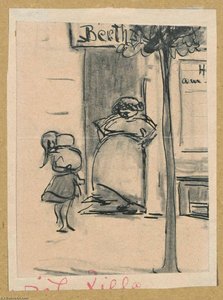
Restoration is a black and white illustration created by Heinrich Hoffmann. The work dates to about 1910 and presents a monochromatic view of an urban environment. The scene focuses on a bustling city street, capturing a specific moment of daily activity within a metropolitan setting. The central subject involves a restaurant that is currently undergoing restoration work, providing a focal point for the surrounding movement.

2
Untitled (AQREDC) (1909) авторства Генрих Зилле

Untitled (AQREDC)

1909 · Etching

Untitled (AQREDC) by Heinrich Hoffmann depicts a bustling scene within a modest, crowded living space. The composition is dynamic and somewhat chaotic, with figures clustered together to fill most of the frame. A central grouping of people is arranged around a table, while other individuals are scattered throughout the room. Some figures are standing, while others are seated or lying down. In the background, a window provides a glimpse of…

3
Untitled (AQRECJ) (1919) авторства Генрих Зилле

Untitled (AQRECJ)

1919 · Drawing

This black and white drawing, dated 1919, depicts a group of at least twelve children positioned in a shared space. The figures are arranged in layers, with several children standing in the immediate foreground while others are situated further back in the composition. These children appear to be engaged in conversation or play. Two teddy bears are placed within the scene: one is located near the center, and the other…

4
Untitled (AQREBC) (1917) авторства Генрих Зилле

Untitled (AQREBC)

1917 · Drawing

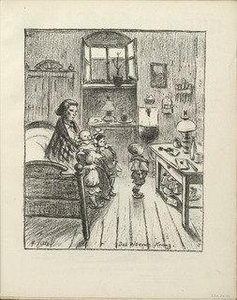
In this black and white drawing, Untitled (AQREBC) by Heinrich Hoffmann presents a quiet, domestic scene from about 1917. The composition centers on a woman seated in a chair, surrounded by her children. She holds a baby in her arms, while the other children settle onto her lap or gather closely around her. There is a palpable sense of intimacy in the way the figures are clustered together, creating a…

5
Untitled (AQREDE) (1884) авторства Генрих Зилле

Untitled (AQREDE)

1884 · Pencil

In this work from 1884, Heinrich Hoffmann invites us into the quiet, lived-in atmosphere of a traditional German tavern or beer hall. The scene captures a specific moment of social interaction and conviviality, focusing on a group of figures gathered around a long table. There is a sense of shared experience here, as patrons engage in conversation and drink within the interior space. It is a glimpse into a communal…

6
Going to Church in the Black Forest (1905) авторства Генрих Зилле

Going to Church in the Black Forest

1905 · Oil On Canvas · Augustiner Museum, Фрайбург

In "Going to Church in the Black Forest" by Heinrich Hoffmann, we find ourselves observing a quiet moment of communal devotion. The scene, painted about 1905, centers on a group of women gathered at the entrance of a rustic stone church. They are dressed in traditional German folk costume, their attire providing a focal point of deep blues, blacks, and intricate patterns. This central gathering is framed by the environment:…

7
Untitled (AQREC6) (1900) авторства Генрих Зилле

Untitled (AQREC6)

1900 · Black and White Photography

Untitled (AQREC6) by Heinrich Hoffmann features a monochrome photographic study of a nude female figure. The composition is centered on the human subject, who is positioned in the foreground within an indoor studio setting. To the left of the central figure, a marble statue of a draped woman is placed, creating a juxtaposition between the living model and the carved stone. The background is composed of dark fabric draped over…

8
Untitled (AQREDJ) (1905) авторства Генрих Зилле

Untitled (AQREDJ)

1905 · Pencil

This 1905 pencil drawing on paper presents a spontaneous, quick sketch of two figures, appearing to be women, within a garden setting. The composition is asymmetrical and dynamic, with the figures positioned diagonally across the frame; one figure is taller than the other, and they seem to be engaged in conversation or a shared activity. The artwork is characterized by a loose, energetic quality, utilizing expressive lines, hatching, and cross-hatching…

9
Untitled (AQRECN) (1903) авторства Генрих Зилле

Untitled (AQRECN)

1903 · Etching

The scene unfolds within the lines of Untitled (AQRECN), an etching created by Heinrich Hoffmann. This work captures a specific, unvarnished moment from 1903, freezing a wrestling match in a state of constant motion. The figures strain against one another, caught in a struggle that feels immediate and raw. Onlookers gather around, their presence adding a layer of communal energy to the central conflict.

10
Untitled (AQREBN) (1905) авторства Генрих Зилле

Untitled (AQREBN)

1905 · Woodcut

This monochrome woodcut print, created in 1905, presents a densely packed and realistic portrayal of a crowded marketplace. The scene is set within an indoor environment, appearing to be a covered bazaar or market, where a multitude of figures are engaged in various activities such as buying, selling, and observing. The composition is tightly structured, utilizing strong, directional lines to define both the individual forms of the people and the…

Картини художника Генрих Зилле, від 11 до 53 місця в рейтингу

11Untitled (AQRECC) (1900) авторства Генрих ЗиллеUntitled (AQRECC)1900 12Untitled (AQRECL) (1910) авторства Генрих ЗиллеUntitled (AQRECL)1910 13Untitled (AQRECY) (1910) авторства Генрих ЗиллеUntitled (AQRECY)1910 14Untitled (AQRECE) (1910) авторства Генрих ЗиллеUntitled (AQRECE)1910 15The Iron Cross (Das eiserne Kreuz) (plate, folio 17) from the periodical Der Bildermann, vol. 1, no. 8 (June 1916) (1916) авторства Генрих ЗиллеThe Iron Cross (Das eiserne Kreuz) (plate, folio 17) from the periodical Der Bildermann, vol. 1, no. 8 (June 1916)1916 16Standing in Line for Potatoes (Kartoffelstehen) (plate, folio 25) from the periodical Der Bildermann, vol. 1, no. 12 (September 1916) (1916) авторства Генрих ЗиллеStanding in Line for Potatoes (Kartoffelstehen) (plate, folio 25) from the periodical Der Bildermann, vol. 1, no. 12 (September 1916)1916 17Untitled (AQREBW) (1919) авторства Генрих ЗиллеUntitled (AQREBW)1919 18Untitled (AQRECA) (1919) авторства Генрих ЗиллеUntitled (AQRECA)1919 19Untitled (AQREBE) (1930) авторства Генрих ЗиллеUntitled (AQREBE)1930 20Untitled (AQREB6) (1898) авторства Генрих ЗиллеUntitled (AQREB6)1898 21Untitled (AQREBL) (1905) авторства Генрих ЗиллеUntitled (AQREBL)1905 22Untitled (AQRECU) (1902) авторства Генрих ЗиллеUntitled (AQRECU)1902 23Untitled (AQRED4) (1903) авторства Генрих ЗиллеUntitled (AQRED4)1903 24Untitled (AQREC4) (1901) авторства Генрих ЗиллеUntitled (AQREC4)1901 25Spinning Room in the Black Forest авторства Генрих ЗиллеSpinning Room in the Black ForestAugustiner Museum 26Untitled (AQREAU) (1910) авторства Генрих ЗиллеUntitled (AQREAU)1910 27Untitled (AQREC2) (1909) авторства Генрих ЗиллеUntitled (AQREC2)1909 28Untitled (AQREB2) (1910) авторства Генрих ЗиллеUntitled (AQREB2)1910 29Untitled (AQRECS) (1911) авторства Генрих ЗиллеUntitled (AQRECS)1911 30Untitled (AQREC8) (1910) авторства Генрих ЗиллеUntitled (AQREC8)1910 31Untitled (AQREAS) (1910) авторства Генрих ЗиллеUntitled (AQREAS)1910 32Untitled (AQRED2) (1916) авторства Генрих ЗиллеUntitled (AQRED2)1916 33Untitled (AQRED6) (1913) авторства Генрих ЗиллеUntitled (AQRED6)1913 34Untitled (AQREBA) (1914) авторства Генрих ЗиллеUntitled (AQREBA)1914 35Untitled (AQRECW) (1916) авторства Генрих ЗиллеUntitled (AQRECW)1916 36Untitled (AQREBJ) (1915) авторства Генрих ЗиллеUntitled (AQREBJ)1915 37Untitled (AQREB4) (1915) авторства Генрих ЗиллеUntitled (AQREB4)1915 38On Vacation (Auf Urlaub) (front cover, folio 26) from the periodical Der Bildermann, vol. 1, no. 13 (October 1916) (1916) авторства Генрих ЗиллеOn Vacation (Auf Urlaub) (front cover, folio 26) from the periodical Der Bildermann, vol. 1, no. 13 (October 1916)1916 39Schnapps Saloon (Schnapsdestille) (plate, folio 33) from the periodical Der Bildermann, vol. 1, no. 16 (November 1916) (1916) авторства Генрих ЗиллеSchnapps Saloon (Schnapsdestille) (plate, folio 33) from the periodical Der Bildermann, vol. 1, no. 16 (November 1916)1916 40Study with Singing Children (Studienblatt mit singenden Kindern) (plate, folio 11) from the periodical Der Bildermann, vol. 1, no. 5 (June 1916) (1916) авторства Генрих ЗиллеStudy with Singing Children (Studienblatt mit singenden Kindern) (plate, folio 11) from the periodical Der Bildermann, vol. 1, no. 5 (June 1916)1916 41Untitled (AQREBU) (1919) авторства Генрих ЗиллеUntitled (AQREBU)1919 42Untitled (AQREBQ) (1919) авторства Генрих ЗиллеUntitled (AQREBQ)1919 43Untitled (AQRECG) (1919) авторства Генрих ЗиллеUntitled (AQRECG)1919 44Untitled (AQREAW) (1919) авторства Генрих ЗиллеUntitled (AQREAW)1919 45Untitled (AQREDA) (1919) авторства Генрих ЗиллеUntitled (AQREDA)1919 46Untitled (AQRED8) (1919) авторства Генрих ЗиллеUntitled (AQRED8)1919 47Untitled (AQRECQ) (1920) авторства Генрих ЗиллеUntitled (AQRECQ)1920 48Untitled (AQREB8) (1919) авторства Генрих ЗиллеUntitled (AQREB8)1919 49Untitled (AQREAY) (1924) авторства Генрих ЗиллеUntitled (AQREAY)1924 50Untitled (AQREAQ) (1960) авторства Генрих ЗиллеUntitled (AQREAQ)1960 51Alte Frau mit Hundefuhrwerk (1910) авторства Генрих ЗиллеAlte Frau mit Hundefuhrwerk1910 52Untitled (AQREBY) авторства Генрих ЗиллеUntitled (AQREBY) 53Untitled (AQREDG) авторства Генрих ЗиллеUntitled (AQREDG)

Теми, що привертали увагу Генрих Зилле

Чотири сюжети, які найчастіше зустрічаються в цих оригіналах, кожен із найкращим прикладом.

Музеї, у яких зберігаються оригінали Генрих Зилле

1 музеїв, у яких зберігається більшість картин на цій сторінці.

Музей Місто Твори Генрих Зилле Картини зі цього списку
Augustiner Museum, ФрайбургAugustiner Museum Фрайбург 2 Going to Church in the Black Forest, Spinning Room in the Black Forest

Генрих Зилле, одна фірмова картина за десятиліття

Роботи за десятиліттями

Оберіть десятиліття, щоб побачити оригінальний твір, який його визначає.

Картини Генрих Зилле: відповіді галереї

Яка картина Генрих Зилле є найвідомішою серед усіх?Дізнатися відповідь

Restoration (1910). Далі йдуть Untitled (AQREDC) (1909) та Untitled (AQRECJ) (1919).

Скільки років було Генрих Зилле, коли він/вона завершив/завершила Restoration?Дізнатися відповідь

51 років: Restoration датована 1910 роком, а Генрих Зилле народився(-лася) у 1859.

Які 10 найкращих картин Генрих Зилле?Дізнатися відповідь

Restoration, Untitled (AQREDC), Untitled (AQRECJ), Untitled (AQREBC), Untitled (AQREDE), Going to Church in the Black Forest, Untitled (AQREC6), Untitled (AQREDJ), Untitled (AQRECN) та Untitled (AQREBN). У рейтингу вище вказано рік створення та музей для кожної картини.

Скільки творів створив Генрих Зилле?Дізнатися відповідь

Наш каталог містить 53 робіт Генрих Зилле, датованих періодом з 1884 по 1930.

Де висять найвідоміші оригінали робіт Генрих Зилле?Дізнатися відповідь

Переважно в Augustiner Museum (Фрайбург). У таблиці музеїв вище наведено їхній повний перелік.

Коли Генрих Зилле створив свої найвідоміші картини?Дізнатися відповідь

У 1910s: 32 із 53 робіт на цій сторінці були створені тоді, серед них Restoration.

Які найранніші та найпізніші відомі роботи Генрих Зилле?Дізнатися відповідь

На цій сторінці найдавніша робота датована Untitled (AQREDE) (1884), а найновіша — Untitled (AQREBE) (1930).

До яких сюжетів Генрих Зилле звертався найчастіше?Дізнатися відповідь

People (7), Social commentary (6) та Figures (5), у 53 роботах на цій сторінці.

У якій техніці найчастіше працював Генрих Зилле?Дізнатися відповідь

Ink On Paper, для 3 із 53 робіт на цій сторінці.

З яким напрямом пов'язаний Генрих Зилле?Дізнатися відповідь

Contemporary realism, судячи з оригіналів на цій сторінці.

Які оригінальні роботи Генрих Зилле зберігаються в Augustiner Museum?Дізнатися відповідь

Going to Church in the Black Forest та Spinning Room in the Black Forest: Augustiner Museum, Фрайбург зберігає 2 робіт із цієї сторінки.

Генрих Зилле: художник

Heinrich Zille (1858–1929): A Chronicler of Berlin’s Soul

Rudolf Heinrich Zille, affectionately known as “Pinselheinrich” – Brush Heinrich – to the people of Berlin, wasn't merely an artist; he was a visual historian, a compassionate observer, and a satirical chronicler of a city undergoing seismic change. Born in 1858 in Radeburg, Germany, Zille’s life mirrored the burgeoning industrialization and social upheaval that defined late 19th and early 20th-century Berlin. His family's relocation to the capital in 1867 proved pivotal, immersing him in a world of stark contrasts – opulent growth alongside grinding poverty. This duality would become the defining characteristic of his artistic vision. Initially apprenticed as a lithographer in 1872, Zille’s early training instilled in him a mastery of line and form that would serve as the foundation for his later work. Though his father envisioned a more conventional trade – perhaps butchery – young Heinrich's passion for draughtsmanship was undeniable, nurtured by an encouraging teacher who recognized his burgeoning talent. This dedication to art, however, wasn’t immediate; it evolved from necessity after losing his job in 1910, with the encouragement of Max Liebermann, allowing him to fully embrace his artistic calling.

Early Life and Artistic Beginnings

Heinrich Rudolf Zille was born on January 10th, 1858, in Radeburg near Dresden. His family’s economic circumstances were challenging from the outset; Johann Traugott Zille, a watchmaker and precision toolmaker, struggled to provide for his household, and Ernestine Louise Zille, née Heinitz, was the daughter of a silver miner from Erbisdorf in the Ore Mountains. These formative experiences instilled in young Heinrich a profound understanding of social disparities and fueled his artistic curiosity. Recognizing his talent early on, he pursued drawing lessons independently, demonstrating an unwavering commitment to honing his craft. His apprenticeship under Theodor Hosemann further solidified his technical skills and exposed him to the broader artistic landscape of Dresden. It was Hosemann who advised Zille to immerse himself in the realities of Berlin – a city brimming with social tensions and cultural contrasts—a suggestion that would profoundly shape his artistic trajectory.

The “Milljöh” and Capturing Everyday Life

Zille’s enduring legacy rests upon his ability to capture the essence of Berlin’s “Milljöh” – a uniquely German term encompassing the everyday life, atmosphere, and social fabric of the city, particularly within its working-class neighborhoods. He didn't romanticize or idealize; instead, he presented an unvarnished portrayal of tenement buildings ("Mietskaserne"), crowded streets, and the lives of those struggling to survive within them. His drawings weren’t simply depictions of poverty; they were empathetic studies of human resilience, humor, and dignity in the face of hardship. Beggars, prostitutes, laborers, and their children populated his world, rendered with meticulous detail and infused with a keen awareness of social dynamics. Zille's artistic vision wasn’t merely about documenting conditions—it was about conveying emotion and capturing the spirit of Berlin’s proletarian milieu. He skillfully employed hatching and cross-hatching techniques to create texture and depth in his monochromatic prints, drawing viewers directly into the gritty realities of urban life. His subjects were often ordinary people – dockworkers, chimney sweeps, street vendors – individuals whose lives intersected with the grand narratives of industrialization and social reform.

Lithography and Artistic Style

Zille’s artistic training as a lithographer proved invaluable in shaping his distinctive style. Mastering the intricacies of stone etching allowed him to achieve remarkable precision and tonal control—skills that would become hallmarks of his oeuvre. He embraced the medium's ability to reproduce images with exceptional clarity and nuance, reflecting his commitment to conveying visual truthfulness. Zille’s artistic output extended beyond lithography; he experimented with pencil sketches and occasional woodcuts, demonstrating versatility and adaptability in his chosen mediums. His drawings were characterized by a remarkable blend of realism and psychological insight—a testament to his ability to portray human character with sensitivity and nuance. He eschewed grand gestures or theatrical poses, favoring understated compositions that captured the quiet dignity of everyday life. This stylistic approach distinguished him from many of his contemporaries and cemented his reputation as one of Berlin’s most perceptive artists.

Recognition and Legacy

Zille gained considerable acclaim during his lifetime through collaborations with prominent publications like *Simplicissimus* and *Jugend*, where his satirical drawings resonated deeply with a readership eager for social critique. These engagements provided him with crucial exposure and propelled him to the forefront of Berlin’s artistic scene. In 1903, he joined the Berlin Secession—a group of artists challenging traditional aesthetic conventions—marking a pivotal moment in his career and aligning him with avant-garde ideals. The Secession fostered intellectual exchange and encouraged experimentation, providing Zille with an environment conducive to pushing boundaries and exploring new artistic horizons. His work was honored by the National Gallery in 1921 – a significant validation of his artistic merit—and he achieved professorship at the Academy of the Arts in 1924, cementing his position as a respected figure within German art history. Zille’s legacy extends beyond his artistic achievements; he remains a beloved cultural icon in Berlin, celebrated for his ability to capture the city's unique character and spirit—a testament to his enduring contribution to visual culture. His art continues to inspire artists and scholars alike, ensuring that Heinrich Zille’s voice—and his unflinching portrayal of Berlin’s soul—will resonate for generations to come.