Портрет Cornelis Lelienbergh

29 найвідоміших картин Cornelis Lelienbergh, кожна з яких є унікальною

Оновлено Листопад 2026 · за рейтингом нашої популярності (кількість пошукових запитів, переглядів та замовлень для кожної роботи) · 31 робіт Cornelis Lelienbergh у нашому каталозі

Коротко кажучи

Still Life with Game Birds (1670) — це картина Cornelis Lelienbergh, яка привертає найбільше уваги; оригінал зберігається в The Holburne Museum, Бас. Після цього погляд переходить на Still life with hare and black rooster (1659) та Dead Game Birds (1653). Серед 31 робіт Cornelis Lelienbergh у нашому каталозі ці 29 є найвідомішими: кожна з них — унікальний оригінал із зазначенням року створення, музею та причини її безсмертя.

1626 – 1676, The Hague Найбільше робіт: Рейксмюзеум

Топ-10 картин Cornelis Lelienbergh крізь призму галереї

1
Still Life with Game Birds (1670) авторства Cornelis Lelienbergh

Still Life with Game Birds

1670 · Oil On Canvas · The Holburne Museum, Бас

Still Life with Game Birds is an oil on canvas work by Cornelis Lelienbergh. Executed in 1670, the painting belongs to the Dutch Golden Age tradition of specialized still life. The artist, Cornelis Lelienbergh, was a prominent figure in the 17th-century Netherlands, known for his meticulous attention to the textures of feathers and organic matter.

2
Still life with hare and black rooster (1659) авторства Cornelis Lelienbergh

Still life with hare and black rooster

1659 · Oil On Canvas · Рейксмюзеум, Амстердам

A vertical arrangement defines this 1659 oil on canvas, where the remnants of a hunt are positioned against a dark, indistinct background. A wooden stick leans diagonally against a rustic table, supporting a dead hare that hangs by its limbs. On the table surface, a dark, deceased rooster lies alongside various vegetables. The lighting originates from a single side source, casting deep shadows and creating a sense of three-dimensional depth…

Знамениті картини Cornelis Lelienbergh, з 11 по 29

Теми, що привертали увагу Cornelis Lelienbergh

Чотири сюжети, які найчастіше зустрічаються в цих оригіналах, кожен із найкращим прикладом.

Музеї, у яких зберігаються оригінали Cornelis Lelienbergh

8 музеїв, у яких зберігається найбільша кількість картин із цього списку.

Музей Місто Твори Cornelis Lelienbergh Картини зі цього списку
Рейксмюзеум, АмстердамРейксмюзеум Амстердам 3 Still life with hare and black rooster, Still Life with Black Rooster and two Rabbits, Cornelis Lelienbergh, 1659, Still Life with Woodpecker and Snipes, Cornelis Lelienbergh, 1655
Баварські державні художні колекції, МюнхенБаварські державні художні колекції Мюнхен 2 Dead Game Birds, Dead Rooster
Національний музей Швеції, СтокгольмНаціональний музей Швеції Стокгольм 2 Still Life with Doves Hanging from an Iron Hook, Still Life with Parrot and Snipes, Cornelis Lelienbergh, 1655
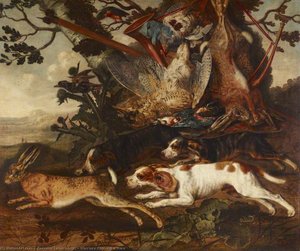
Національна Trust, КембриджНаціональна Trust Кембридж 2 Harriers Chasing a Hare, Spaniels Chasing a Hare
The Holburne Museum, БасThe Holburne Museum Бас 1 Still Life with Game Birds
Музей Бойманса-ван-Бёнінгена, РоттердамМузей Бойманса-ван-Бёнінгена Роттердам 1 Dead Hare and Birds
Gemäldegalerie, БерлінGemäldegalerie Берлін 1 Still life with a brass pail
Національний музей мистецтва, архітектури та дизайну, ОслоНаціональний музей мистецтва, архітектури та дизайну Осло 1 Game

Cornelis Lelienbergh крізь десятиліття: одна унікальна оригінальна робота для кожного

Роботи за десятиліттями

Оберіть десятиліття, щоб побачити оригінальний твір, який його визначає.

Картини Cornelis Lelienbergh: запитання до галереї

Яка найвідоміша робота Cornelis Lelienbergh?Дізнатися відповідь

Still Life with Game Birds (1670), The Holburne Museum, Бас. Далі йдуть Still life with hare and black rooster (1659) та Dead Game Birds (1653).

У якому віці Cornelis Lelienbergh створив(ла) Still Life with Game Birds?Дізнатися відповідь

44 років: Still Life with Game Birds датована 1670 роком, а Cornelis Lelienbergh народився(-лася) у 1626.

Які десять найвідоміших картин Cornelis Lelienbergh?Дізнатися відповідь

Still Life with Game Birds, Still life with hare and black rooster, Dead Game Birds, Dead Rooster, Dead Hare and Birds, Still life with a brass pail, Still Life with Doves Hanging from an Iron Hook, Still Life with Black Rooster and two Rabbits, Cornelis Lelienbergh, 1659, Still Life with Woodpecker and Snipes, Cornelis Lelienbergh, 1655 та Still Life with Parrot and Snipes, Cornelis Lelienbergh, 1655. У рейтингу вище вказано рік створення та музей для кожної картини.

Скільки відомих робіт належить Cornelis Lelienbergh?Дізнатися відповідь

Наш каталог містить 31 робіт Cornelis Lelienbergh, датованих періодом з 1652 по 1670.

Де можна побачити найвідоміші оригінали Cornelis Lelienbergh?Дізнатися відповідь

Переважно в Рейксмюзеум (Амстердам), Баварські державні художні колекції (Мюнхен) та Національний музей Швеції (Стокгольм). У таблиці музеїв вище наведено їхній повний перелік.

У який період Cornelis Lelienbergh створив свої найвідоміші картини?Дізнатися відповідь

У 1650s: 8 із 29 робіт на цій сторінці були створені тоді, серед них Still life with hare and black rooster.

Яка з найвідоміших картин Cornelis Lelienbergh була написана найраніше, а яка — найпізніше?Дізнатися відповідь

На цій сторінці найдавніша робота датована Still life with a brass pail (1652), а найновіша — Still Life with Game Birds (1670).

Яким сюжетам віддавав перевагу Cornelis Lelienbergh?Дізнатися відповідь

Animals (4), Life (3) та Birth and death (3), у 29 роботах на цій сторінці.

Якими матеріалами найчастіше користувався Cornelis Lelienbergh?Дізнатися відповідь

Oil On Canvas, для 2 із 29 робіт на цій сторінці.

Які оригінальні роботи Cornelis Lelienbergh можна побачити в Рейксмюзеум?Дізнатися відповідь

Still life with hare and black rooster, Still Life with Black Rooster and two Rabbits, Cornelis Lelienbergh, 1659 та Still Life with Woodpecker and Snipes, Cornelis Lelienbergh, 1655: Рейксмюзеум, Амстердам зберігає 3 робіт із цієї сторінки.

Cornelis Lelienbergh: портрет художника

A Glimpse into the World of Cornelis van Lelienbergh

Cornelis van Lelienbergh, a name perhaps less immediately recognizable than some of his Dutch Golden Age contemporaries, nevertheless occupies a significant and fascinating niche within the pantheon of 17th-century artists. Born in the Netherlands in 1626, Lelienbergh’s life coincided with a period of unprecedented artistic flourishing, a time when the newly independent Dutch Republic embraced realism, portraiture, and landscape painting with remarkable fervor. While biographical details remain somewhat sparse – a common challenge for artists outside the very highest echelons of fame – his surviving works offer compelling insights into his skill, stylistic development, and the world he inhabited. He died in 1676, leaving behind a legacy that continues to captivate art enthusiasts today.

Early Life and Artistic Training

The specifics of Lelienbergh’s early training are not fully documented, but it is reasonable to assume he began his artistic journey within the established guild system prevalent in Dutch cities. The Netherlands at this time was a hotbed of specialized painting schools and workshops, each with its own distinct approach. It's likely that he apprenticed under a local master, honing fundamental skills in drawing, composition, and color mixing before specializing in portraiture and landscape—the genres for which he would become known. The influence of Flemish painters is strongly apparent in his work, suggesting potential exposure to their techniques either through direct study or the circulation of paintings within the robust art market of the Low Countries. This connection to Flanders is particularly notable in his handling of light and texture, as well as a certain psychological depth present in his portraits.

A Master of Portraiture and Landscape

Lelienbergh’s artistic output primarily centered around two key areas: portraiture and landscape painting. His portraits are not grand statements of power or status, but rather intimate depictions of individuals from the middle classes – merchants, scholars, and members of prosperous families. He possessed a remarkable ability to capture not just physical likeness, but also something of his sitters’ inner character. His landscapes, often featuring serene scenes of Dutch countryside, demonstrate a keen observation of nature combined with a sophisticated understanding of atmospheric perspective. These are not idealized visions; they reflect the actual topography and light conditions of the Netherlands, imbued with a quiet sense of realism. He frequently incorporated figures into his landscapes, adding narrative elements and a human scale to the vastness of the natural world.

Influences and Stylistic Development

The artistic climate of the Dutch Golden Age was one of constant exchange and innovation. Lelienbergh’s work reveals influences from several prominent painters. The aforementioned Flemish tradition, particularly artists like David Teniers the Younger, is evident in his detailed rendering of figures and genre scenes. He also shows an affinity for the works of Pieter de Molyn, a contemporary known for his elegant portraits and refined technique. However, Lelienbergh was not merely an imitator; he synthesized these influences into a distinctive style characterized by its subtle color palette, meticulous brushwork, and psychological sensitivity. Over time, his landscapes became increasingly sophisticated, moving beyond simple topographical representations to explore the emotional impact of light and atmosphere. His ability to balance realism with a poetic sensibility sets him apart.

Legacy and Historical Significance

While Lelienbergh may not be as widely celebrated as Rembrandt or Vermeer, his work offers valuable insights into the lives and values of 17th-century Dutch society. His portraits provide a glimpse into the burgeoning middle class, while his landscapes celebrate the beauty and tranquility of the Netherlands countryside. Today, his paintings are held in prominent museum collections, including the Museum Smidt Van Gelder in Knokke-Heist, Belgium, where they continue to be studied and admired. His contribution lies not in groundbreaking innovation, but in a masterful execution of established genres, imbued with a quiet dignity and psychological depth that resonates with viewers centuries later. The enduring appeal of his work speaks to the timeless power of realistic representation and the human desire to capture moments of beauty and meaning in art.
  • Known for portraits & landscapes
  • Flemish influence is apparent in his handling of light.
  • His paintings are held in prominent museum collections, including Museum Smidt Van Gelder.