A Swedish Master Across Borders: The Life and Art of Carl Frederik von Breda
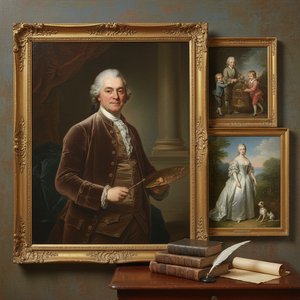
Carl Frederik von Breda, a name often whispered alongside the grandeur of Van Dyck, stands as a pivotal figure in the history of European portraiture. Born in Stockholm in 1759, his artistic journey was not confined by national boundaries but rather blossomed through a remarkable confluence of Swedish tradition and the vibrant innovation of Britain. Descended from Pieter von Breda, a Dutch emigrant who established roots in Sweden around 1670, Carl inherited not only an artistic lineage – his grandfather Lucas was a painter, and his father, Lucas the younger, an art collector and arbitrator – but also a deeply ingrained cosmopolitan sensibility that would profoundly shape his career. This upbringing fostered within him a profound appreciation for aesthetics, laying the groundwork for his subsequent success as one of Sweden’s most celebrated portraitists. From a remarkably young age, Breda demonstrated exceptional talent, enrolling at the Royal Swedish Academy of Arts at nineteen where he diligently studied historical and portrait painting under Lorens Pasch the Younger, absorbing the established techniques and conventions of his homeland. Early recognition swiftly followed; prizes accumulated with impressive frequency, and by 1784, he was already exhibiting nineteen paintings and receiving commissions for prestigious royal portraits – including those of Duchess Hedvig Elisabeth Charlotte, Crown Prince Gustavus Adolphus, and, most notably, King Gustavus III himself. These early works, while firmly rooted in the established Swedish style, subtly hinted at an ambition that stretched far beyond its borders, a yearning to engage with broader artistic currents.London Calling: The Influence of Reynolds and British Portraiture
A transformative moment arrived when Breda faced a difficult choice following his exclusion from a competition at the Academy. Rather than succumbing to the conventional path towards Paris or Rome – destinations often favored by aspiring artists – he made an audacious decision: relocating to London with his family in 1786. This move proved to be nothing short of revolutionary, fundamentally altering the trajectory of his artistic development. In London, Breda sought out and secured tutelage under Sir Joshua Reynolds, a figure widely regarded as the foremost portraitist of his time. While Reynolds’ instruction was not characterized by intensive, formalized lessons, his influence on Breda was profound and immediate. It's often described as a “revolutionary change” in the young artist’s style – a shift towards greater dynamism, boldness, and a more expressive use of light and shadow. Breda quickly established a thriving studio on St James’s Street, attracting a clientele drawn from London’s intellectual and social elite – the "learned men and literati," as they were often referred to. He became highly sought after for his ability not merely to capture likeness but also to imbue his portraits with character, intellect, and an underlying sense of narrative. His London years produced some of his most celebrated works, including portraits of abolitionists Thomas Clarkson and James Ramsay, the ingenious engineers James Watt and Matthew Boulton of the famed Lunar Society, the botanist William Withering, and the captivating Italian opera singer Teresa Vandoni. These weren’t simply commissions; they were engagements with some of the most forward-thinking minds and cultural figures of the era – a testament to Breda's growing influence and artistic vision. A particularly poignant symbol of this transformation was his portrait of Reynolds himself, completed as a diploma piece for admission to the Stockholm Academy of Arts in 1791 – a deliberate acknowledgement of his debt to the British master and a declaration of his own artistic evolution.Return to Sweden and Artistic Maturity
In 1796, Breda made a significant return to Sweden, accepting an invitation from King Gustavus IV Adolf to serve as Professor at the Royal Swedish Academy of Arts. This marked a new chapter in his career – one characterized by artistic maturity, a refined style honed during his years abroad, and a renewed connection with his homeland. Immediately upon his arrival, he was inundated with portrait commissions, swiftly establishing himself as a leading figure within the burgeoning Swedish art scene. His brushwork became noticeably bolder and more spirited, reflecting the energy and dynamism he had absorbed in London. The late 1790s are widely considered to be among his most productive and creatively fulfilling years, producing works that exhibit an early embrace of Romantic sensibilities – a shift towards greater emotional intensity, dramatic lighting, and a heightened sense of individualism. Notable portraits from this period include those of his father Lucas, two of his nephews, the esteemed scholar Nils von Rosenstein, and, perhaps most famously, Teresa Vandoni. The portrait of Vandoni is particularly striking, capturing her dramatic presence and vocal artistry with remarkable sensitivity and nuance – a testament to Breda’s ability to convey not just physical likeness but also the very essence of his subject's personality. These works demonstrate a masterful synthesis of classical training with a distinctly modern sensibility, creating portraits that were both technically accomplished and profoundly emotionally resonant.Legacy and Historical Significance
Carl Frederik von Breda’s impact on Swedish art extended far beyond his own prolific output. His exposure to British artistic trends – particularly the influence of Reynolds – played a crucial role in modernizing portraiture within Sweden, inspiring subsequent generations of artists to embrace new techniques and stylistic approaches. He wasn't simply a painter of faces; he was a visual chronicler of his time, creating a rich and enduring record of some of the leading scientific, intellectual, and cultural figures of the late 18th and early 19th centuries. His portraits of members of the Lunar Society, for example – a group of pioneering scientists, engineers, and philosophers – offer invaluable insights into the intellectual ferment of the era. The artistic legacy continued within his family; his son, Johan Fredrik von Breda, followed in his father’s footsteps, receiving tutelage from him and continuing the family tradition of producing distinguished portraits. While some critics noted a perceived decline in consistency in his later works – a tendency towards a certain stylistic uniformity – Carl Frederik von Breda remained an important figure in Swedish art history until his death in Stockholm in 1818. He is remembered today as “the Van Dyck of Sweden,” a title that encapsulates his exceptional skill, elegance, and enduring contribution to the world of portraiture – a testament to a truly remarkable artist who bridged two continents and left an indelible mark on the art of his time.Key Works & Collections
- James Watt: A compelling portrait of the renowned engineer, held in the National Portrait Gallery, London.
- Matthew Boulton: Another significant work depicting a member of the Lunar Society, residing in Birmingham Museum and Art Gallery.
- Teresa Vandoni: Often considered his most celebrated piece, capturing the essence of the Italian opera singer.
- Portrait of Joshua Reynolds: A testament to Breda’s admiration for his mentor and a key work in establishing his own artistic credentials.
- Mrs. William Hartigan: An example of his skill in capturing the elegance and refinement of society figures.
Питання та відповіді
Які настрої передають роботи Carl Fredrik von Breda?
Сторінка Простір настрою митця Carl Fredrik von Breda дозволяє переглядати його роботи, відсортовані за настроєм.
Чи є повний список творів Carl Fredrik von Breda?
З усіма роботами Carl Fredrik von Breda на цей сайт можна ознайомитися на сторінці Усі роботи митця митця.
Чи можу я переглянути роботи Carl Fredrik von Breda за ключовими словами?
Щоб знайти роботи Carl Fredrik von Breda на певну тему, скористайтеся сторінкою митця За ключовими словами, де твори згруповані за ключовими словами.