A Bridge Between Worlds: The Life and Art of Anne-Louis Girodet
Anne-Louis Girodet de Roussy-Trioson, a name perhaps less instantly recognizable than his teacher Jacques-Louis David, nevertheless occupies a pivotal position in the transition from Neoclassicism to Romanticism. Born in Montargis, France, in 1767, Girodet’s artistic journey was one of both rigorous academic training and burgeoning emotional expression—a delicate balance that defined his unique style and secured his place as a significant figure in French art. His early life was marked by loss; the untimely deaths of both parents left him an orphan, entrusted to the care of his guardian, Benoît-François Trioson – a physician who would later become his adoptive father and whose influence remained constant throughout Girodet’s career. This familial connection ultimately led to the artist adopting “Trioson” as part of his name in 1806, signifying a deep personal bond alongside his artistic identity. Initially drawn to architecture, Girodet soon found himself captivated by painting, entering David's studio and immersing himself in the prevailing Neoclassical aesthetic—an emphasis on clarity, precision, and moral gravitas. This foundation proved crucial, instilling within him a mastery of form and composition that would remain evident even as his work began to diverge from strict classical principles. His triumph at the Prix de Rome with a depiction of the story of Joseph and his brethren at the young age of 22 signaled a promising future, and his subsequent years in Italy (1789-1793) were formative, resulting in acclaimed works like *Hippocrate refusant les presents d'Artaxerxes* and *Endymion-dormant*.Early Career and Neoclassical Foundations
Girodet’s artistic development wasn’t a sudden break from the past, but rather a gradual infusion of new sensibilities into the established framework of Neoclassicism. While he retained the clarity and precision characteristic of David's school—a testament to his rigorous training—his work increasingly embraced emotional intensity and explored themes previously considered unconventional for the genre. He began by meticulously studying classical sculpture and architecture, absorbing the ideals of order, harmony, and proportion that underpinned Neoclassical art. This foundation provided him with a solid technical base, allowing him to execute his compositions with remarkable accuracy and detail. His early works, such as *La Mort de Marat*, demonstrated an impressive command of form and perspective, reflecting David’s influence while hinting at the emotional depth he would later develop. However, it was during his time in Italy that Girodet truly began to forge his own artistic path. He spent several years studying Italian art and culture, absorbing the vibrant colors, dramatic lighting, and expressive gestures of the Venetian masters. This exposure broadened his artistic horizons and encouraged him to experiment with new techniques and approaches.The Influence of Italy and Early Romanticism
His time in Italy proved transformative, resulting in works like *Hippocrate refusant les presents d'Artaxerxes* (1793) and *Endymion-dormant* (1793), both now housed in the Louvre. These paintings showcased a shift towards greater emotionalism and dramatic intensity—qualities that would become hallmarks of the emerging Romantic movement. *Hippocrate refusant les presents d'Artaxerxes*, depicting the Greek physician rejecting bribes from Artaxerxes, is particularly noteworthy for its dynamic composition, carefully rendered details, and subtle portrayal of Hippocrates’ moral integrity. *Endymion-dormant*, a depiction of the mythical shepherd king in his eternal sleep, exemplifies Girodet’s exploration of sensuality and beauty—themes that would become increasingly prominent in his later work. These early Italian paintings demonstrated a willingness to move beyond the purely didactic and allegorical themes favored by Neoclassical artists, embracing instead more intimate and emotionally charged subjects.A Pioneer of Erotic Undertones and Literary Inspirations
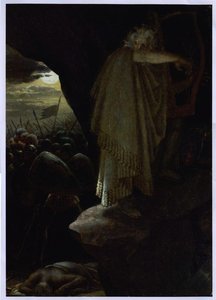
What truly set Girodet apart from many of his contemporaries was his willingness to incorporate elements of eroticism into his paintings—a daring move that challenged artistic norms and paved the way for later artists to explore similar themes with greater freedom. This wasn’t mere sensationalism; rather, it reflected a broader Romantic interest in passion, desire, and the complexities of human experience. His fascination with literature also profoundly influenced his art. He didn't simply illustrate stories; he sought to capture their emotional core, often choosing subjects that allowed for dramatic expression and psychological exploration. The influence of writers like Chateaubriand is particularly noticeable, as seen in portraits and scenes inspired by the author’s works. *Ossian et les généraux français* (1801), a monumental canvas depicting the legendary Scottish warrior Ossian rallying French troops after the Revolution, exemplifies this fusion of literature and art—a unique and evocative composition that captured the spirit of its time. The painting blends imagery drawn from Macpherson’s Ossianic poems with portraits of fallen heroes, creating a powerful visual narrative that explores themes of heroism, sacrifice, and national identity.Later Works and Legacy
In 1806, Girodet was adopted by and took the name of Benoît-François Trioson, who was his tutor and guardian and probably his biological father. Upon inheriting a large fortune (1815), Girodet-Trioson painted little, shuttered himself from daylight, and wrote poetry about painting, adjudged unreadable, and essays on aesthetics. Despite this later period of relative inactivity, Girodet’s earlier works—particularly *Atala au tombeau* (1808) and *La Reddition de Vienne* (1808)—continue to be admired for their dramatic power, psychological insight, and technical brilliance. He remained a respected member of both the Académie de peinture and the Institut de France, receiving honors including the Légion d'honneur—acknowledgements of his artistic merit and societal standing. Anne-Louis Girodet de Roussy-Trioson’s legacy endures as a pivotal figure in the transition from Neoclassicism to Romanticism, demonstrating that innovation often arises from a thoughtful synthesis of tradition and experimentation. His willingness to challenge conventions and explore new artistic territories makes him a compelling figure—a true pioneer who helped shape the course of French painting. Girodet’s works can be found in prestigious museums such as the Musée Girodet in his hometown of Montargis, and the Louvre in Paris, ensuring that his legacy endures for generations to come.Запитання та відповіді
Які роботи Anne-Louis Girodet мають найбільшу кількість переглядів?
Сторінка зі статистикою Статистика для Anne-Louis Girodet містить дані, розраховані на основі творів цього митця, представлених на цей вебсайт.
Чи є можливість відвідати 3D-віртуальний тур роботами Anne-Louis Girodet?
3D Музей Anne-Louis Girodet — це сторінка, на якій роботи митця представлені у віртуальній тривимірній галереї.
Чи можу я переглянути роботи Anne-Louis Girodet за кольоровою палітрою?
Щоб знайти роботи Anne-Louis Girodet у певній палітрі, скористайтеся сторінкою За палітрами художника.