The Genesis of Abstract Expressionism: A Post-War Rejection of Realism
A post-war or postwar period is the interval immediately following the end of a war. The term usually refers to a varying period of time after World War II, which ended in 1945. A post-war period can become an interwar period or interbellum, when a w...
The landscape of American art underwent a seismic shift in the years following World War II, a period marked by profound societal upheaval and a collective questioning of established norms. Where social realism had previously dominated, reflecting the hardships of the Great Depression and a desire for representational clarity, a new aesthetic began to emerge – one that prioritized subjective emotional experience over objective reality. This was Abstract Expressionism, and at its forefront stood Jackson Pollock, a figure whose radical approach would redefine the very act of painting. The war’s aftermath fostered a sense of existential anxiety and a rejection of traditional values, prompting artists to delve inward, seeking new modes of expression that could articulate the complexities of the human condition in a fractured world. The movement wasn't merely a stylistic departure; it was a philosophical one, born from a desire to break free from the constraints of representation and explore the raw power of pure form and color.
Pollock's Revolutionary Technique: Drip Painting and 'Action Painting'
Action painting, sometimes called "gestural abstraction", is a style of painting in which paint is spontaneously dribbled, splashed or smeared onto the canvas, rather than being carefully applied. The resulting work often emphasizes the physical act ...
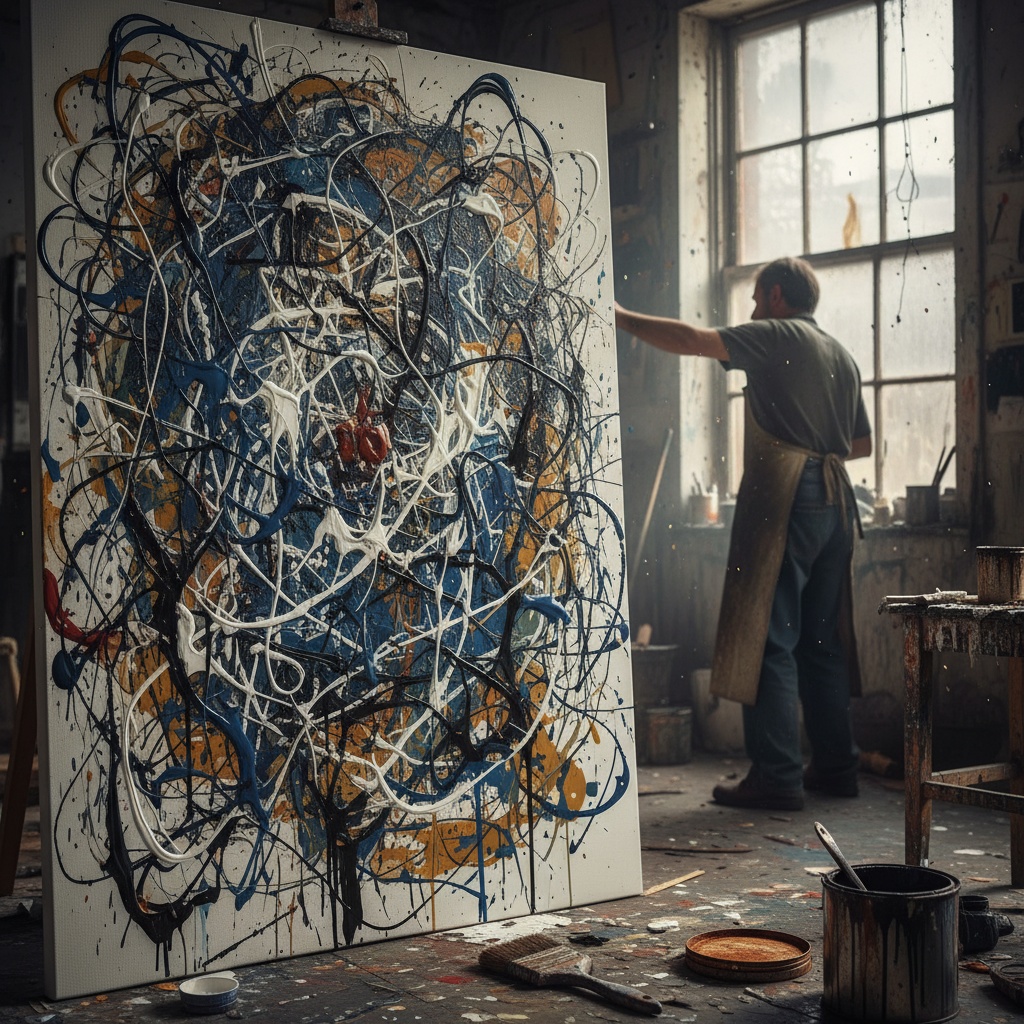
Jackson Pollock didn’t simply paint *on* canvas; he engaged in a dynamic, almost ritualistic performance with it. Rejecting the easel and traditional brushes, he laid his canvases on the floor and employed sticks, knives, even hardened brushes to drip, splash, and pour paint onto the surface. This technique, often referred to as “drip painting,” wasn’t born of haphazard chance but a carefully considered exploration of movement, gesture, and control. Harold Rosenberg famously coined the term “Action Painting” in 1952, recognizing that the process itself – the artist's physical engagement with the materials – was paramount. The canvas became an ‘arena,’ as Rosenberg described it, where Pollock’s inner turmoil and creative energy were directly translated into a visual record. It wasn’t about depicting something *but* about the act of painting *itself*. This emphasis on physicality and spontaneity challenged conventional notions of artistic skill and authorship, elevating the artist's gesture to the level of subject matter.
Key Works & Artistic Evolution: From Figurative Beginnings to All-Over Composition
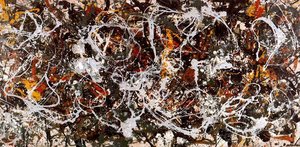 Number 3, 1950
Explore Jackson Pollock’s iconic ‘Number 3, 1950,’ a cornerstone of Abstract Expressionism. Witness the dynamic drip painting technique & immerse yourself in this vibrant, chaotic masterpiece.
Pollock’s journey wasn’t immediate. His early works, influenced by Thomas Hart Benton and Surrealism, reveal a grounding in figurative representation, albeit often imbued with a sense of psychological tension. However, the mid-1940s marked a turning point. Works like “Mural” (1943-44), commissioned by Peggy Guggenheim, demonstrate an increasing abstraction and exploration of all-over composition – a rejection of focal points in favor of a dynamic field of energy. The pivotal year 1948 witnessed the full emergence of his drip technique, exemplified in paintings like “Number 6” (1949) and “Number 3, 1950.” These canvases are not merely compositions; they are immersive environments, swirling with layers of color and texture. “Easter and the Totem” (1953), while still embodying the drip technique, reveals a subtle return to figuration, hinting at underlying symbolic concerns – perhaps a subconscious grappling with mythic archetypes or primal forces. The evolution demonstrates Pollock’s constant experimentation and refusal to be confined by stylistic boundaries.
The Influence of Surrealism and Jungian Psychology on Pollock’s Vision
While often presented as a purely spontaneous act, Pollock's work was deeply informed by intellectual currents of the time, particularly Surrealism. Artists like André Masson and Max Ernst had pioneered techniques that embraced automatism – accessing the subconscious through free association and unplanned mark-making. Pollock adopted these principles, seeking to bypass conscious control and tap into a deeper realm of psychic energy. Crucially, his engagement extended beyond mere technique; he was profoundly influenced by the theories of Carl Jung, particularly the concept of the collective unconscious and archetypal imagery. The swirling forms and ambiguous shapes in his paintings can be interpreted as manifestations of these universal symbols, resonating with primal instincts and shared human experiences. The work of exile-surrealist Wolfgang Paalen also played a key role, fostering the theory of subjective struggle within the artistic process and exploring totemic visions.
Pollock's Legacy and Impact on Subsequent Art Movements
Jackson Pollock’s impact reverberates through art history. He didn’t just create paintings; he fundamentally altered our understanding of what painting *could be*. His emphasis on gesture, process, and the artist’s subjective experience paved the way for a multitude of subsequent movements, including Color Field Painting, Minimalism, and Performance Art. The “all-over” composition, once radical, became a common trope in abstract art. While Abstract Expressionism eventually waned as the dominant force, its influence remains undeniable. The movement's focus on individual expression and emotional intensity continues to inspire artists today. However, it’s important to acknowledge the complexities of this legacy, including the exclusionary nature of the New York School and the marginalization of female artists like Lee Krasner, whose contributions were often overshadowed by their male counterparts.
Collecting Pollock Today: Considerations for the Discerning Investor
Acquiring a work by Jackson Pollock represents not only an investment in art history but also a connection to a pivotal moment in American culture. Given his iconic status and limited output, original Pollocks command significant prices, ranging from millions of dollars. Authenticity is paramount; thorough provenance research and expert appraisal are essential. OriginalUniqueArt offers access to high-quality reproductions that capture the essence of Pollock’s technique and aesthetic – a compelling alternative for those seeking to experience his vision without the financial commitment of an original. When considering a purchase, it's crucial to understand the historical context of the work, its place within Pollock’s artistic evolution, and the nuances of his unique style. Beyond monetary value, owning a Pollock – or even a meticulously crafted reproduction – is about embracing a spirit of innovation, emotional honesty, and a willingness to challenge conventional boundaries.