Перейти до друку
 Розгорнути текст







































 Для творів мистецтва або репродукцій, розмір яких перевищує 105 см (приблизно 41 дюйм) з будь-якого боку, рама доставляється у вигляді розібраного комплекту. Такий метод гарантує безпечну доставку та запобігає пошкодженням під час транспортування.


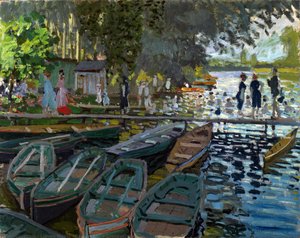
La Grenouillère: A Parisian Summer Dream by Claude Monet
Claude Monet’s “La Grenouillère” isn't merely a depiction of a riverside scene; it’s a vibrant snapshot of a fleeting moment, a distillation of atmosphere and social life captured with the revolutionary techniques of Impressionism. Painted in 1869, this artwork transports us to La Grenouillère – a beloved floating restaurant and boat-hire location on the Seine near Paris – a place where Parisian society sought respite from the city’s bustle. It's a scene brimming with leisure, conversation, and the shimmering beauty of a summer afternoon, rendered not as a precise record but as an impression of light, color, and movement.
A Glimpse into Belle Époque Leisure
The painting unfolds like a memory – hazy, luminous, and imbued with a sense of joyful abandon. We see figures scattered across boats and a wooden gangplank, engaged in animated conversations, quiet contemplation, and the simple pleasure of being by the water’s edge. A playful dog adds a touch of domesticity to this lively tableau, anchoring the scene within a familiar, comforting context. Monet deliberately avoids focusing on individual portraits; instead, he masterfully captures the *atmosphere* – the feeling of freedom, the warmth of the sun, and the collective energy of a gathering. La Grenouillère itself embodies the spirit of the Belle Époque, representing a new era of leisure and recreation that was transforming Parisian society.
Impressionistic Technique: Capturing Fleeting Moments
Monet’s brushwork is the very essence of Impressionism. Loose, visible strokes dance across the canvas, creating an immediate sense of movement and light. He doesn't strive for photographic realism; rather, he prioritizes capturing the *impression* of a scene – the way sunlight glints off the water, the dappled shadows beneath the trees, the shimmering reflections that shift with every ripple. The colors are vibrant yet subtly blended, creating an overall sense of atmosphere and immediacy. Notice how Monet uses broken color—small dabs of pure pigment applied side-by-side—to build up the image, mimicking the way our eyes perceive light and color in nature. This technique was revolutionary for its time, moving away from the rigid conventions of academic painting towards a more subjective and sensory experience of art.
Historical Context: Renoir’s Companion and Parisian Innovation
“La Grenouillère” exists within a pivotal moment in the development of Impressionism. It was painted during a period when artists were actively challenging traditional artistic conventions, seeking new ways to represent the world around them. Monet collaborated closely with his friend Pierre-Auguste Renoir on this project, and their paintings offer fascinating insights into each other’s creative processes. The location itself – “Flowerpot Island” as it was nicknamed due to its collection of houseboats – was a popular gathering place for Parisian society, embodying a sense of freedom and modern recreation that defined the Belle Époque. The painting's creation coincided with a surge in leisure activities and a desire to capture the dynamism of urban life, reflecting broader social changes.
Symbolism and Emotional Impact
Beyond its depiction of a specific scene, “La Grenouillère” resonates with deeper symbolic meanings. It represents the pursuit of pleasure, the importance of community, and the beauty of nature. The shimmering water, the dappled sunlight, and the lively figures evoke a sense of joy, relaxation, and connection. Monet’s masterful use of light and color creates an emotional atmosphere that is both inviting and nostalgic, transporting us back to a time when life moved at a slower pace and simple pleasures were celebrated. The painting's enduring appeal lies in its ability to capture not just a moment in time but also the essence of human experience – the joy of shared moments by the water’s edge.
Питання та відповіді
Чи використовує «La Grenouillère» роботи Клод Моне сильні контрасти чи м'які гармонії?
Колірний аналіз «La Grenouillère» роботи Клод Моне підкреслює Виразний контраст та Збалансована гармонія гармонію.
Чи належить «La Grenouillère» роботи Клод Моне до найбільш затребуваних творів Impressionism?
«La Grenouillère» має рівень популярності Культові серед творів у стилі Impressionism, представлених у каталозі.
Для якої кімнати рекомендується «La Grenouillère» роботи Клод Моне, враховуючи її кольорову гаму?
Кольорова палітра Землисті відтінки у творі «La Grenouillère» роботи Клод Моне ідеально підходить для рекомендованого інтер'єру: це Вітальня.
 Переглянути в інтер'єрі
 Надіслати як листівку
 Поділитися
 Деталі витвору
 Посібник

 Завантажити
 Схожі екземпляри
 Рентгенівське дослідження
 Слайд-шоу
 Q&A
Q&A Статистика