Pop Art · 1955
Collection (Роберт Раушенберг, 1955)
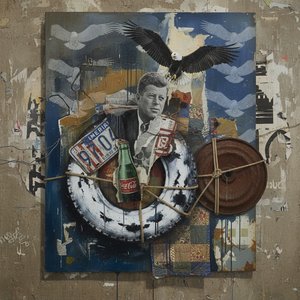
Роберт Раушенберг (1925–2008) створив Collection. Дата створення — 1955. Він належить до напряму Pop Art. Виконано в Mixed Media. Екземпляр зберігається в Сан-Францисский музей сучасного мистецтва у Сан-Франциско, Сполучені Штати Америки. Розмір: 203 × 243 cm
- 1955
- Mixed Media
- 203 × 243 cm
- Сан-Францисский музей сучасного мистецтва, Сан-Франциско

 Переглянути в інтер'єрі

 Картина олією ручної роботи
 Надіслати як листівку
 Поділитися
 Інформаційна картка


 Завантажити
 Схожі екземпляри
 Рентгенівське дослідження
 Слайд-шоу
 Питання та відповіді

 Статистика
Collection коротко
- Назва
- Collection
- Художник
- Роберт Раушенберг (1925–2008)
- Рік народження митця
- Порт-Артур, Сполучені Штати Америки
- Дата
- 1955
- Матеріал
- Mixed Media
- Розміри
- 203 × 243 cm
- Де подивитися
- Сан-Францисский музей сучасного мистецтва, Сан-Франциско, Сполучені Штати Америки
- Рух
- Pop Art
- Період
- Modern
- Сюжет
- combine painting, collage, fabric, wood scraps, color field, everyday objects
Що зображено на Collection?
A Symphony of Chaos and Color: Rediscovering Rauschenberg’s “Collection”
In the mid-1950s, the art world was gripped by the intense, often brooding emotionalism of Abstract Expressionism. Yet, amidst this era of heavy shadows and singular gestures, Robert Rauschenberg emerged with a vision that refused to be contained by the edges of a traditional canvas. His 1955 masterpiece, “Collection,” serves as a breathtaking manifesto of this new era—a work that does not merely sit upon a wall but breathes with the vibrant, messy, and beautiful energy of life itself. To encounter this piece is to witness a pivotal moment in American art history, where the boundaries between the high art of the gallery and the raw textures of the street began to dissolve into something entirely new.
The visual impact of “Collection” is immediate and overwhelming. Spanning an impressive 203 x 243 cm, the work presents a kaleidoscopic tapestry that defies monochromatic simplicity. Instead of the somber tones favored by his contemporaries, Rauschenberg orchestrates a brilliant dialogue between deep reds, sunny yellows, calming blues, and fiery oranges. This is not a painting of static shapes, but a dynamic landscape of layered complexity. As your eyes wander across the surface, you encounter an asymmetrical dance of elements: fragments of weathered wood scraps juxtaposed against unexpected textures, and even the subtle, haunting presence of a mirror positioned off-center, which invites the viewer to physically enter the artwork’s space.
The Alchemy of the Combine: Technique and Texture
At the heart of this work lies Rauschenberg’s revolutionary “Combine” technique, a method that fundamentally redefined what a painting could be. He moved beyond the brush to embrace the world around him, seamlessly blending traditional painting with the tactile reality of collage. Through the use of silkscreen printing alongside meticulously applied fabric and found objects, he achieved a textural richness that is almost sculptural in nature. This hybrid approach allows light to play differently across the canvas, catching on raised surfaces and receding into deep, shadowed crevices.
For the discerning collector or interior designer, this piece offers an unparalleled depth of character. The way the artwork incorporates various shades—from verdant greens to stark whites—creates a sense of movement that changes depending on the lighting of a room. It is a work that demands attention, providing a sophisticated focal point that bridges the gap between modern abstraction and contemporary installation art. The inclusion of diverse shapes, including a delicate bird figure that drifts through the composition, adds a layer of narrative intrigue, making every viewing a new discovery.
A Legacy of Freedom and Artistic Rebellion
To understand “Collection” is to understand the spirit of rebellion that defined Rauschenberg’s career. Born in the oil fields of Texas, his life was one of transition and movement, a nomadic sensibility that allowed him to see beauty in the discarded and the everyday. By integrating found objects into his work, he sought to liberate painting from the rigid confines of form and content, mirroring the broader cultural shifts of a post-war America seeking new modes of expression. He rejected the perceived heaviness of the New York School in favor of a more democratic, inclusive aesthetic.
Ultimately, “Collection” is an invitation to embrace complexity. It symbolizes the beauty found in the collision of disparate parts—the way chaos can be orchestrated into harmony. For those seeking to bring a sense of historical significance and avant-garde energy into a curated space, a high-quality reproduction of this work offers more than just decoration; it offers a piece of the revolution. It is a profound statement of artistic freedom that continues to inspire awe, reminding us that art is not just something to be looked at, but something to be lived within.
У якому музеї зберігається Collection?
Сан-Францисский музей сучасного мистецтва
Сан-Франциско, Сполучені Штати Америки
Витоки та історія установи Сан-Францисский музей сучасного мистецтва був заснований у 1935 році. Під керівництвом директора Грейс Л. Макканн Морлі установа спочатку функціонувала як Сан-Франциско Музей мистецтва.


Зображення високої роздільної здатності Collection

Protected by copyright: these files are for personal reference, not a licence to republish.
Роберт Раушенберг, Collection (1955), Сан-Францисский музей сучасного мистецтва.
Відповіді на запитання про Collection
Де можна побачити оригінал «Collection» роботи Роберт Раушенберг?
«Collection» роботи Роберт Раушенберг експонується в Сан-Францисский музей сучасного мистецтва, Сан-Франциско, Сполучені Штати Америки. У описі музею йдеться про оригінальний твір, а не про репродукції.
У якому році було створено «Collection» роботи Роберт Раушенберг?
«Collection» датована 1955 роком. Ця дата дозволяє визначити місце твору в творчому шляху Роберт Раушенберг та відповідну епоху.
Яка техніка використана у творі "Collection"?
Техніка виконання «Collection» роботи Роберт Раушенберг — Mixed Media. Репродукції мають на меті відтворити вигляд цієї техніки.
Які реальні розміри має «Collection» роботи Роберт Раушенберг?
«Collection» має розмір 203 x 243 cm в оригіналі. Оригінальні розміри є корисним орієнтиром під час вибору розміру репродукції.
Що зображено на творі "Collection"?
Тематика, представлена у «Collection» роботи Роберт Раушенберг, включає combine painting, collage, fabric, wood scraps, color field, everyday objects, abstract forms. Разом вони підсумовують зміст твору.
Чи не захищений твір "Collection" авторським правом?
Статус авторського права для «Collection» роботи Роберт Раушенберг: цей твір є все ще перебуває під захистом авторського права. Це визначає, чи можна вільно створювати репродукції зображення.
Хто є автором "Collection"?
Автором твору «Collection» є Роберт Раушенберг. Робота внесена до каталогу під іменем Роберт Раушенберг.
До якого художнього напряму належить «Collection» роботи Роберт Раушенберг?
Мистецький напрям, до якого належить «Collection» роботи Роберт Раушенберг, — це Pop Art. Така класифікація дозволяє розмістити цей твір у контексті суміжних митців та творів мистецтва.
Який етап творчого розвитку Роберт Раушенберг представляє твір "Collection"?
«Collection» належить до Combine Era Роберт Раушенберг.
Про художника Роберт Раушенберг

1925–2008, Сполучені Штати Америки
Роберт Раушенберг
A Life Forged in Transition Robert Rauschenberg, born Milton Ernest Rauschenberg in 1925 amidst the oil-rich landscapes of Port Arthur, Texas, was an artist whose very existence seemed to echo the dynamic energy and transformative spirit he brought to the art world. His childhood wasn’t defined by a single location; his father's profession necessitated a nomadic lifestyle, traversing diverse terrains that subtly instilled within him a receptiveness to varied visual stimuli and a willingness to embrace change. This early exposure fostered a sensibility attuned to the textures and rhythms of American life—an undercurrent profoundly shaping his artistic explorations. Though initially drawn towards pharmacology at the University of Texas, Rauschenberg’s path swiftly diverged, leading him into art – first through necessity during wartime service in the Navy, then with focused study at the Kansas City Art Institute and crucially, at Black Mountain College in North Carolina.
Також за участю Роберт Раушенберг
 Власності1963
 Signs1970
 Barge1963
 Odalisk1958
Есе до твору Collection
 Robert Rauschenberg: Bridging Painting & Life – A Comprehensive Exploration of Combines, Silkscreens, and the Erasure of BoundariesExplore the revolutionary art of Robert Rauschenberg – Combines, silkscreens & more. Discover his impact on Pop Art, investment potential &…
 Mastering Art Collecting: A Professional Guide to Acquiring Museum-Quality Famous ReproductionsMaster the art of collecting with our expert guide to museum-quality oil reproductions. Learn to distinguish hand-painted masterpieces from…
 Beyond the Subject: The Raw Power of Abstract Expressionism | A Definitive Guide for the Modern CollectorExplore the visceral power of Abstract Expressionism. From the New York School to action painting, discover how to collect high-impact, han…