

 Переглянути в інтер'єрі
 Надіслати
 Поділитися
 Деталі
 Посібник

 Завантажити
 Схожі предмети колекціонування
 Рентгенівське дослідження
 Слайд-шоу
 Статистика переглядів
Голова Пророка


 Читати далі
Придбайте цифрову копію високої роздільної здатності з покращеною якістю, що значно перевершує онлайн-перегляд.
Кожен файл ретельно підготовлений нашими фахівцями за допомогою сучасних інструментів та професійної ручної ретуші. Ми гарантуємо виняткову чіткість, точну передачу кольору та високу деталізацію кожного зображення.
Фінальний файл надсилається електронною поштою протягом 72 годин і оптимізований для негайного використання у професійних виданнях та друкованих матеріалах. Таку якість обирають провідні дизайнерські студії, видавництва та галереї.
Цифрове зображення
Завантажте файл високої роздільної здатності для особистого використання, друку та творчих проєктів. ( Перейти до друку Купити картину ручної роботи)
Що входить у кожне замовлення цифрових зображень
Експертна цифрова доставка з гарантією якості
Обираючи OriginalUniqueArt.com, ви отримуєте не просто зображення — ви отримуєте професійно вдосконалений цифровий витвір мистецтва, створений з надзвичайною точністю та підкріплений гарантією задоволення. Ось усе, що автоматично додається до вашого замовлення:

Швидка доставка на email
Ваш цифровий файл із зображенням високої роздільної здатності буде надісланий вам електронною поштою протягом 72 годин після оформлення замовлення — він буде готовий до негайного використання.

Цифровий файл із покращенням ШІ
Ваш витвір мистецтва професійно оптимізовано за допомогою передових інструментів штучного інтелекту та ручної корекції, що забезпечує максимальну деталізацію, чіткість і точність передачі кольорів.

Безкоштовне повторне завантаження назавжди
Випадково видалили або втратили файл? Не хвилюйтеся — ми надішлемо його вам повторно в будь-який час безкоштовно.

Без митних зборів — завжди
Насолоджуйтесь вашим витвором мистецтва миттєво без жодних мит, зборів або плати за доставку — цифрові завантаження завжди не оподатковуються.

Гарантія точності кольорів
Ми гарантуємо максимально точне відтворення оригінальних кольорів на вашому цифровому зображенні завдяки використанню професійних інструментів та систем управління кольором.

100-денна гарантія задоволення клієнта
Якщо ви не задоволені придбаним цифровим зображенням, ми внесемо правки або повернемо 100% вартості протягом 100 днів — без зайвих запитань.

Гарантія повернення 100% коштів
Незадоволені покупкою? Отримайте повне повернення коштів протягом 100 днів після отримання цифрового файлу — без зайвих запитань.

Знижки на оптові замовлення
Купуйте 3 зображення — заощаджуйте 10% — Купуйте 5 — заощаджуйте 15% — Купуйте 10+ — заощаджуйте 20%. Чудово підходить для творчих проєктів, галерей та агентств.
A Glimpse into Divinity: Paolo Uccello’s ‘Head of Prophet’
Painted in 1443, this fragment – a compelling “Head of Prophet” by the Florentine master Paolo Uccello – offers a rare and intimate encounter with Early Renaissance artistry. More than just a portrait, it is a window into the evolving artistic sensibilities of the 15th century, showcasing Uccello’s unique blend of meticulous detail and burgeoning perspective.
Style & Technique: Bridging Gothic Grace with Renaissance Innovation
- Early Renaissance Portraiture: The work exemplifies the shift from the stylized forms of the Gothic period towards a more naturalistic representation of the human figure, characteristic of the Early Renaissance. While still possessing a degree of formality, Uccello imbues his subject with a palpable sense of individual presence.
- Meticulous Detail & Oil Painting: The artist’s masterful technique is evident in the delicate rendering of facial features – the carefully delineated beard, the strands of hair, and the subtle modeling of skin tones. Likely executed in oil paint (or potentially fresco transferred to panel), the surface exhibits a soft texture and layered application, creating depth and luminosity.
- Geometric Underpinning: Uccello’s fascination with mathematics and perspective is subtly present, even within this cropped composition. The circular frame itself speaks to his interest in geometric forms, while the careful arrangement of light and shadow contributes to a sense of spatial depth.
Symbolism & Historical Context: A Saintly Visage
- Identifying the Prophet: Recent scholarship suggests this portrait likely depicts Saint Augustine of Hippo, a highly influential theologian and philosopher. This identification is supported by comparisons to other known depictions of the saint.
- The Halo & Divine Authority: The luminous halo above the prophet’s head unequivocally signifies his sanctity and spiritual authority, a common visual cue in religious art of the period.
- Florence & Artistic Patronage: Created during a period of intense artistic activity in Florence, this work likely formed part of a larger decorative scheme – potentially within a church or private chapel. Uccello’s commissions often reflected the intellectual and spiritual currents of his time, catering to a discerning clientele eager for innovative art.
- The Clock with Heads of Prophets: This piece is related to Uccello's larger work, “Clock with Heads of Prophets” in Florence’s Duomo. Both demonstrate the artist’s interest in representing prophetic figures and his skill in portraiture.
Emotional Resonance & Interior Design Considerations
“Head of Prophet” evokes a sense of serene contemplation and quiet dignity. The soft lighting, coupled with the subject's gentle expression, creates an atmosphere of peaceful introspection. Its warm color palette – dominated by creams, golds, and browns – lends itself beautifully to a variety of interior settings.
- A Focal Point: This artwork would serve as a compelling focal point in a study, library, or living room, adding a touch of historical elegance and intellectual depth.
- Harmonious Palette: The warm tones complement neutral color schemes and natural materials like wood and stone. It pairs well with antique furniture or contemporary designs that embrace classic influences.
- Timeless Appeal: As a work of enduring artistic merit, “Head of Prophet” transcends fleeting trends, offering a timeless aesthetic that will enrich any space for generations to come.
Біографія митця
A Florentine Visionary: The Life and Art of Paolo Uccello
Paolo Uccello, born Paolo di Dono in 1397 amidst the rolling hills near Florence, remains one of the most captivatingly enigmatic figures of the Early Renaissance. His very nickname, “Uccello” – little bird – hints at a whimsical nature and an artistic inclination towards depicting the avian world, yet it belies a mind deeply engaged with the burgeoning intellectual currents of his time. He wasn’t merely a painter; he was a pioneer, a mathematician of the canvas, striving to unlock the secrets of visual space and translate them into breathtaking works of art. His father, Dono di Paolo, practiced the dual profession of barber-surgeon, while his mother, Antonia, hailed from a Florentine noble family – a lineage that perhaps instilled in young Paolo both a practical sensibility and an appreciation for refined aesthetics. From 1412 to 1416, Uccello’s formative years were spent under the tutelage of Lorenzo Ghiberti, whose workshop was a crucible of artistic innovation, focused on the creation of the magnificent bronze doors for Florence's Baptistery. This early exposure steeped him in the prevailing Gothic style, with its emphasis on decorative elegance and narrative clarity, yet also ignited within him a desire to push beyond established boundaries.The Pursuit of Perspective: A Mathematical Mind at Play
Uccello’s artistic development wasn’t simply about mastering technique; it was driven by an insatiable curiosity regarding the underlying principles governing perception. He became consumed with mathematics, particularly geometry and perspective, not as abstract disciplines but as tools to unlock a more truthful representation of reality. While Filippo Brunelleschi is often credited with discovering linear perspective, Uccello was among the first to systematically apply it to painting, meticulously calculating vanishing points and orthogonal lines to create an illusion of depth that had previously been largely absent from art. This wasn’t merely about technical accuracy; for Uccello, perspective became a means of structuring narrative, enhancing drama, and imbuing his compositions with a sense of order and intellectual rigor. His fascination bordered on obsession, as recounted by Giorgio Vasari, who described Uccello staying up late into the night, lost in contemplation of vanishing points and spatial relationships. This dedication, while sometimes perceived as eccentric, ultimately revolutionized painting and paved the way for future generations of artists. He sought to understand how the eye perceives distance and form, translating these observations into a visual language that defied traditional artistic conventions.Masterpieces of Illusion: Key Works and Stylistic Traits
Uccello’s oeuvre, though relatively small, is marked by a distinctive style that blends Gothic elegance with Renaissance innovation. The Battle of San Romano, a series of three panels commissioned to commemorate a Florentine victory, stands as perhaps his most celebrated achievement. These paintings are not simply depictions of warfare; they are dynamic compositions filled with swirling figures, fragmented armor, and dramatically foreshortened lances – all rendered in vibrant colors and arranged according to meticulously calculated perspective. The sheer ambition and technical complexity of this project showcased Uccello’s mastery of linear perspective and his ability to create a sense of overwhelming scale within a relatively small canvas. The Birth of the Virgin, showcases Uccello’s skill at creating an illusion of depth within a shallow space, while his St George and the Dragon presents a striking depiction of the legendary saint, characterized by bold colors and stylized forms. Even in works like *The Flood and the Ark*, part of the San Miniato al Monte frescoes, Uccello’s fascination with architectural detail and complex compositions is readily apparent. His style consistently reveals:- A vibrant palette and a bold use of color.
- An emphasis on linear perspective, often pushed to its limits for dramatic effect.
- Stylized figures and decorative patterns reminiscent of Gothic art.
- A profound fascination with geometric forms and spatial relationships.
Influences and Connections
Uccello’s artistic journey was shaped by a confluence of influences. His early training under Lorenzo Ghiberti exposed him to the rich traditions of Florentine Gothic painting, while his association with Donatello fostered an appreciation for sculptural form and dynamism. He also benefited from contact with other leading artists of the time, including Masaccio and Piero della Francesca, whose innovative use of perspective influenced his own work. Notably, Uccello’s interest in mathematics and optics was fueled by the intellectual ferment of Florence during the Renaissance, a period marked by renewed interest in classical learning and scientific inquiry. His meticulous approach to composition reflects this broader cultural context, demonstrating a desire to understand and represent the world according to rational principles.Legacy and Influence: A Lasting Impact on Art History
Paolo Uccello’s contribution to the Renaissance extends far beyond his individual paintings. His pioneering exploration of perspective fundamentally altered the course of art history, influencing countless artists who followed in his wake. Albrecht Dürer, the renowned German printmaker and painter, was deeply inspired by Uccello's work, dedicating himself to the study of perspective and incorporating its principles into his own artistic practice. While Uccello’s style remained somewhat idiosyncratic throughout his career – a unique blend of Gothic refinement and Renaissance innovation – his groundbreaking approach to space and form secured his place as a pivotal figure in the development of Western art. He died in Florence in 1475, leaving behind a legacy not only of beautiful paintings but also of intellectual curiosity and artistic daring. His work continues to inspire awe and admiration, reminding us that true artistry lies not just in what is seen, but in the understanding of how we see it.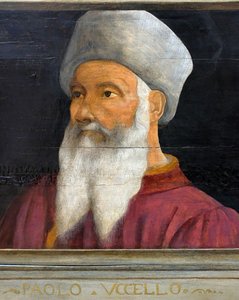
Паоло Учелло
1397 - 1475 , Італія
Коротко про автора
- Artistic Movement Or Style: Ранній Ренесанс
- Artists Or Movements Influenced By This Artist: ['Альбрехт Дюрер']
- Artists Who Influenced This Artist:
- Лоренцо Гіберті
- Донателло
- Date Of Birth: 1397
- Date Of Death: 1475
- Full Name: Паоло ді Дона
- Nationality: Італійський
- Notable Artworks:
- Битва при Сан-Романо
- Народження Діви
- Святий Георгій та дракон
- Place Of Birth: Пратоветтіо, Італія