Портрет Джозеф Ноель Патон

46 найвідоміших картин Джозеф Ноель Патон: добірка галереї

Оновлено Листопад 2026 · за рейтингом нашої популярності (кількість пошукових запитів, переглядів та замовлень для кожної роботи) · 46 робіт Джозеф Ноель Патон у нашому каталозі

Коротко кажучи

З усіх оригінальних робіт, які залишив Джозеф Ноель Патон, найвідомішою є Hesperus, the Evening Star, Sacred to Lovers (1857). Слідом за ними йдуть Puck and Fairies, from "A Midsummer Night's Dream" (1850) та Michelangelo's dream. Наш каталог містить 46 робіт Джозеф Ноель Патон; галерея зберегла 46 найвідоміших у світі творів, кожен із яких представлений із датою створення, назвою музею та своєю історією.

1821 – 1901, Данфермлін Pre-raphaelite Найбільше робіт: Шотландська національна галерея

10 найкращих картин Джозеф Ноель Патон: вибір галереї

1
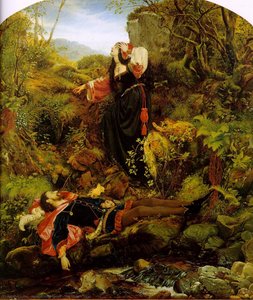
Hesperus, the Evening Star, Sacred to Lovers (1857) авторства Джозеф Ноель Патон

Hesperus, the Evening Star, Sacred to Lovers

1857 · Oil On Board

A man kneels before a woman in a secluded natural setting, their figures framed by the dense foliage of trees. He holds her hands in a gesture of devotion, his gaze fixed upon her as she looks down at him. The scene is quiet, set within a clearing where the soft light of the evening begins to settle. A single star hangs in the sky above them, casting a subtle…

2
Puck and Fairies, from "A Midsummer Night's Dream" (1850) авторства Джозеф Ноель Патон

Puck and Fairies, from "A Midsummer Night's Dream"

1850 · Oil On Board · Yale Center for British Art, Нью-Хейвен

The forest breathes with a secret life as the moonlight filters through a dense canopy of tangled vegetation. In this intimate clearing, the air feels heavy with the scent of damp earth and the hum of unseen magic. Puck leans over the scene from the upper right, his large, rounded form casting a watchful presence over the delicate gathering below. The sprites move with a fluid, organic grace, their soft…

3
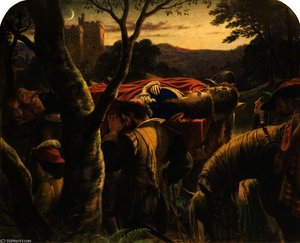
Michelangelo's dream авторства Джозеф Ноель Патон

Michelangelo's dream

Oil On Canvas

The artwork presents a dramatic portrait of a figure draped in a deep red robe, positioned within an archway formed by classical columns. This central figure dominates the vertically oriented composition, creating a sense of enclosure. Through the arch, a landscape is visible, featuring a crescent moon and a distant horizon line suggesting twilight or dawn. The scene is characterized by a strong use of chiaroscuro, with a single light…

4
The Temptations of St. Anthony (1860) авторства Джозеф Ноель Патон

The Temptations of St. Anthony

1860 · Terracotta · Ізраїльський музей, Єрусалим

In this circular, terracotta-colored relief sculpture, Joseph Noel Paton presents a quiet, intimate scene titled The Temptations of St. Anthony. The composition is centered on two figures rendered in classical attire, creating a focused, balanced arrangement. A seated female figure is captured in profile, facing toward the left. She is dressed in a draped garment characterized by fine vertical folds that catch the light. Opposite her, a smaller winged figure…

5
In Memoriam (1863) авторства Джозеф Ноель Патон

In Memoriam

1863 · Watercolor · Королівська колекція, Лондон

The scene unfolds within the delicate, translucent layers of In Memoriam, a poignant watercolor or gouache study by the Scottish artist Joseph Noel Paton. Created in 1863, this work captures a quiet, spectral moment where the boundaries between the physical and the spiritual begin to dissolve. The paper holds a vision of memory, rendered with a softness that suggests the fleeting nature of life itself.

6
The Man with the Muck Rake (study) (1872) авторства Джозеф Ноель Патон

The Man with the Muck Rake (study)

1872 · Oil

The Man with the Muck Rake (study) emerges from the brush of Joseph Noel Paton, a man whose hands were shaped by the intricate patterns of the Scottish textile industry. Born in 1821 in Dunfermline, United Kingdom, Paton carries the precision of a weaver into his work as an artist, illustrator, and sculptor. This particular piece, dating to 1872, captures a moment of intense spiritual or moral focus. It exists…

8
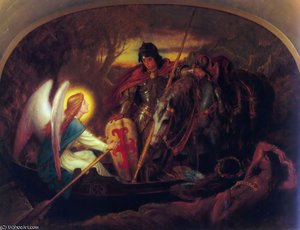
The choice авторства Джозеф Ноель Патон

The choice

In "The choice" by Joseph Noel Paton, a heavy tension hangs in the air, freezing a moment of profound conflict. Three figures dressed in medieval clothing occupy the center of the scene, their bodies angled toward one another in a struggle of words or wills. On the left, a man clad in armor stands as a rigid presence, his metallic attire catching the light amidst the unfolding drama. The others…

9
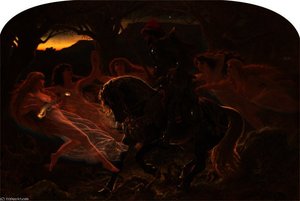
Oskold and the Elle Maids авторства Джозеф Ноель Патон

Oskold and the Elle Maids

Oil

A man sits atop a horse, a solitary figure amidst a sudden surge of movement. Around him, the forest breathes with the presence of the Elle Maids. These women, appearing as nymphs or fairies, drift through the shadows and the light, their forms scattered like fallen petals across the woodland floor. Some linger in the foreground, their presence felt in the immediate air, while others recede into the deep green…

10
The Reconciliation of Oberon and Titania авторства Джозеф Ноель Патон

The Reconciliation of Oberon and Titania

The Reconciliation of Oberon and Titania emerges from the shadows of a Scottish forest, a scene where magic and emotion collide. Painted in 1847, this oil on canvas work by Sir Joseph Noel Paton captures a moment of profound transition. The air feels heavy with the aftermath of a great dispute, as the fairy rulers move toward a delicate peace. It is a sequel to a previous quarrel, a continuation…

Вибірка Джозеф Ноель Патон триває, від 11 до 46

Теми, що привертали увагу Джозеф Ноель Патон

Чотири сюжети, які найчастіше зустрічаються в цих оригіналах, кожен із найкращим прикладом.

Музеї, у яких зберігаються оригінали Джозеф Ноель Патон

7 музеїв, у яких зберігається найбільша кількість картин із цього списку.

Музей Місто Твори Джозеф Ноель Патон Картини зі цього списку
Шотландська національна галерея, ЕдінбургШотландська національна галерея Едінбург 3 The Reconciliation of Oberon and Titania, Dawn - Luther at Erfurt, The Quarrel of Oberon and Titania
Королівська колекція, ЛондонКоролівська колекція Лондон 2 In Memoriam, 'Home': The Return from the Crimea
Yale Center for British Art, Нью-ХейвенYale Center for British Art Нью-Хейвен 1 Puck and Fairies, from "A Midsummer Night's Dream"
Ізраїльський музей, ЄрусалимІзраїльський музей Єрусалим 1 The Temptations of St. Anthony
Laing Art Gallery, New South WalesLaing Art Gallery New South Wales 1 The Man of Sorrows
Sheffield City Art Galleries, ШеффілдSheffield City Art Galleries Шеффілд 1 The Fairy Queen
Musée de Grenoble, ГренобльMusée de Grenoble Гренобль 1 Beati mundo corde

Джозеф Ноель Патон десятиліття за десятиліттям: оригінали, що визначають кожне з них

Роботи за десятиліттями

Оберіть десятиліття, щоб побачити оригінальний твір, який його визначає.

Запитання колекціонерів про картини Джозеф Ноель Патон

Яка робота Джозеф Ноель Патон є найвідомішою?Дізнатися відповідь

Hesperus, the Evening Star, Sacred to Lovers (1857). Далі йдуть Puck and Fairies, from "A Midsummer Night's Dream" (1850) та Michelangelo's dream.

Скільки років було Джозеф Ноель Патон, коли було створено Hesperus, the Evening Star, Sacred to Lovers?Дізнатися відповідь

36 років: Hesperus, the Evening Star, Sacred to Lovers датована 1857 роком, а Джозеф Ноель Патон народився(-лася) у 1821.

Які десять найвідоміших картин Джозеф Ноель Патон?Дізнатися відповідь

Hesperus, the Evening Star, Sacred to Lovers, Puck and Fairies, from "A Midsummer Night's Dream", Michelangelo's dream, The Temptations of St. Anthony, In Memoriam, The Man with the Muck Rake (study), Michelangelo Sculpting the Statue of 'Night', The choice, Oskold and the Elle Maids та The Reconciliation of Oberon and Titania. У рейтингу вище вказано рік створення та музей для кожної картини.

Скільки картин залишив Джозеф Ноель Патон?Дізнатися відповідь

Наш каталог містить 46 робіт Джозеф Ноель Патон, датованих періодом з 1849 по 1875.

У яких музеях виставляються шедеври Джозеф Ноель Патон?Дізнатися відповідь

Переважно в Шотландська національна галерея (Едінбург), Королівська колекція (Лондон) та Yale Center for British Art (Нью-Хейвен). У таблиці музеїв вище наведено їхній повний перелік.

У які роки Джозеф Ноель Патон створив свої найвідоміші роботи?Дізнатися відповідь

У 1850s: 4 із 46 робіт на цій сторінці були створені тоді, серед них Hesperus, the Evening Star, Sacred to Lovers.

Які перша та остання відомі оригінальні роботи Джозеф Ноель Патон?Дізнатися відповідь

На цій сторінці найдавніша робота датована The Quarrel of Oberon and Titania (1849), а найновіша — The Man of Sorrows (1875).

Які сюжети Джозеф Ноель Патон обирав найчастіше?Дізнатися відповідь

Man (5), Woman (5) та Forest (5), у 46 роботах на цій сторінці.

Яку техніку найчастіше використовував(ла) Джозеф Ноель Патон?Дізнатися відповідь

Oil On Canvas, для 4 із 46 робіт на цій сторінці.

До якого художнього напряму належить Джозеф Ноель Патон?Дізнатися відповідь

Pre-raphaelite та Romanticism, судячи з оригіналів на цій сторінці.

Які роботи Джозеф Ноель Патон виставлені в Шотландська національна галерея?Дізнатися відповідь

The Reconciliation of Oberon and Titania, Dawn - Luther at Erfurt та The Quarrel of Oberon and Titania: Шотландська національна галерея, Едінбург зберігає 3 робіт із цієї сторінки.

Джозеф Ноель Патон: життя та творчість

A Scottish Visionary: The Life and Art of Sir Joseph Noel Paton

Sir Joseph Noel Paton, a name synonymous with the evocative beauty of Victorian fairy paintings and allegorical scenes, was born in Dunfermline, Scotland, on December 13, 1821. His early life, steeped in the intricate designs of damask weaving – his parents were skilled designers and weavers themselves – instilled within him an unparalleled appreciation for detail and pattern, a characteristic that would profoundly shape his artistic style. Though initially involved in the family business, directing design at a muslin factory, Paton’s true passion lay in the realm of art, fueled by a deep love for storytelling and a fascination with Celtic legends and religious narratives. A brief period of study at the Royal Academy in London in 1843 exposed him to the artistic currents of his time, yet he ultimately chose to forge his own distinctive path, rooted firmly in his Scottish heritage.

The Pre-Raphaelite Connection and Artistic Development

While never formally joining the Pre-Raphaelite Brotherhood, Sir Joseph Noel Paton’s work bears a striking resemblance to their aesthetic principles. His early paintings, such as “The Quarrel of Oberon and Titania” (1847), now a cornerstone of the National Gallery of Scotland's collection, demonstrate his remarkable ability to capture fantastical scenes with breathtaking realism. This painting, inspired by Shakespeare’s *A Midsummer Night’s Dream*, is not merely a depiction of fairies; it’s a portrayal of their passions, conflicts, and vulnerabilities – imbued with psychological complexity that set him apart from many of his contemporaries. The invitation he received from John Everett Millais to join the Brotherhood underscores his connection to this influential movement, even as he developed a unique artistic voice. Paton's meticulous attention to detail, evident in the intricate costumes, landscapes, and facial expressions, reflects a deep understanding of both visual representation and narrative storytelling. He wasn’t simply illustrating tales; he was breathing life into them with an extraordinary level of skill and emotional depth.

Weaving Myth and Morality: A Unique Artistic Style

Paton's artistic journey was characterized by a remarkable synthesis of diverse influences. His upbringing amidst the intricate designs of damask weaving—his parents were skilled designers and weavers themselves—instilled in him an unparalleled appreciation for detail and pattern, a characteristic that would profoundly shape his artistic style. Though initially involved in the family business, directing design at a muslin factory, Paton’s true passion lay in the realm of art, fueled by a deep love for storytelling and a fascination with Celtic legends and religious narratives. A brief period of study at the Royal Academy in London in 1843 exposed him to the artistic currents of his time, yet he ultimately chose to forge his own distinctive path, rooted firmly in his Scottish heritage. His work is not just visually stunning but also intellectually stimulating, inviting viewers to contemplate profound questions about faith, morality, and the human condition. He explored religious themes with equal fervor, as evidenced in works like “Luther discovering justification by faith,” revealing a deep engagement with theological concepts. His paintings are not merely historical artifacts; they are living embodiments of imagination, faith, and artistic vision.

Major Works and Royal Recognition

Throughout his career, Paton consistently produced masterpieces that blended historical accuracy with imaginative storytelling. “Puck and Fairies” (1857), a vibrant depiction of the mischievous sprite Puck leading a group of fairies through a moonlit forest, exemplifies his mastery of capturing the ethereal beauty and playful spirit of the fairy world. “The Man of Sorrows” (1875), now housed in the Laing Art Gallery in Newcastle upon Tyne, is a particularly poignant work that showcases Paton’s ability to convey profound emotion through carefully rendered detail. In 1866, he was appointed as Queen's Limner for Scotland – a prestigious position signifying his status as the foremost artist in the country – and subsequently knighted by Queen Victoria in 1867, recognizing his significant contributions to Scottish art and culture. These honors cemented his place as a leading figure in Victorian society.

Themes, Symbolism, and Lasting Legacy

Paton’s work is deeply imbued with symbolism, reflecting both personal beliefs and the broader cultural anxieties of the Victorian era. His fascination with Celtic legends speaks to a growing interest in national identity and folklore during this period. The fairy paintings, while seemingly whimsical, often carry underlying moral messages about temptation, innocence, and the dangers of unchecked desire. Religious works, such as those depicting scenes from the life of Martin Luther, explore themes of faith, redemption, and the struggle against oppression.
  • His meticulous attention to detail—evident in the intricate costumes, landscapes, and facial expressions—adds layers of meaning to his compositions.
  • The use of dramatic lighting and rich color palettes enhances the emotional impact of his paintings.
  • Paton’s works often feature allegorical figures representing abstract concepts like love, death, and justice.
He wasn't simply recreating stories; he was using them as vehicles for exploring universal human experiences. Sir Joseph Noel Paton passed away on December 26, 1901, leaving behind a rich artistic legacy that continues to captivate audiences today. His works can be found in prominent museums and collections, including the Scottish National Gallery and the National Records of Scotland, ensuring his art remains accessible for generations to come. However, Paton’s unique blend of Celtic mythology, religious themes, and Victorian sensibilities sets him apart as a truly original artist. He stands as a testament to the power of art to transport us to other worlds, explore profound truths, and celebrate the rich cultural heritage of Scotland.