Portrait of Michael Pacher

The 44 Most Famous Michael Pacher Paintings, a Gallery Selection

Updated Ekim 2026 · ranked by our popularity score (searches, visits and orders for each work) · 44 works by Michael Pacher in our catalogue

In short

Of all the originals Michael Pacher left, the most famous is Altarpiece of the Church Fathers: St Jerome (1483), in the collection of the Alte Pinakothek, Münih. Close behind it come Altarpiece of the Church Fathers: St Augustine and St Gregory (1483) and St Wolfgang Altarpiece: Resurrection of Lazarus (1479). Our catalog holds 44 works by Michael Pacher; the gallery has kept the 44 the world admires most, each shown with its date, its museum and its story.

1435 – 1498, Falzes Northern renaissance Most works: Parish Church

Michael Pacher's top 10 paintings: the gallery's choice

1
Altarpiece of the Church Fathers: St Jerome (1483) by Michael Pacher

Altarpiece of the Church Fathers: St Jerome

1483 · Acrylic On Canvas · Alte Pinakothek, Münih

Michael Pacher’s Altarpiece of the Church Fathers: St. Jerome, completed in 1483, isn't merely a painting; it’s an immersive theatrical experience rendered in oil on wood panel. Created during a pivotal moment in European art – bridging the Gothic and burgeoning Renaissance – this altarpiece transcends its religious function to become a profound meditation on faith, suffering, and the very nature of divine inspiration. Pacher, a Tyrolean artist born amidst…

2
Altarpiece of the Church Fathers: St Augustine and St Gregory (1483) by Michael Pacher

Altarpiece of the Church Fathers: St Augustine and St Gregory

1483 · Oil On Panel · Alte Pinakothek, Münih

The Altarpiece of the Church Fathers: A Synthesis of Gothic Tradition and Renaissance Innovation Michael Pacher’s “Altarpiece of the Church Fathers,” completed in 1483 for the Neustift Monastery near Brixen, South Tyrol, stands as a testament to the transformative artistic currents sweeping across Central Europe during the late fifteenth century. More than just a devotional image, it represents a pivotal moment in art history—a harmonious blend of Gothic sensibilities and…

3
St Wolfgang Altarpiece: Resurrection of Lazarus (1479) by Michael Pacher

St Wolfgang Altarpiece: Resurrection of Lazarus

1479 · Oil On Panel · Parish Church, St. Wolfgang

The air in the scene feels heavy with the scent of damp earth and ancient stone. At the center, a figure of divine authority reaches into the darkness of a tomb to pull a man back from the silence of death. Lazarus emerges, his body a pale contrast against the muted tones of the surrounding architecture. Around him, a crowd of thirteen souls gathers, their faces etched with the sudden,…

4
Mary of Burgundy (1490) by Michael Pacher

Mary of Burgundy

1490 · Oil On Panel · Heinz Kisters Collection, Kreuzlingen

A woman gazes directly at the viewer, her presence defined by a stark, monochromatic palette. She wears a dark dress that absorbs the light, contrasted by a gold necklace that catches a subtle glint. Her long hair falls around a face marked by a steady, unblinking stare. Behind her, a clock hangs upon the wall, a quiet marker of time within the composition. The work utilizes a black and white…

5
Saint Ambrose from Milan (1480) by Michael Pacher

Saint Ambrose from Milan

1480 · Tempera On Panel · Bavarian State Painting Collections, Münih

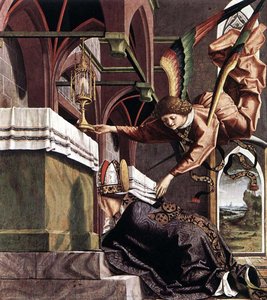
The panel known as Saint Ambrose from Milan emerges from the intricate layers of the Altarpiece of the Church Fathers. Painted by Michael Pacher, this work captures a moment of profound spiritual connection. It exists as one of the four sections of a larger, complex structure designed to honor the great Doctors of the Western Church. The saint appears caught in a state of divine inspiration, a scene that breathes…

7
Laurentius Altar: The Death of Mary (1462) by Michael Pacher

Laurentius Altar: The Death of Mary

1462 · Tempera On Panel · Bavarian State Painting Collections, Münih

The Laurentius Altar: The Death of Mary by Michael Pacher captures a moment of heavy stillness. Created about 1462, the work centers on the Dormition of the Virgin. She lies at the heart of the scene, a figure of quiet transition. Around her, the apostles gather in a dense, crowded assembly. Their presence forms a ring of mourning, each face etched with the weight of the passing. The air in…

The Michael Pacher selection continues, 11 to 44

11Church Fathers Altar, Outer Wing: Disputation of Saint Augustine with the Heretics (1480) by Michael PacherChurch Fathers Altar, Outer Wing: Disputation of Saint Augustine with the Heretics1480 · Bavarian State Painting Collections 12Church Fathers Altar: Saint Augustine (1480) by Michael PacherChurch Fathers Altar: Saint Augustine1480 · Bavarian State Painting Collections 13Scene on the right: Saint Gregory (1471) by Michael PacherScene on the right: Saint Gregory1471 · Bavarian State Painting Collections 14St. Barbara (1485) by Michael PacherSt. Barbara1485 15Joseph is trown into a well (1474) by Michael PacherJoseph is trown into a well1474 16Coronation of the Virgin (1471) by Michael PacherCoronation of the Virgin1471 · Parish Church 17The Engagement of Virgin (1495) by Michael PacherThe Engagement of Virgin1495 · Österreichische Galerie Belvedere 18Annunciation (1465) by Michael PacherAnnunciation1465 · Alte Pinakothek 19St Catherine (1465) by Michael PacherSt Catherine1465 · Tiroler Landesmuseum Ferdinandeum 20Altarpiece of the Church Fathers: St Augustine Liberating a Prisoner (1483) by Michael PacherAltarpiece of the Church Fathers: St Augustine Liberating a Prisoner1483 · Alte Pinakothek 21St Wolfgang Altarpiece: Circumcision (1479) by Michael PacherSt Wolfgang Altarpiece: Circumcision1479 · Parish Church 22Altarpiece of the Church Fathers: Vision of St Sigisbert (1483) by Michael PacherAltarpiece of the Church Fathers: Vision of St Sigisbert1483 · Alte Pinakothek 23Follower of ) (1400) by Michael PacherFollower of )1400 24Altarpiece of the Church Fathers (1483) by Michael PacherAltarpiece of the Church Fathers1483 · Alte Pinakothek 25St Wolfgang Altarpiece: The Miracle of the Bread (1479) by Michael PacherSt Wolfgang Altarpiece: The Miracle of the Bread1479 · Parish Church 26Coronation of the Virgin between St Wolfgang and St Benedict (1479) by Michael PacherCoronation of the Virgin between St Wolfgang and St Benedict1479 · Parish Church 27St Wolfgang Altarpiece: Temptation of Christ (1479) by Michael PacherSt Wolfgang Altarpiece: Temptation of Christ1479 · Parish Church 28St Wolfgang Altarpiece: The Attempt to Stone Christ (1479) by Michael PacherSt Wolfgang Altarpiece: The Attempt to Stone Christ1479 · Parish Church 29St Wolfgang Altarpiece: Nativity (1479) by Michael PacherSt Wolfgang Altarpiece: Nativity1479 · Parish Church 30St Wolfgang Altarpiece: Purification of the Temple (1479) by Michael PacherSt Wolfgang Altarpiece: Purification of the Temple1479 · Parish Church 31St Wolfgang Altarpiece: Scenes from the Life of Christ (1479) by Michael PacherSt Wolfgang Altarpiece: Scenes from the Life of Christ1479 · Parish Church 32Flagellation (1495) by Michael PacherFlagellation1495 · Österreichische Galerie Belvedere 33St Lawrence Distributing the Alms (1465) by Michael PacherSt Lawrence Distributing the Alms1465 · Alte Pinakothek 34St. Barbara by Michael PacherSt. Barbara 35st wolfgang altarpiece by Michael Pacherst wolfgang altarpiece 36Temptation of Christ by Michael PacherTemptation of Christ 37Marriage at Cana by Michael PacherMarriage at Cana 38Baptism of Christ by Michael PacherBaptism of Christ 39Christ and the Adulteress by Michael PacherChrist and the Adulteress 40St Augustine and St Gregory by Michael PacherSt Augustine and St GregoryBavarian State Painting Collections 41St augustine freeing a prisoner by Michael PacherSt augustine freeing a prisoner 42Resurrection of Lazar by Michael PacherResurrection of Lazar 43Scenes from the Life of Christ by Michael PacherScenes from the Life of Christ 44The Virgin and Child Enthroned with Angels and Saints by Michael PacherThe Virgin and Child Enthroned with Angels and SaintsNational Gallery

The subjects that held Michael Pacher's eye

The four subjects that come back most often in these originals, each with its finest example.

The museums that keep Michael Pacher's originals

The 7 museums that hold the most of the paintings on this page.

Museum City Works by Michael Pacher Paintings from this list
Parish Church, St. WolfgangParish Church St. Wolfgang 10 St Wolfgang Altarpiece: Resurrection of Lazarus, Coronation of the Virgin, St Wolfgang Altarpiece: Circumcision
Alte Pinakothek, MünihAlte Pinakothek Münih 7 Altarpiece of the Church Fathers: St Jerome, Altarpiece of the Church Fathers: St Augustine and St Gregory, Annunciation
Bavarian State Painting Collections, MünihBavarian State Painting Collections Münih 6 Saint Ambrose from Milan, Laurentius Altar: The Death of Mary, Church Fathers Altar, Outer Wing: Disputation of Saint Augustine with the Heretics
Österreichische Galerie Belvedere, ViyanaÖsterreichische Galerie Belvedere Viyana 2 The Engagement of Virgin, Flagellation
Heinz Kisters Collection, KreuzlingenHeinz Kisters Collection Kreuzlingen 1 Mary of Burgundy
Tiroler Landesmuseum Ferdinandeum, InnsbruckTiroler Landesmuseum Ferdinandeum Innsbruck 1 St Catherine
National Gallery, LondraNational Gallery Londra 1 The Virgin and Child Enthroned with Angels and Saints

Michael Pacher decade by decade: the original that defines each

Works per decade

Pick a decade to see the original that defines it.

Collectors' questions about Michael Pacher's paintings

Which work is Michael Pacher most famous for?Reveal the answer

Altarpiece of the Church Fathers: St Jerome (1483), Alte Pinakothek, Münih. Altarpiece of the Church Fathers: St Augustine and St Gregory (1483) and St Wolfgang Altarpiece: Resurrection of Lazarus (1479) come next.

What age was Michael Pacher when Altarpiece of the Church Fathers: St Jerome was made?Reveal the answer

48 years old: Altarpiece of the Church Fathers: St Jerome dates from 1483, and Michael Pacher was born in 1435.

What are the ten most famous Michael Pacher paintings?Reveal the answer

Altarpiece of the Church Fathers: St Jerome, Altarpiece of the Church Fathers: St Augustine and St Gregory, St Wolfgang Altarpiece: Resurrection of Lazarus, Mary of Burgundy, Saint Ambrose from Milan, Saint Lawrence before Emperor Decius, Laurentius Altar: The Death of Mary, St. Peter, Pope Sixtus II. bids farewell to St. Lawrence and St. Paul. The ranking above gives each one's year and museum.

How many paintings did Michael Pacher leave?Reveal the answer

Our catalog holds 44 works by Michael Pacher, dated from 1462 to 1495.

In which museums do Michael Pacher's masterpieces hang?Reveal the answer

Mostly in Parish Church (St. Wolfgang), Alte Pinakothek (Münih) and Bavarian State Painting Collections (Münih). The museum table above lists them all.

In which years did Michael Pacher paint the most famous works?Reveal the answer

In 1470s: 12 of the 44 works on this page were made then, St Wolfgang Altarpiece: Resurrection of Lazarus among them.

What are the first and the last famous originals of Michael Pacher?Reveal the answer

On this page, the earliest is Laurentius Altar: The Death of Mary (1462) and the latest The Engagement of Virgin (1495).

Which subjects did Michael Pacher choose most often?Reveal the answer

Altarpiece (9), Saints (7) and Religious scene (7), across the 44 works on this page.

Which technique did Michael Pacher use most?Reveal the answer

Oil On Panel, for 7 of the 44 works on this page.

To which art movement does Michael Pacher belong?Reveal the answer

Northern renaissance, judging by the originals on this page.

Which Michael Pacher works hang at the Parish Church?Reveal the answer

St Wolfgang Altarpiece: Resurrection of Lazarus, Coronation of the Virgin and St Wolfgang Altarpiece: Circumcision: the Parish Church, St. Wolfgang holds 10 of the works on this page.

Can I commission a reproduction of a Michael Pacher painting?Reveal the answer

Yes, as a reproduction: the original stays in its museum, but any painting on this page can be painted by hand for you, made to order one at a time, from the painting's own page.

Michael Pacher: life and work

Dünyalar Arasında Bir Tirol Köprüsü

Yaklaşık 1435 yılında Bolzano'nun Alp manzaraları arasında dünyaya gelen Michael Pacher, Almanca konuşulan topraklarda Gotik sanatın geçişinden filizlenen Rönesans ruhuna uzanan yolda kilit bir figür olarak durmaktadır. O, yalnızca bir ressam değil; resim ve heykeli, mimariyi ve ince detayları kusursuzca harmanlayan, dini objelerden ziyade inancın ve hikaye anlatıcılığının sürükleyici dünyalarını yaratan bir zanaatkârdı. Erken yaşamı, ilk eğitimine dair ayrıntıların kıtlığı nedeniyle bir miktar gizem içinde kalsa da, Pacher'in 15. yüzyıl ortalarında Tirol üzerinden akan sanatsal akımlarla beslenen doğuştan gelen bir yeteneğe sahip olduğu aşikârdır. Sanat yolculuğu, İtalya'nın Padua şehrine yaptığı ziyaretle kesin bir dönüm noktasına ulaştı; burada Andrea Mantegna'nın devrim niteliğindeki freskleriyle tanıştı. Bu deneyim, eserlerine perspektif ve mekânsal kompozisyon konusunda yeni bir anlayış kazandırarak dönüştürücü bir rol oynadı ve onu çağdaşlarından ayıran temel unsurlardan biri oldu.

St. Wolfgang Altarpiece: Bir Başyapıtın Açılışı

Pacher'in ünü, en sağlam şekilde Avusturya'daki hac kilisesi için 1471 ile 1481 yılları arasında yaratılan muhteşem St. Wolfgang Altarpiece üzerine kuruludur. Bu eser sadece bir tablo değildir; kutsal bir anlatı gibi açılmak üzere tasarlanmış, çok panelli, görkemli bir poliptiktir. Sunak tablosunun dâhiyane tasarımı üç farklı sergileme imkânı sunar: günlük ibadet için bir düzenleme, Pazar günleri için daha süslü bir versiyon ve özel kutsal günler için ayrılmış tamamen genişletilmiş bir form. Her bir konfigürasyon, İsa ve Meryem Ana'nın yaşamlarından farklı sahneleri gün yüzüne çıkarırken, bu süreç Meryem Ana'nın Göklerin Kraliçesi olarak taçlandırılmasını tasvir eden nefes kesici merkezi panelde doruğa ulaşır; bu, ilahi bir görkemle parıldayan heykelvari bir sahnedir. Dış kanatlar ise hacıların ve zanaatkârların koruyucu azizi olan Aziz Wolfgang'ın yaşamından kesitler sunar. Bilim insanları, atölyedeki iş birliği ruhunu vurgulayacak şekilde, kardeşi Friedrich Pacher'in bazı dış panellerin boyanmasına katkıda bulunmuş olabileceğini öne sürmektedir. Bu eseri asıl benzersiz kılan şey; devasa ölçeği, karmaşıklığı ve hem boyalı unsurlarda hem de ince işlenmiş figürlerde görülen şaşırtıcı detay seviyesidir. Bu, Pacher'in birden fazla sanatsal disiplini aynı anda yönetme yeteneğinin bir kanıtıdır.

Disiplinlerin Harmanlanması: Resim, Heykel ve Mimari Vizyon

St. Wolfgang Altarpiece'in ötesinde Pacher, Neustift Manastırı için 1483 civarında tamamlanan Kilise Babaları Sunak Tablosu gibi eserlerinde sanat formlarının eşsiz sentezini sergilemiştir. Burada resim ve heykel arasındaki sınırları ustalıkla bulanıklaştırarak bütünleşik bir sanatsal deneyim yaratmıştır. Kilise Babalarının anıtsal figürleri, nişlerinden sankın belirgin bir varlık hissiyle dışarı çıkıyor gibidir. Pacher'in ışık ve gölgeyi manipüle etmedeki becerisi, kompozisyona derinlik ve gerçekçilik katarak bu etkiyi daha da güçlendirir. O, mekanı sadece tasvir etmekle kalmamış; sunak tablosu yapısının sınırları içinde o mekanı bizzat *yaratmıştır*. Bu yenilikçi yaklaşım, farklı sanatsal teknikleri uyumlu bir bütün haline getirme yeteneğini örnek almak isteyen Kuzey Avrupa'daki sonraki sanat nesillerini önemli ölçüde etkilemiştir. 1467 yılına gelindiğinde Pacher, Bruneck'te gelişen bir atölye kurarak Tirol sanat sahnesinin önde gelen isimlerinden biri haline gelmişti. 1484 civarında Salzburg'daki Fransiskenler de dahil olmak üzere çeşitli dini tarikatlardan siparişler aldı. Ne yazık ki, çatışmalar ve doğal afetler nedeniyle eserlerinin birçoğu zaman içinde kaybolmuş veya zarar görmüştür; bu durum, sanatsal mirasın kırılganlığına dair dokunaklı bir hatırlatıcıdır. Bu kayıplara rağmen, hayatta kalan başyapıtlar Pacher'in olağanüstü yeteneğinin ve yenilikçi ruhunun kalıcı tanıkları olarak durmaktadır. O, Kuzey Gotik sanatının dışavurumcu formları ile İtalyan Rönesans resminin yükselen ilkeleri arasında köprü kurmayı başarmış gerçek bir öncüydü. Mirası, sadece eserlerinin güzelliğinde ve teknik dehasında değil, aynı zamanda yüzyıllar sonra bile izleyicileri büyülemeye ve onlara ilham vermeye devam eden kendine özgü, kişisel bir üslup oluşturabilme yeteneğinde yatmaktadır. Pacher'in çalışması, sanat tarihinde geleneğin ve yeniliğin birleşerek yeni sanatsal olasılıkların doğduğu kritik bir anı temsil eder.

All 44 works by Michael Pacher →