


1


Ekim 2026 tarihinde güncellendi · popülerlik puanımıza göre sıralanmıştır (her bir eser için aramalar, ziyaretler ve siparişler) · 36 eser Alan Davie kataloğumuzda
Özetle
Galerinin gözünde, Alan Davie'in en ünlü tablosu Woman Arranging Flowers (1945)'tir. Untitled Abstract ve Self Portrait with Brushes (1937), her gözün hemen fark edeceği o üçlüyü tamamlıyor. Katalogumuzdaki Alan Davie imzalı 36 eser arasından galerimiz, her biri yapıldığı yıl, sergilendiği müze ve onu eşsiz kılan özellikleriyle birlikte en ünlü 36 eseri aşağıda sunmaktadır.


 Joe's Magic Lantern1961
12
 Joe's Lucky Dip1961
13
 Keep Your Fingers Crossed1961
14
 Hopi Studies No.32, Opus 0.11731991 · University of Hertfordshire
15
 Hopi Studies No.30 (Big Blue) (Opus O.1171)1991
16
 Homage to an Earth Goddess No.61992
17
 Symbols in a Landscape1994 · The Pier Arts Centre
18
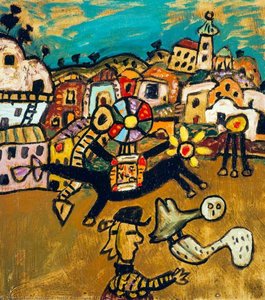 Village Witch (Opus O.1263)1994
19
 Magic Casket1997 · Scottish National Gallery of Modern Art
20
 Celtic Landscape (Dreamscape)1996 · The Pier Arts Centre
21
 Magic Landscape (Opus O.1337)1996
22
 The Alchemist's Mirror No.1 (Opus 1357)1997
23
 Cosmic Signals I2000
24
 Cosmic Signals No.72000
25
 The Golden Palace1999
26
 Magician's Mirror No.22000 · The Mercer Art Gallery
27
 Serpent's Idea of a Horse2000
28
 The Magician's Mirror No.3 (Opus 1450)2000
29
 Without Devices2004 · Pembroke College Oxford Jcr Art Collection
30
 Around and Around in the PinkKanada Ulusal Galerisi
31
 Kaleidoscope for a Parrot
32
 Prize for a Serpent
33
 Flowers on a TableThe Fleming Collection
34Prophet in a Tree, 1963Fitzwilliam Koleji
35
 Double MonumentRobinson College
36
 Hallucination with Monster and Cock
Bu sayfadaki tabloların çoğuna ev sahipliği yapan 8 müze.
| Müze | Şehir | Alan Davie Eserleri | Bu listedeki tablolar |
|---|---|---|---|
 The Pier Arts Centre |
Stromness | 2 | Symbols in a Landscape, Celtic Landscape (Dreamscape) |
 University of Hertfordshire |
North Hatley | 1 | Hopi Studies No.32, Opus 0.1173 |
 Scottish National Gallery of Modern Art |
Edinburgh | 1 | Magic Casket |
 The Mercer Art Gallery |
Harrogate | 1 | Magician's Mirror No.2 |
 Pembroke College Oxford Jcr Art Collection |
Oxford | 1 | Without Devices |
 Kanada Ulusal Galerisi |
Ottawa | 1 | Around and Around in the Pink |
 The Fleming Collection |
London | 1 | Flowers on a Table |
 Fitzwilliam Koleji |
Cambridge | 1 | Prophet in a Tree, 1963 |
O dönemi tanımlayan orijinal eseri görmek için bir on yıl seçin.


Woman Arranging Flowers (1945). Ardından Untitled Abstract ve Self Portrait with Brushes (1937) geliyor.
25 yaşında: Woman Arranging Flowers 1945 yılına aittir ve Alan Davie 1920 yılında doğmuştur.
Woman Arranging Flowers, Untitled Abstract, Self Portrait with Brushes, The Saint, Entrance to a Paradise, Jingling Space, Ram Grip, Piggy Chain, Joy Bag No. 1 ve Entrance For A Red Temple No. 4. Yukarıdaki sıralama, her birinin yapım yılını ve bulunduğu müzeyi göstermektedir.
Kataloğumuzda Alan Davie tarafından 1937 ile 2004 tarihleri arasında üretilmiş 36 eser bulunmaktadır.
Çoğunlukla The Pier Arts Centre (Stromness), University of Hertfordshire (North Hatley) ve Scottish National Gallery of Modern Art (Edinburgh) bünyesinde yer almaktadır. Yukarıdaki müze tablosu tümünü listelemektedir.
1990s döneminde: Bu sayfadaki 36 eserin 10 tanesi o dönemde yapılmıştır, bunların Hopi Studies No.32, Opus 0.1173 tanesi ise Hopi Studies No.32, Opus 0.1173 arasındadır.
Bu sayfadaki en eski eser Self Portrait with Brushes (1937), en yeni eser ise Without Devices (2004)'dir.
bu sayfadaki orijinallerine bakılırsa Abstract expressionism,
Symbols in a Landscape ve Celtic Landscape (Dreamscape): The Pier Arts Centre, Stromness, bu sayfadaki eserlerden 2 tanesine ev sahipliği yapmaktadır.