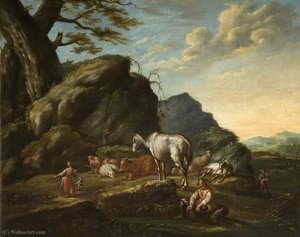
Goats and Flock of Sheep
Goats and Flock of Sheep is an oil painting by Philipp Peter Roos. The artist, who was also known by the moniker Rosa di Tivoli, produced this work about 1681. He was a German Baroque painter born in Sankt Goar, Germany.
Özetle
Philipp Peter Roos tarafından bırakılan tüm orijinal eserler arasında, en ünlüsü Münih, Bavarian State Painting Collections koleksiyonunda yer alan Goats and Flock of Sheep (1681) adlı eserdir. Hemen ardından Piece of Livestock (1681) ve Landscape with Cattle and Shepherd (1681) geliyor. Kataloğumuz Philipp Peter Roos tarafından yapılmış 93 eser barındırmaktadır; galeri, her biri tarihi, müzesi ve hikayesiyle birlikte sergilenen, dünyanın en çok hayranlık duyduğu 92 eseri muhafaza etmektedir.
Goats and Flock of Sheep is an oil painting by Philipp Peter Roos. The artist, who was also known by the moniker Rosa di Tivoli, produced this work about 1681. He was a German Baroque painter born in Sankt Goar, Germany.
Piece of Livestock is an oil painting by Philipp Peter Roos, executed in 1681. The work originates from the Baroque period, a time when the artist was establishing his presence within the Italianate landscape tradition.
Landscape with Cattle and Shepherd is a work by the German Baroque painter Philipp Peter Roos. Created about 1681, the painting reflects the artist's specialized focus on pastoral scenes and animal subjects. Roos was a significant figure in the development of Italianate landscapes, often characterized by his intimate study of livestock and the natural environment.
In Piece of Livestock, Philipp Peter Roos organizes a pastoral scene through a close-up, ground-level perspective that establishes an immediate intimacy with the subjects. The composition is dominated by a large, seated cow positioned slightly to the right of the center. To the left, a smaller lamb or calf provides a sense of scale, while a woman interacts with a dog in the space behind the primary subject. This arrangement…
Resting Flock with Shepherds is an oil painting by the German Baroque artist Philipp Peter Roos. Created about 1681, this work captures a quiet moment within a rugged landscape. The composition focuses on a group of livestock and a shepherd, rendered with a sense of immediate presence that draws the viewer into the scene.
Resting Flock with Shepherds is an oil painting by Philipp Peter Roos. The canvas captures a heavy stillness among livestock and their guardian. This work was created about 1681. It presents a scene of animals and men gathered in a quiet, layered space under a turbulent sky.
In this Baroque-style oil painting, the mythological drama of the Liberation of Io unfolds with a sudden, heavy intensity. Created by Philipp Peter Roos about 1681, the scene captures a moment of profound tension between the divine and the mortal. A massive, powerful bull dominates the foreground, its muscular form rendered with a weight that feels almost tangible. This central figure looms over the landscape, its presence commanding the space…
This oil on canvas painting, dated 1681, presents a monochromatic scene rendered in various shades of gray. In the foreground, a young woman is positioned amidst a group of livestock, including sheep or goats. The composition is a medium shot, placing the human subject and the animals in the immediate front and middle ground. The terrain is undulating, forming rolling hills that recede into a background of hazy mountains and…
Returning Flock with Shepherds is an oil painting by Philipp Peter Roos. Created about 1681, the work captures a quiet moment of pastoral movement. The artist, a German Baroque painter, was born in Sankt Goar. He would later become known by the moniker Rosa di Tivoli.
The scene unfolds in Shepherd with Cow, Sheep and Goats in Italian Mountain Landscape, a work that captures a quiet moment of pastoral life. This painting, created about 1680, brings together a shepherd and his diverse herd amidst a rugged, mountainous setting. The figures and animals exist within a landscape that feels both immediate and deeply rooted in the natural world.
Bu orijinal eserlerde en sık karşılaşılan ve her biri en seçkin örneğine sahip olan dört konu.
Bu sayfadaki tabloların çoğuna ev sahipliği yapan 8 müze.
| Müze | Şehir | Philipp Peter Roos Eserleri | Bu listedeki tablolar |
|---|---|---|---|
| Münih | 15 | Goats and Flock of Sheep, Piece of Livestock, Landscape with Cattle and Shepherd | |
| Kopenhag | 5 | Cattle Piece, Landscape with a Bull, Sheep and Goats, A Shepherd with his Herd | |
| Buenos Aires | 4 | Landscape with shepherd and animals, Landscape with figures and animals, Shepherd and animals in a landscape | |
| Bratislava | 3 | Goat Herd with a Goatherd, Shepherd's Idyl in a Romantic Landscape with Ruins, Herd by an Ancient Well | |
| Prag | 3 | Ravine with a Stream, a Shepherd and His Herd, Horse and Goats Grazing, Shepherd with a Herd of Sheep and Goats | |
| Viyana | 3 | Herd with Sleeping Shepherds, Rider Meeting, Landscape with Flock of Sheep | |
| Saint Petersburg | 3 | Landscape with a Grotto, Landscape with a Waterfall, Landscape with a Herd | |
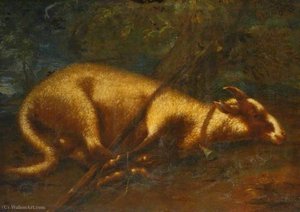
| Stockholm | 3 | Dead Hare, Landskap med hjord, A Goat Resting |
O dönemi tanımlayan orijinal eseri görmek için bir on yıl seçin.
This large-scale oil painting, dated 1669, presents a crowded, maximalist composition of diverse animal species. The arrangement is packed, with various animals overlapping to create a sense of density and movement. The color palette relies on deep, earthy tones, including rich browns, blacks, and dark ochres. These dark shades are interrupted by specific highlights of white and cream, alongside splashes of red from a rooster and parrots. The lighting follows…
Goats and Flock of Sheep is an oil painting by Philipp Peter Roos. The artist, who was also known by the moniker Rosa di Tivoli, produced this work about 1681. He was a German Baroque painter born in Sankt Goar, Germany.
A heavy, dark-colored cow anchors the center of this scene, its presence felt in the weight of its silhouette. To the left, two goats rest upon the ground, one a pale contrast of white and light tan against the shadows. A man sits nearby, leaning back in a moment of stillness, his gaze directed toward the animals or perhaps the viewer. The air in the enclosure feels thick and dim,…
In this work, titled Shepherd's Idyl in a Romantic Landscape with Ruins, the artist Philipp Peter Roos presents a quiet moment of rural existence. Created about 1700, the painting captures a shepherd tending to his flock amidst a landscape of rolling hills and weathered stone structures. There is a sense of stillness in the way the figures and animals occupy the space, suggesting a life governed by the rhythms of…
Goats and Flock of Sheep (1681), Bavarian State Painting Collections, Münih. Ardından Piece of Livestock (1681) ve Landscape with Cattle and Shepherd (1681) geliyor.
24 yaşında: Goats and Flock of Sheep 1681 yılına aittir ve Philipp Peter Roos 1657 yılında doğmuştur.
Goats and Flock of Sheep, Piece of Livestock, Landscape with Cattle and Shepherd, Piece of Livestock, Resting Flock with Shepherds, Resting Flock with Shepherds, Liberation of Io, Piece of Cattle, Returning Flock with Shepherds ve Shepherd with Cow, Sheep and Goats in Italian Mountain Landscape. Yukarıdaki sıralama, her birinin yapım yılını ve bulunduğu müzeyi göstermektedir.
Kataloğumuzda Philipp Peter Roos tarafından 1669 ile 1700 tarihleri arasında üretilmiş 93 eser bulunmaktadır.
Çoğunlukla Bavarian State Painting Collections (Münih), Statens Museum For Kunst (Kopenhag) ve National Museum of Fine Arts (Buenos Aires) bünyesinde yer almaktadır. Yukarıdaki müze tablosu tümünü listelemektedir.
1680s döneminde: Bu sayfadaki 92 eserin 21 tanesi o dönemde yapılmıştır, bunların Goats and Flock of Sheep tanesi ise Goats and Flock of Sheep arasındadır.
Bu sayfadaki en eski eser Various animals gathered before Noah's Ark (1669), en yeni eser ise Shepherd's Idyl in a Romantic Landscape with Ruins (1700)'dir.
Landscape (33), Animals (29) ve Goats (19), bu sayfadaki 92 eser genelinde.
Bu sayfadaki 92 eserin 18 tanesi Oil On Canvas türündedir.
bu sayfadaki orijinallerine bakılırsa Baroque,
Goats and Flock of Sheep, Piece of Livestock ve Landscape with Cattle and Shepherd: Bavarian State Painting Collections, Münih, bu sayfadaki eserlerden 15 tanesine ev sahipliği yapmaktadır.
İtalyan Barok döneminin altın ışıkları altında, çok az isim Philipp Peter Roos kadar kırsal yaşamın pastoral huzurunu çağrıştırabilir. Tarih boyunca etkileyici lakabıyla Rosa di Tivoli olarak tanınan bu Alman asıllı usta, doğal dünyayla kurduğu derin ve neredeyse içsel bir bağ sayesinde manzara türünü dönüştürdü. 1655 yılında Ren Bölgesi'nde —özellikle Sankt Goar yakınlarında— dünyaya gelen Roos, henüz çocuk yaşlarda fırçaya mahkum edilmiş bir yetenekti. Sanatçının olgun stilini tanımlayacak olan tonal uyum ve kompozisyon dengesi konusundaki temel dersleri ona, daha sonra saygın bir manzara ressamı olan babası Johann Heinrich Roos vermiştir. Bu erken dönem çıraklığı sadece teknik bir eğitim değil; dünyayı ışık, gölge ve toprağın sessiz vakarı merceğinden görmeye yönelik bir ruhsal yolculuktu.
Roos'un hayatının seyri, 1677 yılında Hesse-Kassel Konti Charles I'in cömertliğiyle dramatik bir şekilde değişti. Genç ressamın içindeki parlayan yeteneği fark eden Kont, Roos'un Roma'ya yapacağı dönüştürücü yolculuk için finansal imkanlar sağladı. Germen geleneklerinden İtalyan Barok sanatının kalbine yapılan bu göç, Roos'un Roma sanatının canlı enerjisini özümsemesine olanak tanıdı. Burada, klasik yapıyı daha spontane ve atmosferik bir gerçekçilikle harmanlama yeteneğini geliştirmesine yardımcı olan ünlü Giacinto Brandi'nin mentorluğuna sığındı. Roma'daki bu dönem aynı zamanda son derece kişisel bir dönemi de kapsıyordu; Roos, bu yıllar sırasında mentoru Brandi'nin kızı Isabella Brandi'ye aşık oldu. Bu birliktelik onu sonunda Tivoli'ye yerleşmeye yönlendirecek ve kimliğini sonsuza dek çok sevdiği o manzaralarla mühürleyecekti.
Rosa di Tivoli'nin eserlerini gerçekten farklı kılan şey, hayvan konularındaki eşsiz otantikliğidir. Hayvanları bir manzara içinde yalnızca dekoratif unsurlar olarak kullanan çağdaşlarının aksine, Roos her canlıya —iri kıyım bir boğadan çevik bir keçiye kadar— bir portre ressamının saygısıyla yaklaştı. Tivoli'deki ikametgahı, adeta yaşayan bir stüdyo kavramı etrafında tasarlanmıştı; egzotik ve evcil hayvanlardan oluşan geniş bir koleksiyonu bir araya getirerek çevresini hareket, anatomi ve mizaç üzerine sürekli bir çalışmaya dönüştürdü. Bu yakın temas, bir kulağın hafifçe seğirmesini veya zor durumdaki bir hayvanın kas gerilimini yakalamasına olanak tanıyarak tuvallerine nefes kesici bir canlılık kazandırdı.
Teknik ustalığı, Barok estetiğinin karmaşıklıklarını ele alış biçiminde açıkça görülmektedir. Kompozisyonları sıklıkla Hollanda Altın Çağı'nın huzurlu ve atmosferik niteliklerinden beslense de, İtalyan ekolünün karakteristik dramatik yoğunluğuyla harmanlanmıştır. Eserlerinde sıklıkla şu temalar öne çıkar:
Philipp Peter Roos'un tarihsel önemi, Kuzey Avrupa'nın yapılandırılmış manzara gelenekleri ile İtalya'nın duygusal, ışık dolu draması arasındaki boşluğu doldurabilme yeteneğinde yatar. Dini ve mitolojik temaların sanatsal bilinci hala domine ettiği bir dönemde, bilimsel araştırmaların doğal dünya hakkında daha kesin gözlemler talep etmeye başladığı bir zamanda ortaya çıktı. Resimlerinde hem bir doğa bilimcinin titiz detaylarını hem de bir romantik ruhun şiirselliğini bulmak mümkündür. Roma kırsalının flora ve faunasını böylesine bir adanmışlıkla belgeleyerek, hem dönemin ruhunu hem de öznelerin kendisini yansıtan görsel bir kayıt oluşturdu.
1706 yılında hayata gözlerini yumduğunda, geride Tivoli'nin toprağına kazınmış bir miras bıraktı; ancak etkisi nesiller boyu sürdü. Hayvan ressamlığının (animalier) evrimi ve İtalyan tarzı manzara resminin gelişimi üzerine çalışanlar için merkezi bir figür olmaya devam ediyor. Onun gözlerinden baktığımızda, sadece bir hayvan topluluğu görmüyoruz; yaşamın en temel, en yalın formlarındaki o derin kutlamaya tanıklık ediyoruz. Eserleri, gözlemin gücünün ve pastoral idealin kalıcı güzelliğinin bir kanıtı olarak yankılanmaya devam ediyor.