Usta Mateo portresi

Her Biri Benzersiz, En Ünlü 44 Usta Mateo Tablosu

Ekim 2026 tarihinde güncellendi · popülerlik puanımıza göre sıralanmıştır (her bir eser için aramalar, ziyaretler ve siparişler) · 44 eser Usta Mateo kataloğumuzda

Özetle

The disappeared façade at the end of the Camino (1211), en çok ilgi çeken Usta Mateo tablosudur; orijinali Santiago de Compostela, The Catedral de Santiago Foundation bünyesinde bulunmaktadır. Ardından göz, Base of the mullion of the Portico of Glory (1188) ve Trinity of the Portico of Glory (1188) üzerine yoğunlaşır. Kataloğumuzdaki Usta Mateo imzalı 44 eser arasından seçilen bu 44 eser; yapıldığı yıl, sergilendiği müze ve zamana meydan okuma nedenleriyle birlikte sunulan en ünlü ve her biri eşsiz orijinal çalışmalardır.

1161 – 1217 Romanesque En çok eser: The Catedral de Santiago Foundation

Galerinin gözünden Usta Mateo tarafından yapılan en iyi 10 tablo

2
Base of the mullion of the Portico of Glory (1188) tarafından Usta Mateo

Base of the mullion of the Portico of Glory

1188 · Stone · The Catedral de Santiago Foundation, Santiago de Compostela

To stand before the Portico of Glory is to witness a profound shift in the language of stone. This specific base of the mullion, carved around 1188, offers a glimpse into the transition from the rigid forms of the Romanesque to a more fluid, naturalistic sensibility. Here, the stone does not merely exist; it breathes. The sculptor, Master Mateo, utilized a technique known as trabajo vivo, layering limestone to create…

3
Trinity of the Portico of Glory (1188) tarafından Usta Mateo

Trinity of the Portico of Glory

1188 · Stone · The Catedral de Santiago Foundation, Santiago de Compostela

Divine Presence in Stone The capital features God the Father holding the Christ child upon his lap. Above them, the Holy Spirit takes form as a dove at the peak of the composition. Angels surround these central figures, carrying incense burners to complete the celestial scene. This sculptural arrangement uses the trabajo vivo technique, layering stone slabs to create textures that mimic flesh and fabric. The result is a sense…

4
Statue-column of king David (1188) tarafından Usta Mateo

Statue-column of king David

1188 · Stone · The Catedral de Santiago Foundation, Santiago de Compostela

In the hallowed atmosphere of the Santiago Cathedral, where history and spirituality converge, stands a figure of profound majesty: the Statue-column of King David. Carved by the legendary Master Mateo around 1188, this Romanesque masterpiece is far more than a mere architectural ornament; it is a window into the soul of the twelfth century. The sculpture captures the biblical monarch in a moment of eternal resonance, seated upon a cross-frame…

5
The Glory, Central Arch, Portico of Glory (1211) tarafından Usta Mateo

The Glory, Central Arch, Portico of Glory

1211 · Stone · The Catedral de Santiago Foundation, Santiago de Compostela

The Glory, Central Arch, Portico of Glory is a sculptural work by Master Mateo. It forms a primary component of the Portico of Glory, located at the Cathedral of Santiago de Compostela in Spain. This specific section of the portal was part of a complete three-piece set that reached its conclusion in 1211. The work is currently held at The Catedral de Santiago Foundation in Santiago de Compostela.

6
The Elders holding instruments, Central Arch, Portico of Glory (1211) tarafından Usta Mateo

The Elders holding instruments, Central Arch, Portico of Glory

1211 · Stone · The Catedral de Santiago Foundation, Santiago de Compostela

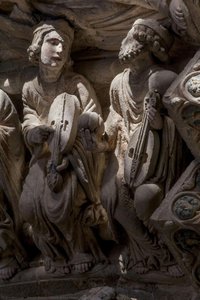
Within the sacred shadows of the Portico of Glory, a profound scene unfolds in stone. The Elders holding instruments, Central Arch, Portico of Glory emerges from the limestone, appearing as if caught in a moment of eternal preparation. This work, created by the hands of Master Mateo, brings the figures of the Apocalypse into a tangible, breathing presence. They sit amidst the radial archivolts, their bodies leaning toward one another…

8
Saint Matthew, Central Arch, Portico of Glory (1211) tarafından Usta Mateo

Saint Matthew, Central Arch, Portico of Glory

1211 · Stone · The Catedral de Santiago Foundation, Santiago de Compostela

The stone breathes under the soft, diffuse light of the cathedral, revealing a figure caught in a moment of eternal devotion. Here, within the central arch of the Portico of Glory, Saint Matthew sits with a quiet, heavy presence. He is a winged presence, his form emerging from the granite with a startling sense of life. He leans over a desk, his knees supporting the weight of his task, as…

9
Saint Luke, Central Arch, Portico of Glory (1211) tarafından Usta Mateo

Saint Luke, Central Arch, Portico of Glory

1211 · Stone · The Catedral de Santiago Foundation, Santiago de Compostela

The limestone relief of Saint Luke, carved around 1211, occupies a central position within the Portico of Glory at the Cathedral of Santiago de Compostela in Spain. The figure is depicted reclining on his right side, a posture that suggests both physical repose and deep introspection. In his left hand, he holds a book, while his head rests upon a lamb, a direct reference to his role as an Evangelist…

10
Arma Christi, Central Arch, Portico of Glory (1211) tarafından Usta Mateo

Arma Christi, Central Arch, Portico of Glory

1211 · Stone · The Catedral de Santiago Foundation, Santiago de Compostela

The relief known as Arma Christi, Central Arch, Portico of Glory is a sculptural work by the artist Master Mateo. This specific piece is situated within the Central Arch of the Portico of Glory. It was created in 1211. The work is part of a larger architectural and sculptural program located at the Santiago de Compostela Cathedral in Galicia, Spain.

Usta Mateo'in ünlü tabloları, 11. ile 44. arası

11Santo dos Croques of the Portico of Glory (1200) tarafından Usta MateoSanto dos Croques of the Portico of Glory1200 · The Catedral de Santiago Foundation 12Saint Matthew (1200) tarafından Usta MateoSaint Matthew1200 · The Catedral de Santiago Foundation 13Statues of David and Solomon (1188) tarafından Usta MateoStatues of David and Solomon1188 · The Catedral de Santiago Foundation 14Portico de la Gloria (1168) tarafından Usta MateoPortico de la Gloria1168 · Cathedral 15Portico de la Gloria (detail) (1168) tarafından Usta MateoPortico de la Gloria (detail)1168 · Cathedral 16Portico de la Gloria (1168) tarafından Usta MateoPortico de la Gloria1168 · Cathedral 17Portico de la Gloria (detail) (1168) tarafından Usta MateoPortico de la Gloria (detail)1168 · Cathedral 18Right arch of the Portico of Glory. Iconography of the condemned (1188) tarafından Usta MateoRight arch of the Portico of Glory. Iconography of the condemned1188 · The Catedral de Santiago Foundation 19Right arch of the Portico of Glory (1188) tarafından Usta MateoRight arch of the Portico of Glory1188 · The Catedral de Santiago Foundation 20Left arch of the Portico of Glory (1188) tarafından Usta MateoLeft arch of the Portico of Glory1188 · The Catedral de Santiago Foundation 21Right columns of the central arch of the Portico of Gloryh (1188) tarafından Usta MateoRight columns of the central arch of the Portico of Gloryh1188 · The Catedral de Santiago Foundation 22Saint Marcus, Central Arch, Portico of Glory (1211) tarafından Usta MateoSaint Marcus, Central Arch, Portico of Glory1211 · The Catedral de Santiago Foundation 23Saint John, Central Arch, Portico of Glory (1211) tarafından Usta MateoSaint John, Central Arch, Portico of Glory1211 · The Catedral de Santiago Foundation 24Ordo Prophetarum, The counter facade, Portico of Glory (1211) tarafından Usta MateoOrdo Prophetarum, The counter facade, Portico of Glory1211 · The Catedral de Santiago Foundation 25The Sybil, The counter facade, Portico of Glory (1211) tarafından Usta MateoThe Sybil, The counter facade, Portico of Glory1211 · The Catedral de Santiago Foundation 26Right arch of the Portico of Glory. Iconography of the blessed (1211) tarafından Usta MateoRight arch of the Portico of Glory. Iconography of the blessed1211 · The Catedral de Santiago Foundation 27Detail of the Elders, Central Arch, Portico of Glory (1211) tarafından Usta MateoDetail of the Elders, Central Arch, Portico of Glory1211 · The Catedral de Santiago Foundation 28Tribune of Portico of Glory (1211) tarafından Usta MateoTribune of Portico of Glory1211 · The Catedral de Santiago Foundation 29Angels, The Tribune, Portico of Glory (1211) tarafından Usta MateoAngels, The Tribune, Portico of Glory1211 · The Catedral de Santiago Foundation 30Portico of Glory (1211) tarafından Usta MateoPortico of Glory1211 · The Catedral de Santiago Foundation 31Keystones from Portico of the Glory (1211) tarafından Usta MateoKeystones from Portico of the Glory1211 · The Catedral de Santiago Foundation 32Detail Maiestas Domini of The Portico of Glory (1211) tarafından Usta MateoDetail Maiestas Domini of The Portico of Glory1211 · The Catedral de Santiago Foundation 33Arma Christi, Central Arch, Portico of Glory (1211) tarafından Usta MateoArma Christi, Central Arch, Portico of Glory1211 · The Catedral de Santiago Foundation 34The Just, Central Arch, Portico of Glory (1211) tarafından Usta MateoThe Just, Central Arch, Portico of Glory1211 · The Catedral de Santiago Foundation 35Detail of the Elders, Central Arch, Portico of Glory (1211) tarafından Usta MateoDetail of the Elders, Central Arch, Portico of Glory1211 · The Catedral de Santiago Foundation 36Detail of the Blessed, Central Arch, Portico of Glory (1211) tarafından Usta MateoDetail of the Blessed, Central Arch, Portico of Glory1211 · The Catedral de Santiago Foundation 37Central Arch of The Portico of Glory (1211) tarafından Usta MateoCentral Arch of The Portico of Glory1211 · The Catedral de Santiago Foundation 38Organistrum, Central Arch, Portico of Glory (1211) tarafından Usta MateoOrganistrum, Central Arch, Portico of Glory1211 · The Catedral de Santiago Foundation 39Drawing José Vega y Verdugo (1656-1657) Archivo de la Catedral (1657) tarafından Usta MateoDrawing José Vega y Verdugo (1656-1657) Archivo de la Catedral1657 · The Catedral de Santiago Foundation 40Left arch of the Portico of Glory. Iconography (1188) tarafından Usta MateoLeft arch of the Portico of Glory. Iconography1188 · The Catedral de Santiago Foundation 41Estatuas-columna de dos profetas procedentes de la desaparecida fachada exterior del Pórtico de la Gloria\n\n- Isaac (1188) tarafından Usta MateoEstatuas-columna de dos profetas procedentes de la desaparecida fachada exterior del Pórtico de la Gloria\n\n- Isaac1188 · The Catedral de Santiago Foundation 42Rose window (1200) tarafından Usta MateoRose window1200 · The Catedral de Santiago Foundation 43Stony choir reconstruction (1211) tarafından Usta MateoStony choir reconstruction1211 · The Catedral de Santiago Foundation 44Lintels Central Arch of The Portico of Glory (1188) tarafından Usta MateoLintels Central Arch of The Portico of Glory1188 · The Catedral de Santiago Foundation

Usta Mateo'ın ilgisini çeken konular

Bu orijinal eserlerde en sık karşılaşılan ve her biri en seçkin örneğine sahip olan dört konu.

Usta Mateo'in orijinal eserlerinin sergilendiği müzeler

Bu sayfadaki tabloların çoğuna ev sahipliği yapan 2 müze.

Müze Şehir Usta Mateo Eserleri Bu listedeki tablolar
The Catedral de Santiago Foundation, Santiago de CompostelaThe Catedral de Santiago Foundation Santiago de Compostela 40 The disappeared façade at the end of the Camino, Base of the mullion of the Portico of Glory, Trinity of the Portico of Glory
Cathedral, Santiago de CompostelaCathedral Santiago de Compostela 4 Portico de la Gloria, Portico de la Gloria (detail), Portico de la Gloria

On yıllar boyunca Usta Mateo: her biri için eşsiz bir orijinal eser

On yıllara göre eserler

O dönemi tanımlayan orijinal eseri görmek için bir on yıl seçin.

Usta Mateo'in tabloları: galeri için sorular

Usta Mateo tarafından yapılmış en ünlü eser hangisidir?Cevabı göster

The disappeared façade at the end of the Camino (1211), The Catedral de Santiago Foundation, Santiago de Compostela. Ardından Base of the mullion of the Portico of Glory (1188) ve Trinity of the Portico of Glory (1188) geliyor.

Usta Mateo, The disappeared façade at the end of the Camino eserini kaç yaşında yarattı?Cevabı göster

50 yaşında: The disappeared façade at the end of the Camino 1211 yılına aittir ve Usta Mateo 1161 yılında doğmuştur.

Usta Mateo tarafından yapılmış en ünlü on tablo hangileridir?Cevabı göster

The disappeared façade at the end of the Camino, Base of the mullion of the Portico of Glory, Trinity of the Portico of Glory, Statue-column of king David, The Glory, Central Arch, Portico of Glory, The Elders holding instruments, Central Arch, Portico of Glory, Voussoirs with the punishment of lust, Saint Matthew, Central Arch, Portico of Glory, Saint Luke, Central Arch, Portico of Glory ve Arma Christi, Central Arch, Portico of Glory. Yukarıdaki sıralama, her birinin yapım yılını ve bulunduğu müzeyi göstermektedir.

Usta Mateo tarafından yapılmış kaç eser bilinmektedir?Cevabı göster

Kataloğumuzda Usta Mateo tarafından 1188 ile 1211 tarihleri arasında üretilmiş 44 eser bulunmaktadır.

En ünlü Usta Mateo orijinalleri nerede görülebilir?Cevabı göster

Çoğunlukla The Catedral de Santiago Foundation (Santiago de Compostela) ve Cathedral (Santiago de Compostela) bünyesinde yer almaktadır. Yukarıdaki müze tablosu tümünü listelemektedir.

Usta Mateo en bilinen tablolarını hangi dönemde yaptı?Cevabı göster

1210s döneminde: Bu sayfadaki 44 eserin 24 tanesi o dönemde yapılmıştır, bunların The disappeared façade at the end of the Camino tanesi ise The disappeared façade at the end of the Camino arasındadır.

Hangi ünlü Usta Mateo tablosu en eski, hangisi ise en yenidir?Cevabı göster

Bu sayfadaki en eski eser Base of the mullion of the Portico of Glory (1188), en yeni eser ise The disappeared façade at the end of the Camino (1211)'dir.

Usta Mateo hangi konuları tercih ederdi?Cevabı göster

Sculpture (6), Medieval art (5) ve Stone (4), bu sayfadaki 44 eser genelinde.

Usta Mateo en çok hangi malzemelerle resim yaptı?Cevabı göster

Bu sayfadaki 44 eserin 11 tanesi Stone türündedir.

Usta Mateo eserleri hangi akıma aittir?Cevabı göster

bu sayfadaki orijinallerine bakılırsa Romanesque,

The Catedral de Santiago Foundation bünyesinde Usta Mateo imzalı hangi orijinal eserleri görebilirim?Cevabı göster

The disappeared façade at the end of the Camino, Base of the mullion of the Portico of Glory ve Trinity of the Portico of Glory: The Catedral de Santiago Foundation, Santiago de Compostela, bu sayfadaki eserlerden 40 tanesine ev sahipliği yapmaktadır.

Usta Mateo: sanatçının bir portresi

Santiago’ın Görkeminin Ruhu

Catedral de Santiago de Compostela Katedrali üzerindeki anıtsal katkılarına rağmen ismi gizemlerle dolu bir sanatçı olan Usta Mateo, İspanya'daki Romanesk sanatın en saygın figürlerinden biri olarak kabul edilir. Yaklaşık 1161 yılında Galisya'da doğan ve hayatına dair kesin detayların azlığına rağmen Mateo'nun mirası, temel olarak onun eşsiz başarısı olan Portico de la Gloria üzerine kuruludur. Bu nefes kesici mimari harika, katedralin cephesine hakimiyet kurarak on ikinci yüzyılın manevi coşkusunu bünyesinde barındırır. O, Santiago'ya yapılan hac yolunun binlerce ruh için şimdiden dönüştürücü bir yolculuk olduğu bir dönemde, ateşli bir dini bağlılık ve sanatsal yenilikle şekillenen bir dünyada bir heykeltıraş olarak ortaya çıkmıştır.

En büyük eserinin doğuşu, başyapıtı haline gelecek olan üçlü kapının yapımını denetlemekle görevlendirildiği 1188 yılı civarında başladı. Katedral projesinin kendisi, Kral VIII. Alfonso tarafından teşvik edilen ve bölgenin muazzam dini önemiyle beslenen bir süreç olarak onlarca yıl önce tasarlanmıştı. Bu kutsal bağlam içerisinde Mateo, sadece taşı oymakla kalmadı; ona hayat verdi. Portico de la Adamant'taki varlığı, yapısal bir gerekliliği, hem hacıları hem de sanat tarihçilerini büyülemeye devam eden teolojik bir anlatıya dönüştüren ilahi bir girişimdi.
Taştan Bir Senfoni: Teknik ve Üslup

Mateo'nun heykel tarzı, daha önceki katı Romanesk geleneklerden derin bir kopuşu temsil eden olağanüstü bir gerçekçilik ile karakterize edilir. Çağdaşları genellikle stilize ve düz figürlere dayanırken, Mateo insan anatomisini ve kumaşın karmaşık hareketlerini titizlikle inceleyerek tasvirlerinde şaşırtıcı bir doğruluk yakalamıştır. Özellikle trabajo vivo olarak bilinen tekniği kullanmasıyla kireçtaşı oymacılığındaki ustalığı eşsizdi. Bu yöntem, et ve kumaş görünümini taklit eden dokulu yüzeyler oluşturmak için taş plakların katmanlanmasını içeriyor, böylece statik ortama bir hareket ve canlılık hissi katıyordu.

Bu yenilikçi yaklaşım, dünyevi olan ile ilahi olan arasındaki boşluğu kapatmasına olanak tanıdı. Eserleri incelendiğinde, kabartmalarının derinliğini artırmak için ışık ve gölgeyi ne kadar ustaca kullandığı görülebilir. Taşı, bir azizin cübbesinin yumuşaklığını veya bir İncil figürünün kas gerilimini hissettirecek şekilde manipüle etme yeteneği, ustalığını Orta Çağ'da nadir görülen bir sofistike seviyeye taşıdı. Bu teknik mükemmellik, figürlerinin yalnızca semboller değil, katedralin girişinde hissedilir varlıklar olmasını sağladı.

Portico de la Gloria: İnancın Bir Kanıtı

Portico de la Gloria, Mateo'nun sanatsal ve ruhani vizyonunun nihai kanıtı olarak hizmet eder. Merkezi paneller; Doğuş, Müjde ve Çarmıha Gerilme dahil olmak üzere İncil'den derin sahneleri, izleyiciyi kutsal bir tarih boyunca yönlendirecek şekilde düzenler. İkonografi geniş ve karmaşıktır ve şunları içerir:

  • Merkezi Kemer: Aziz Luka gibi ikonik figürlerin yer aldığı ve karmaşık Romanesk heykel sanatının derin dini sembolizm sergilediği bölüm.
  • Sol Kemer: Detaylı İncil anlatılarını sergileyen, 12. yüzyıl İspanyol kabartma oymacılığının bir ustalık dersi.
  • Sağ Kemer: Karmaşık mimari ve heykel entegrasyonunu yönetme yeteneğini kanıtlayan, girift bir güzellik sergisi.

Mateo, bu eserleri aracılığıyla doğduğu dönemi aşan bir tarihsel önem kazandı. Romanesk stili, Gotik tarzın gelişen zarafetine doğru dönüştürerek, Santiago de Compostela'nın kalp atışı olmaya devam eden bir miras bıraktı. Eseri, Orta Çağ zihniyeti ile sonsuzluk arasında kalıcı bir köprü olarak durmakta ve 1217'deki ölümünden yüzyıllar sonra bile taş senfonisinin görkeminin hayranlık uyandırmaya devam etmesini sağlamaktadır.