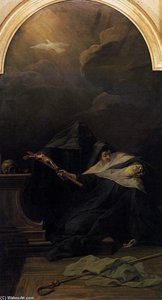
Jean Restout portresi

Her Biri Benzersiz, En Ünlü 31 Jean Restout Tablosu

Kasım 2026 tarihinde güncellendi · popülerlik puanımıza göre sıralanmıştır (her bir eser için aramalar, ziyaretler ve siparişler) · 31 eser Jean Restout kataloğumuzda

Özetle

Pentekost (1732), en çok ilgi çeken Jean Restout tablosudur; orijinali Paris, Louvre Müzesi bünyesinde bulunmaktadır. Ardından göz, Ananias Laying Hands on Saint Paul (1719) ve Venus Presenting Arms to Aeneas (1717) üzerine yoğunlaşır. Kataloğumuzdaki Jean Restout imzalı 31 eser arasından seçilen bu 31 eser; yapıldığı yıl, sergilendiği müze ve zamana meydan okuma nedenleriyle birlikte sunulan en ünlü ve her biri eşsiz orijinal çalışmalardır.

1692 – 1768, Rouen En çok eser: Louvre Müzesi

Galerinin gözünden Jean Restout tarafından yapılan en iyi 10 tablo

1
Pentekost (1732) tarafından Jean Restout

Pentekost

1732 · Tuval Üzerine Yağlı Boya · Louvre Müzesi, Paris

Fransız sanat tarihi'nin muazzam dokusunda, çok az eser ilahi coşku ile tiyatral ihtişamın kesişimini Jean II Restout’un Pentekost eseri kadar derinlemesine yakalar. 1732 yılında tamamlanan bu anıtsal tuval üzerine yağlıboya çalışma, kutsal metinlerin basit bir illüstrasyonundan çok daha fazlasıdır; özenle kurgulanmış ruhani bir deneyimdir. Tablo, izleyiciyi Kutsal Ruh'un inişinin bir mürit topluluğunu sarsıcı bir vahy sahnesine dönüştürdüğü kutsal bir anın kalbine taşır. Işık kompozisyonu delip geçerken, insan ilahi varlığın ağırlığını…

2
Ananias Laying Hands on Saint Paul (1719) tarafından Jean Restout

Ananias Laying Hands on Saint Paul

1719 · Oil On Canvas

Ananias Laying Hands on Saint Paul is a religious painting by Jean Restout created in 1719. The work depicts a specific moment from the New Testament regarding the Conversion of Saint Paul. The subject matter focuses on the restoration of sight to Paul the Apostle through divine intervention.

3
Venus Presenting Arms to Aeneas (1717) tarafından Jean Restout

Venus Presenting Arms to Aeneas

1717 · Kanada Ulusal Galerisi, Ottawa

The scene unfolds in 1717, a moment where Venus Presenting Arms to Aeneas captures a pivotal exchange of strength and destiny. Jean Restout, the hand behind this composition, breathes life into the mythological encounter through a lens of late Baroque classicism. The figures exist in a state of heightened drama, caught in the very instant of preparation and purpose. Every line and shadow works to sustain the tension of this…

5
The Nymph Arethusa Pursued by Alpheus (1720) tarafından Jean Restout

The Nymph Arethusa Pursued by Alpheus

1720 · Oil · Musée Des Beaux, Tours

In Jean Restout's "The Nymph Arethusa Pursued by Alpheus," a sense of urgent, diagonal movement pulls the eye through a celestial struggle. The composition relies on an asymmetrical arrangement that heightens the tension of the chase. High above the viewer, two female figures cling to one another atop soft, billowing clouds. One nymph recoils in distress, her body twisting away from the pursuit, while the other reaches upward. Below them,…

6
Diana and Endymion (1724) tarafından Jean Restout

Diana and Endymion

1724 · Oil

The night is a heavy, velvet weight. In this oval window into the dark, a celestial glow breaks through the midnight blues and deep browns. Diana descends, a luminous presence carved from white drapery and pale skin. She leans toward the earth, toward the quiet stillness of a mortal man. Endymion lies in a deep, undisturbed slumber, his body a soft contour against the shadows. The air between them feels…

7
Christ Healing the Paralytic, also called The Pool of Bethesda (1725) tarafından Jean Restout

Christ Healing the Paralytic, also called The Pool of Bethesda

1725 · Oil

The air in the scene feels heavy with the scent of damp stone and expectation. At the center of this dramatic composition, a figure of light moves through the shadows. Christ stands as the axis of the work, his blue mantle cutting through a palette of ochre and deep sienna. Above, an angelic presence descends, casting an ethereal glow that pierces the atmospheric gloom. Below, the human condition is laid…

8
Le Baptème du Christ (1733) tarafından Jean Restout

Le Baptème du Christ

1733 · Oil · Musée Fabre, Montpellier

Le Baptème du Christ is an oil painting by the French artist Jean Restout. Created about 1733, this large-scale work depicts the biblical scene of the Baptism of Christ. The composition captures a specific moment of religious significance through a wide horizontal arrangement of figures set within a rugged landscape.

9
Alexander Gives His Mistress Campaspe to Apelles, or Painting (1737) tarafından Jean Restout

Alexander Gives His Mistress Campaspe to Apelles, or Painting

1737 · Oil On Canvas · Staatliche Kunsthalle Karlsruhe, Karlsruhe

We are looking at Alexander Gives His Mistress Campaspe to Apelles, or Painting, a work executed by Jean Restout. This piece dates to about 1737, a period when the artist was establishing his presence within the French academic tradition. The composition captures a specific moment of classical narrative, rendered with a sense of theatricality that defines much of Restout's output.

10
Alexander with Apelles, who gives him his mistress Campaspe (Painting) (1739) tarafından Jean Restout

Alexander with Apelles, who gives him his mistress Campaspe (Painting)

1739 · Oil On Canvas

Alexander with Apelles, who gives him his mistress Campaspe (Painting) by Jean Restout is organized around a central group of figures. A sense of movement flows from the left toward the right side of the canvas. The figures are layered across the foreground and the middle ground, which creates a sense of depth within the scene. This arrangement depicts Alexander the Great receiving Campaspe from the painter Apelles. Various onlookers,…

Jean Restout'in ünlü tabloları, 11. ile 31. arası

Jean Restout'in dönemlere göre ünlü tabloları

Jean Restout'ın ilgisini çeken konular

Bu orijinal eserlerde en sık karşılaşılan ve her biri en seçkin örneğine sahip olan dört konu.

Jean Restout'in orijinal eserlerinin sergilendiği müzeler

Bu sayfadaki tabloların çoğuna ev sahipliği yapan 8 müze.

Müze Şehir Jean Restout Eserleri Bu listedeki tablolar
Louvre Müzesi, ParisLouvre Müzesi Paris 2 Pentekost, Ananias Restoring the Sight of St Paul
Musée Des Beaux, ToursMusée Des Beaux Tours 2 The Nymph Arethusa Pursued by Alpheus, The Death of St Scholastica
Musée Fabre, MontpellierMusée Fabre Montpellier 2 Le Baptème du Christ, Baptism of Christ
Kanada Ulusal Galerisi, OttawaKanada Ulusal Galerisi Ottawa 1 Venus Presenting Arms to Aeneas
Los Angeles County Museum of Art, Los AngelesLos Angeles County Museum of Art Los Angeles 1 Venus Ordering Arms from Vulcan for Aeneas
Staatliche Kunsthalle Karlsruhe, KarlsruheStaatliche Kunsthalle Karlsruhe Karlsruhe 1 Alexander Gives His Mistress Campaspe to Apelles, or Painting
Palais des Beaux-Arts de Lille, LillePalais des Beaux-Arts de Lille Lille 1 The Pilgrims at Emmaus
Musée des Beaux-Arts de Caen, CaenMusée des Beaux-Arts de Caen Caen 1 Jesus Christ Washing the Feet of the Apostles

On yıllar boyunca Jean Restout: her biri için eşsiz bir orijinal eser

On yıllara göre eserler

O dönemi tanımlayan orijinal eseri görmek için bir on yıl seçin.

Jean Restout'in tabloları: galeri için sorular

Jean Restout tarafından yapılmış en ünlü eser hangisidir?Cevabı göster

Pentekost (1732), Louvre Müzesi, Paris. Ardından Ananias Laying Hands on Saint Paul (1719) ve Venus Presenting Arms to Aeneas (1717) geliyor.

Jean Restout, Pentekost eserini kaç yaşında yarattı?Cevabı göster

40 yaşında: Pentekost 1732 yılına aittir ve Jean Restout 1692 yılında doğmuştur.

Jean Restout tarafından yapılmış en ünlü on tablo hangileridir?Cevabı göster

Pentekost, Ananias Laying Hands on Saint Paul, Venus Presenting Arms to Aeneas, Venus Ordering Arms from Vulcan for Aeneas, The Nymph Arethusa Pursued by Alpheus, Diana and Endymion, Christ Healing the Paralytic, also called The Pool of Bethesda, Le Baptème du Christ, Alexander Gives His Mistress Campaspe to Apelles, or Painting ve Alexander with Apelles, who gives him his mistress Campaspe (Painting). Yukarıdaki sıralama, her birinin yapım yılını ve bulunduğu müzeyi göstermektedir.

Jean Restout tarafından yapılmış kaç eser bilinmektedir?Cevabı göster

Kataloğumuzda Jean Restout tarafından 1717 ile 1768 tarihleri arasında üretilmiş 31 eser bulunmaktadır.

En ünlü Jean Restout orijinalleri nerede görülebilir?Cevabı göster

Çoğunlukla Louvre Müzesi (Paris), Musée Des Beaux (Tours) ve Musée Fabre (Montpellier) bünyesinde yer almaktadır. Yukarıdaki müze tablosu tümünü listelemektedir.

Jean Restout en bilinen tablolarını hangi dönemde yaptı?Cevabı göster

1730s döneminde: Bu sayfadaki 31 eserin 8 tanesi o dönemde yapılmıştır, bunların Pentekost tanesi ise Pentekost arasındadır.

Hangi ünlü Jean Restout tablosu en eski, hangisi ise en yenidir?Cevabı göster

Bu sayfadaki en eski eser Venus Presenting Arms to Aeneas (1717), en yeni eser ise Portrait of Abbé Tournus (1672-1733) (1768)'dir.

Jean Restout hangi konuları tercih ederdi?Cevabı göster

Man (13), Drapery (13) ve People (10), bu sayfadaki 31 eser genelinde.

Jean Restout en çok hangi malzemelerle resim yaptı?Cevabı göster

Bu sayfadaki 31 eserin 12 tanesi Oil türündedir.

Louvre Müzesi bünyesinde Jean Restout imzalı hangi orijinal eserleri görebilirim?Cevabı göster

Pentekost ve Ananias Restoring the Sight of St Paul: Louvre Müzesi, Paris, bu sayfadaki eserlerden 2 tanesine ev sahipliği yapmaktadır.

Jean Restout: sanatçının bir portresi

Jean II Restout: Life and Legacy

Jean II Restout (1692 – 1768) was a French painter who distinguished himself through his late Baroque classicism, particularly in the realm of religious altarpieces. He stood as a notable figure resisting the prevailing Rococo style of his era.

Early Life and Family Background

Born in Rouen, France, in 1692, Jean II Restout came from an artistic family. His father was Jean I Restout, also a painter. Importantly, his mother, Marie M. Jouvenet, was the sister and pupil of the well-known painter Jean Jouvenet, who would become a significant influence on young Restout’s development.

Artistic Training and Early Career

In 1717, Restout achieved an early milestone by being elected to the Académie Royale de Peinture et de Sculpture based on his work for the prestigious Prix de Rome. However, unlike many recipients, he chose to remain in Paris rather than proceeding to Italy for further study. This decision allowed him to consistently exhibit at the Salons and steadily climb the ranks within the academic hierarchy.

Artistic Style and Major Works

Restout’s artistic style is characterized by a deliberate return to classical principles, even as Rococo flourished around him. His works are marked by their solemnity, dramatic composition, and meticulous detail. He excelled in large-scale altar pieces, ceilings, and designs for the Gobelin tapestries.

Influences and Artistic Development

Jean Jouvenet, his maternal uncle, was a crucial early influence on Restout’s artistic development. Jouvenet's emphasis on classical form and dramatic lighting profoundly shaped Restout’s approach to painting. Restout also studied the works of earlier masters, absorbing their techniques and principles.

Later Life and Legacy

Restout held various positions within the Académie throughout his career, demonstrating his standing in the artistic community. His son, Jean-Bernard Restout (1732–1797), also became a painter and won the Prix de Rome in 1758, though he later faced difficulties with the Academy due to disagreements over its rules.

Historical Significance

Jean II Restout occupies a unique position in French art history. While his work doesn’t possess the widespread fame of some of his contemporaries, his steadfast commitment to classical principles during the height of Rococo makes him a significant figure. He represents a resistance to fleeting trends and a dedication to enduring artistic values. His altarpieces remain important examples of late Baroque classicism in France.