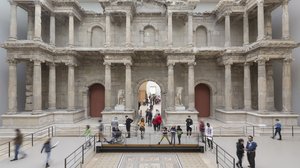
A Legacy of Craftsmanship in Aleppo
The name Halab Schah bin ʿisa, production, evokes the industrious spirit of a master workshop that once flourished within the historic Christian quarter of Aleppo, Syria. Rather than a single solitary painter, this entity represents a pinnacle of Ottoman-era artistic excellence, where a skilled workshop under the guidance of a master craftsman breathed life into decorative treasures. The work emerging from this production was deeply embedded in the domestic and spiritual fabric of the early seventeenth century, serving as a vital conduit for the cultural currents flowing through the Syrian Levant.
The Confluence of Traditions
The artistry produced by this workshop is most profoundly realized in the breathtaking Aleppo Room, a masterpiece that serves as a window into the complex identity of the era. The work embodies a remarkable synthesis of Christian and Islamic artistic traditions, reflecting the lived reality of prosperous Armenian merchant families residing under Ottoman rule. Within these intricate panels, one finds a beautiful dialogue between different worlds:
- The influence of Byzantine illumination is evident in the use of flattened figures and elongated proportions.
- The application of Islamic ornamentation provides a structured elegance through geometric patterns, concentric circles, and stylized arabesques.
- A unique narrative tapestry emerges where biblical symbolism meets the rich traditions of Persian aesthetics.
Artistic Significance and Historical Echoes
The production of Halab Schah bin ʿisa remains a significant milestone in the annals of Syrian
art history. By skillfully employing complex designs that served both decorative and spiritual purposes, the workshop created works that were much more than mere embellishments; they were vessels for piety and
social status. The intricate patterns and symbolic depth found in their creations reflect the zenith of Ottoman-era craftsmanship, capturing a pivotal moment where diverse cultural influences merged to create a harmonious visual language that continues to fascinate scholars and art lovers today.