Ferran Cabrera i Cantó portresi

Ferran Cabrera i Cantó Tabloları: Bir Galerinin Gözünden En Ünlü 16 Eser

Kasım 2026 tarihinde güncellendi · popülerlik puanımıza göre sıralanmıştır (her bir eser için aramalar, ziyaretler ve siparişler) · 16 eser Ferran Cabrera i Cantó kataloğumuzda

Özetle

Galerinin gözünde, Ferran Cabrera i Cantó'in en ünlü tablosu El Abismo'tir. Escena en la Iglesia ve Mujer del pintor, her gözün hemen fark edeceği o üçlüyü tamamlıyor. Katalogumuzdaki Ferran Cabrera i Cantó imzalı 16 eser arasından galerimiz, her biri yapıldığı yıl, sergilendiği müze ve onu eşsiz kılan özellikleriyle birlikte en ünlü 16 eseri aşağıda sunmaktadır.

1866 – 1937, Alcoy

Galerinin en iyi 10 Ferran Cabrera i Cantó tablosu

1
El Abismo tarafından Ferran Cabrera i Cantó

El Abismo

The composition is defined by a stark, monochromatic tension, utilizing a palette of deep blacks and jarring yellows to render a scene of profound human distress. Set against a coastal backdrop where the ocean meets the shore, the work captures a moment of acute instability. Figures are scattered across the terrain; some remain upright in states of agitation, while others lie prone, surrendered to the earth. Two boats, positioned at…

2
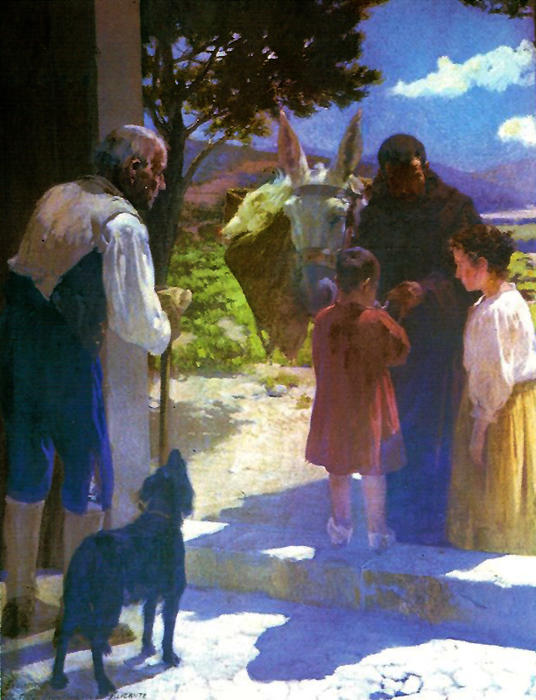
Escena en la Iglesia tarafından Ferran Cabrera i Cantó

Escena en la Iglesia

The afternoon sun casts a gentle light over a peaceful scene unfolding before the stone facade of a church. A man moves through the space, leaning slightly on a cane, his blue trousers catching the light as he walks alongside his faithful dog. There is a sense of unhurried movement here, a moment caught in the middle of a communal pause. Nearby, an ox stands still, its heavy presence grounding…

3
Mujer del pintor tarafından Ferran Cabrera i Cantó

Mujer del pintor

Oil On Canvas

The portrait depicts a seated woman, positioned centrally within the frame. Her upper body and face occupy the primary focus, while the background recedes into a soft, blurred expanse of foliage and atmospheric haze. The lighting is diffused, casting a gentle glow across the contours of her face and the folds of her clothing. Warm tones of yellow and ochre dominate the palette, creating a sense of luminosity that permeates…

4
Mujer Rezando tarafından Ferran Cabrera i Cantó

Mujer Rezando

Oil On Canvas

A single light source descends from above, carving the subject out of a heavy, dark void. The woman sits at a table, her hands clasped in a silent plea. Shadows pool in the folds of her clothing and the hollows of her face, creating a sharp contrast that pulls the viewer into her private sanctuary. Beside her, a vase holds pink flowers, their soft petals offering the only hint of…

11. sıradan 16. sıraya kadar Ferran Cabrera i Cantó tabloları

Ferran Cabrera i Cantó'ın ilgisini çeken konular

Bu orijinal eserlerde en sık karşılaşılan ve her biri en seçkin örneğine sahip olan dört konu.

Ferran Cabrera i Cantó'in tabloları: galeri yanıtları

Tüm Ferran Cabrera i Cantó tabloları arasında en ünlüsü hangisidir?Cevabı göster

El Abismo. Ardından Escena en la Iglesia ve Mujer del pintor geliyor.

Ferran Cabrera i Cantó sanatçısının en iyi 10 tablosu hangileridir?Cevabı göster

El Abismo, Escena en la Iglesia, Mujer del pintor, Mujer Rezando, Retrato de mujer, Paisaje con arbol, Paisaje Verde, Mujer Joven, Escena en el Jardin ve Paisaje. Yukarıdaki sıralama, her birinin yapım yılını ve bulunduğu müzeyi göstermektedir.

Ferran Cabrera i Cantó kaç eser yarattı?Cevabı göster

Kataloğumuzda Ferran Cabrera i Cantó tarafından yapılmış 16 eser bulunmaktadır.

Ferran Cabrera i Cantó en çok hangi konulara geri döndü?Cevabı göster

People (2), Portrait (2) ve Reflection (2), bu sayfadaki 16 eser genelinde.

Ferran Cabrera i Cantó en çok hangi teknikle çalıştı?Cevabı göster

Bu sayfadaki 16 eserin 2 tanesi Oil On Canvas türündedir.

Ferran Cabrera i Cantó: sanatçı

The Genesis of a Spanish Master

Born amidst the cultural richness of Valencia in 1866, Fernando Cabrera Cantó embarked on an artistic journey that would eventually bridge the gap between the grounded reality of the late 19th century and the ethereal whispers of Symbolism. His early training at the Real Academia de Bellas Artes de San Carlos under Lorenzo Casanova provided a sturdy foundation, but it was his travels through Madrid and Italy—supported by the generosity of the Diputación provincial de Alicante—that truly expanded his visual vocabulary. This period of wandering and study allowed him to absorb the technical precision of Spanish realism while preparing his soul for the more decorative, flowing aesthetics of the burgeoning Art Nouveau movement.

A Tapestry of Light and Shadow

The brilliance of Cabrera Cantó lies in his remarkable ability to traverse the vast emotional landscape of the human condition. His oeuvre is a study in contrasts, where one might encounter the cheerful, sun-drenched satire of a genre scene only to be confronted by the darkly morbid or the profoundly contemplative. In works such as Mujer Rezando, he utilizes a delicate rendering and subtle light to capture moments of serene devotion, echoing the influence of masters like Fortuny and Pinazo. Conversely, his more somber compositions, such as Sermón soporífero, demonstrate a mastery of atmosphere, using heavy, contemplative tones to evoke a sense of solemnity that lingers in the viewer's mind long after the gaze has departed. Whether through the organic lines of Art Nouveau or the psychological depth of his portraits, his brushwork remains an intimate dialogue between the artist and the subject.

Legacy Beyond the Canvas

Beyond his individual canvases, Cabrera Cantó’s influence permeated the very architecture and education of his era. His collaboration with the architect Vicente Pascual Pastor in decorating the iconic Casa del Pavo stands as a testament to his ability to integrate fine art into the living fabric of the Art Nouveau landscape in Alcoy. Furthermore, his tenure as a teacher at the School of Arts and Crafts ensured that his technical prowess and philosophical approach to painting were passed down to a new generation of Spanish talent. His life’s work remains a vital link in the evolution of Spanish art, reminding us of a time when the boundaries between realism, decoration, and emotion were beautifully, inextricably blurred.