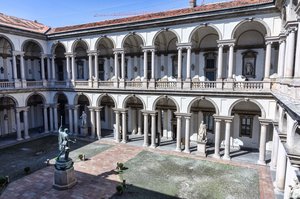
Daniele Crespi portresi

En Ünlü 16 Daniele Crespi Tablosu, Bir Galeri Seçkisi

Kasım 2026 tarihinde güncellendi · popülerlik puanımıza göre sıralanmıştır (her bir eser için aramalar, ziyaretler ve siparişler) · 17 eser Daniele Crespi kataloğumuzda

Özetle

Daniele Crespi tarafından bırakılan tüm orijinal eserler arasında en ünlüsü Cain Killing Abel (1618) adlı çalışmasıdır. Hemen ardından The Flagellation (1625) ve Massacre of the Innocents in Bethlehem (1613) geliyor. Kataloğumuz Daniele Crespi tarafından yapılmış 17 eser barındırmaktadır; galeri, her biri tarihi, müzesi ve hikayesiyle birlikte sergilenen, dünyanın en çok hayranlık duyduğu 16 eseri muhafaza etmektedir.

1598 – 1630, Bussoleno Baroque En çok eser: Museo del Prado

Daniele Crespi tarafından yapılan en iyi 10 tablo: galerinin seçimi

1
Cain Killing Abel (1618) tarafından Daniele Crespi

Cain Killing Abel

1618 · Oil On Canvas

Cain Killing Abel is a religious painting executed by the artist Daniele Crespi. This work dates to 1618. The piece is an oil on canvas that focuses on a specific biblical narrative. It is categorized as an early work in the artist's career, specifically one that deals with issues of anatomy and movement.

2
The Flagellation (1625) tarafından Daniele Crespi

The Flagellation

1625 · Oil On Canvas · Museo del Prado, Madrid

Step closer to observe the way the light catches the pale, muscular torso in the foreground. In this 1625 oil painting, the focus remains tightly held upon the central figure of Christ, whose body is caught in a moment of profound physical strain. The composition does not allow for distractions; it pushes the subject toward us through a shallow depth of field, where the background dissolves into dark, indistinct shadows.…

3
Massacre of the Innocents in Bethlehem (1613) tarafından Daniele Crespi

Massacre of the Innocents in Bethlehem

The scene unfolds through the heavy, dramatic weight of Massacre of the Innocents in Bethlehem. This religious art piece captures a moment of profound human suffering and divine tragedy. Daniele Crespi breathes life into this harrowing biblical narrative, rendering the chaos of the event with a startling, visceral presence. Every figure seems caught in a frantic, desperate struggle that refuses to settle into stillness.

4
The Angel's Message to Joseph (1620) tarafından Daniele Crespi

The Angel's Message to Joseph

1620 · Oil On Canvas

The Angel's Message to Joseph is an oil on canvas created by the Italian painter Daniele Crespi. The work dates to about 1620. It captures a singular, sacred moment of divine communication. A celestial messenger descends to deliver a message to Joseph, marking a pivotal biblical intersection between the heavens and the earthly realm.

5
The Last Supper (1624) tarafından Daniele Crespi

The Last Supper

1624 · Intaglio · Pinacoteca di Brera, Milano

The Last Supper is an artwork by Daniele Crespi. Created in 1624, this piece captures the heavy atmosphere of revelation and betrayal. It belongs to the Baroque and Italian Baroque styles of the Early Modern period. The scene focuses on the tension held within a single, pivotal moment of human history.

6
The Entombment of Christ (1626) tarafından Daniele Crespi

The Entombment of Christ

1626 · Oil On Canvas · Szépművészeti Múzeum, Budapeşte

The heavy silence of the tomb hangs over The Entombment of Christ, a work that captures a moment of profound stillness. Daniele Crespi brings this somber scene to life through the medium of oil on canvas, where the light catches the edges of grief and the weight of the body. The composition unfolds within a space measuring 122.5 x 98.5 cm, drawing the eye toward the central figure resting upon…

7
Porrtrait of Antonio Olgiati (1621) tarafından Daniele Crespi

Porrtrait of Antonio Olgiati

1621 · Oil

The portrait depicts a man from the early seventeenth century, positioned in a three-quarter view. He is dressed in a dark doublet, likely black, which features a crisp white collar. His facial hair consists of a mustache and a beard, and his hair shows graying at the temples. The subject's gaze is directed slightly away from the viewer, toward the side, creating a sense of quiet contemplation. The lighting is…

8
Portrait of a Gentleman (1625) tarafından Daniele Crespi

Portrait of a Gentleman

1625 · Oil

The man stares directly from the canvas, his eyes meeting the viewer with a quiet, heavy confidence. He sits enveloped in a darkness so profound it feels as though he is emerging from a void, a technique that pulls his features into sharp, sudden relief. A white collar provides a stark, bright boundary between his weathered skin and the deep black of his doublet. Every line on his face tells…

Daniele Crespi seçkisi devam ediyor, 11 ile 16 arası

Daniele Crespi'in dönemlere göre ünlü tabloları

Daniele Crespi'ın ilgisini çeken konular

Bu orijinal eserlerde en sık karşılaşılan ve her biri en seçkin örneğine sahip olan dört konu.

Daniele Crespi'in orijinal eserlerinin sergilendiği müzeler

Bu sayfadaki tabloların çoğuna ev sahipliği yapan 7 müze.

Müze Şehir Daniele Crespi Eserleri Bu listedeki tablolar
Museo del Prado, MadridMuseo del Prado Madrid 2 The Flagellation, Pietà
Pinacoteca di Brera, MilanoPinacoteca di Brera Milano 2 The Last Supper, The Last Supper
Bavarian State Painting Collections, MünihBavarian State Painting Collections Münih 1 Massacre of the Innocents in Bethlehem
Szépművészeti Múzeum, BudapeşteSzépművészeti Múzeum Budapeşte 1 The Entombment of Christ
Los Angeles County Museum of Art, Los AngelesLos Angeles County Museum of Art Los Angeles 1 The flagellation
Kunsthistorisches Museum, ViyanaKunsthistorisches Museum Viyana 1 Joseph’s dream
Castello Sforzesco, MilanoCastello Sforzesco Milano 1 Martyrdom of Saint Stephen

Daniele Crespi yıl yıl: her birini tanımlayan orijinaller

1613 ile 1628 yılları arasında, Daniele Crespi 16 yıl boyunca çalıştı: bu seçki, sanatçının uzun kariyerini en seçkin orijinal eserleri üzerinden yıl yıl takip ediyor.

Yıla göre eserler

Orijinallerini görmek için bir yıl seçin.

Koleksiyonerlerin Daniele Crespi'in tabloları hakkındaki soruları

Daniele Crespi en çok hangi eseriyle tanınır?Cevabı göster

Cain Killing Abel (1618). Ardından The Flagellation (1625) ve Massacre of the Innocents in Bethlehem (1613) geliyor.

Cain Killing Abel yapıldığında Daniele Crespi kaç yaşındaydı?Cevabı göster

20 yaşında: Cain Killing Abel 1618 yılına aittir ve Daniele Crespi 1598 yılında doğmuştur.

En ünlü on Daniele Crespi tablosu hangileridir?Cevabı göster

Cain Killing Abel, The Flagellation, Massacre of the Innocents in Bethlehem, The Angel's Message to Joseph, The Last Supper, The Entombment of Christ, Porrtrait of Antonio Olgiati, Portrait of a Gentleman, Flagellation of Christ. ve Painting in the nave of San Nazaro Maggiore basilica in Milan. Yukarıdaki sıralama, her birinin yapım yılını ve bulunduğu müzeyi göstermektedir.

Daniele Crespi kaç tablo bıraktı?Cevabı göster

Kataloğumuzda Daniele Crespi tarafından 1613 ile 1628 tarihleri arasında üretilmiş 17 eser bulunmaktadır.

Daniele Crespi'in şaheserleri hangi müzelerde sergileniyor?Cevabı göster

Çoğunlukla Museo del Prado (Madrid), Pinacoteca di Brera (Milano) ve Bavarian State Painting Collections (Münih) bünyesinde yer almaktadır. Yukarıdaki müze tablosu tümünü listelemektedir.

Daniele Crespi en ünlü eserlerini hangi yıllarda yaptı?Cevabı göster

1624 döneminde: Bu sayfadaki 16 eserin 2 tanesi o dönemde yapılmıştır, bunların The Last Supper tanesi ise The Last Supper arasındadır.

Daniele Crespi sanatçısının ilk ve son ünlü orijinal eserleri nelerdir?Cevabı göster

Bu sayfadaki en eski eser Massacre of the Innocents in Bethlehem (1613), en yeni eser ise Supper of St Carlo Borromeo (1628)'dir.

Daniele Crespi en çok hangi konuları seçti?Cevabı göster

Man (6), Figures (4) ve People (3), bu sayfadaki 16 eser genelinde.

Daniele Crespi en çok hangi tekniği kullandı?Cevabı göster

Bu sayfadaki 16 eserin 7 tanesi Oil On Canvas türündedir.

Daniele Crespi hangi sanat akımına ait?Cevabı göster

bu sayfadaki orijinallerine bakılırsa Baroque,

Museo del Prado bünyesinde hangi Daniele Crespi eserleri sergilenmektedir?Cevabı göster

The Flagellation ve Pietà: Museo del Prado, Madrid, bu sayfadaki eserlerden 2 tanesine ev sahipliği yapmaktadır.

Daniele Crespi: yaşamı ve eserleri

A Vision of the Lombard Baroque

Daniele Crespi stands as one of the most original and compelling voices to emerge from Milan during the 1620s. An Italian painter and draughtsman of profound sensitivity, he played a pivotal role in reshaping the aesthetic landscape of his era. At a time when the region was still deeply entrenched in the exaggerated, often convoluted manner of Lombard Mannerism, Crespi sought a different path. He moved toward an early Baroque style characterized by a striking clarity of form and content, favoring a more naturalistic and direct emotional appeal that resonated with the spiritual needs of his time.

His artistic journey was marked by a rapid ascent and a tragic, premature end. Though his formal training remains somewhat elusive, his early career is anchored by his work alongside Guglielmo Caccia, known as Moncalvo, on significant ecclesiastical commissions in Milan. Through these early endeavors, Crespi began to refine a technique that would eventually define the Lombard school. His development was deeply influenced by the masters of his day, particularly Giovanni Battista Crespi, called Il Cerano, and Giulio Cesare Procaccini. From them, he inherited a sense of monumental stability, yet he infused his work with a unique dynamism and a simplified composition that stripped away unnecessary artifice.

Mastery of Light and Emotion

The true brilliance of Crespi’s oeuvre lies in his ability to bridge the gap between the earthly and the eternal through the masterful use of chiaroscuro. His religious paintings are not merely historical or biblical depictions; they are immersive experiences of devotion. By manipulating light to emerge from deep, impenetrable shadows, he sculpted his figures with a sculptural realism that commands the viewer's attention. This dramatic interplay of shadow and brilliance serves as a powerful spiritual metaphor, symbolizing divine grace piercing through the darkness of human suffering.

In masterpieces such as his Pietà, one can witness the profound depth of human grief captured with exquisite precision. The way light falls softly upon wounded flesh or illuminates the heavy, somber folds of drapery invites a lingering, meditative gaze. Whether through his prolific history paintings or his intimate portraits, Crespi maintained a commitment to clarity and emotional intensity. His work often featured:

  • Dramatic Chiaroscuro: The use of intense light and shadow to create depth and spiritual tension.
  • Devotional Narratives: A focus on monastic and religious themes that emphasized direct emotional connection.
  • Naturalistic Detail: A move away from Mannerist distortion toward a more tangible, human reality.

Legacy and Historical Significance

Though his life was cut short by the Milan plague in 1630 at approximately thirty-two years of age, Crespi’s impact on Italian art remains indelible. He successfully transitioned Lombard painting from the complex rhythms of late Mannerism toward a more accessible, seventeenth-century idiom. His ability to blend classical clarity with Baroque dynamism ensured that his works would find a permanent home in some of the world's most prestigious institutions.

Today, his legacy is preserved within the halls of major encyclopedic museums, including the Metropolitan Museum of Art, the Pinacoteca di Brera, and the Los Angeles County Museum of Art (LACMA). Through these enduring works, Crespi continues to offer a window into the profound depths of human compassion and the timeless beauty of the Baroque spirit.