The Genesis of Abstract Expressionism: From Post-War Anxiety to Artistic Revolution
The mid-20th century bore witness to a seismic shift in the art world, one born not from utopian ideals but from the fractured psyche of a post-war generation. Abstract Expressionism wasn’t merely a stylistic departure; it was an attempt to grapple with existential anxieties, the trauma of global conflict, and the search for meaning in a seemingly chaotic world. Emerging primarily in New York City, this movement rejected traditional representational art, favoring instead spontaneous gesture, non-geometric abstraction, and monumental scale as vehicles for expressing inner turmoil and profound emotional states. The shadow of European Surrealism loomed large – artists like Arshile Gorky, fleeing political upheaval, brought with them a fascination with automatism and the subconscious, techniques that would become foundational to the new American aesthetic. But Abstract Expressionism wasn’t simply an imitation; it was a distinctly American response, fueled by a unique cultural context and a desire to forge a new artistic identity.
The early pioneers – Jackson Pollock, with his revolutionary drip paintings; Mark Rothko, exploring the sublime power of color; Willem de Kooning, whose visceral brushstrokes captured raw energy – weren’t unified by a single aesthetic approach. Rather, they shared a commitment to authenticity and emotional honesty. Pollock's method, famously abandoning easel and brush in favor of pouring and flinging paint onto canvas laid on the floor, was less about creating an image and more about enacting a performance, a direct translation of inner experience onto the surface. Rothko’s canvases, conversely, were deeply contemplative spaces, layered rectangles of color designed to evoke feelings of awe, melancholy, or spiritual transcendence. De Kooning's work, often characterized by aggressive brushwork and fragmented figures, embodied a more turbulent emotional landscape.
This initial wave, however, wasn’t monolithic. The movement quickly fractured into distinct tendencies, setting the stage for subsequent artistic explorations that built upon – and reacted against – its core principles. The desire to move beyond purely subjective expression led artists to explore different avenues of abstraction, paving the way for movements like Lyrical Abstraction and Post-Painterly Abstraction.
Color Field Painting: Exploring the Sublimity of Hue and Emotional Depth
From the broader canvas of Abstract Expressionism emerged Color Field painting, a subgenre that distilled the movement’s emotional intensity into its purest form: color itself. Artists like Mark Rothko, Barnett Newman, and Clyfford Still sought to create paintings that were not *about* something but rather *were* something – immersive fields of hue designed to evoke profound feelings in the viewer. This wasn't simply about aesthetic preference; it was a deliberate attempt to bypass narrative and symbolism, engaging directly with the subconscious through the power of color.
Mark Rothko, perhaps the most iconic figure associated with Color Field painting, believed that color possessed an inherent emotional resonance. His signature style involved layering luminous rectangles of color on canvas, creating a sense of depth and contemplation. Paintings like ‘Untitled’ (1964) and ‘No. 4’ (1964) exemplify this approach, inviting viewers to lose themselves in the subtle nuances of hue and tone. He wasn't interested in depicting objects or scenes; he wanted to create paintings that were experienced rather than observed – spaces for introspection and emotional connection.
Barnett Newman, another pivotal figure, approached color field painting with a different sensibility. His works are characterized by large fields of color punctuated by vertical ‘zips’ – unpainted bands that divide the canvas. These zips weren't merely formal elements; they served as symbolic representations of human presence and spiritual experience, offering a sense of scale and monumentality. Newman aimed to create paintings that were both visually striking and intellectually stimulating.
Clyfford Still, often overlooked but equally influential, explored the jagged edges and intense color palettes of abstract form. His paintings evoke landscapes or geological formations, suggesting a connection between art and nature. The layering and juxtaposition of colors create a sense of depth and dynamism, inviting viewers to contemplate the raw power of the natural world.
Lyrical Abstraction: A Softer Edge – Intuition, Fluidity, and Atmospheric Resonance
As Abstract Expressionism matured, a countercurrent emerged—a movement that retained its focus on color but shifted away from the aggressive energy of Pollock and the austere formalism of Newman. Lyrical Abstraction, exemplified by artists such as Helen Frankenthaler and Morris Louis, embraced fluidity, intuition, and atmospheric resonance. This wasn’t a rejection of Abstract Expressionism so much as an evolution, a softening of its edges and a greater emphasis on subjective experience.
Helen Frankenthaler's ‘soak-stain’ technique revolutionized abstract painting in the 1950s. By pouring thinned paint directly onto unprimed canvas, she created luminous, ethereal effects that blurred the boundaries between form and ground. This method allowed colors to flow and blend organically, resulting in paintings that were both delicate and dynamic. The emphasis was on chance and spontaneity, allowing the paint itself to dictate the composition.
Morris Louis further refined this approach with his ‘Veil Paintings.’ He poured vibrant hues onto unprimed canvas, allowing them to flow and blend in unpredictable ways. These paintings are characterized by their large scale and luminous colors, creating an immersive visual experience. Louis’s work is notable for its lack of traditional brushwork or compositional structure; the focus is entirely on the interaction of color.
Post-Painterly Abstraction: Formal Clarity, Intellectual Rigor, and the Pursuit of Pure Aesthetics
By the late 1950s, a growing dissatisfaction with the perceived emotionalism of earlier Abstract Expressionists led to the emergence of Post-Painterly Abstraction. Championed by critic Clement Greenberg, this movement sought greater clarity, intellectual rigor, and a return to formal concerns. It wasn’t about rejecting emotion altogether but rather about expressing it through more controlled means.
Barnett Newman, though often associated with Color Field painting, also played a key role in shaping Post-Painterly Abstraction. His ‘zips,’ as previously mentioned, weren't merely decorative elements; they served as symbolic representations of human presence and spiritual experience, offering a sense of scale and monumentality within a rigorously defined formal structure.
Friedel Dzubas's large-scale Magna paintings demonstrate a meticulous precision and exploration of color and shape. He used Magna paint – an acrylic polymer medium – to create vibrant, luminous surfaces with sharp edges and defined forms. Dzubas sought to create paintings that were both visually striking and intellectually stimulating, emphasizing the purity of form and color.
Beyond the Canvas: Identifying Emotional Resonance in Contemporary Abstract Works
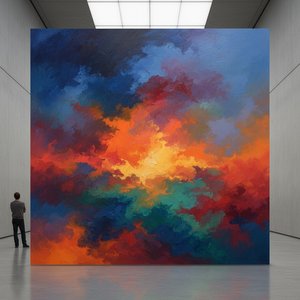
The legacy of Abstract Expressionism extends far beyond its historical moment. Contemporary artists continue to explore the possibilities of abstraction, building upon – and challenging – the principles established by their predecessors. But how do we identify genuine emotional resonance in these works? Scale remains a crucial factor; large-scale canvases create an immersive experience that can evoke feelings of awe or vulnerability.
The use of color is equally important. Artists like Gerhard Richter, while rooted in German art history, demonstrate a dynamic impasto technique and vibrant color palettes reminiscent of the movement’s energy. However, Richter introduces an element of chance and ambiguity through squeegeeing techniques, blurring the line between control and spontaneity. Texture adds another layer of emotional depth; impasto techniques create tactile surfaces that invite viewers to engage with the painting on a physical level.
Ultimately, identifying emotional resonance is a subjective experience. Look for works that evoke a visceral response – paintings that stir your emotions, challenge your perceptions, and invite contemplation. Consider the artist’s intent, the historical context of the work, and the interplay of form, color, and texture.
Building Your Collection: Investing in Lasting Value within the Abstract Expressionist Tradition
Investing in art is not merely a financial transaction; it's an investment in culture, history, and emotional experience. Abstract Expressionism remains a cornerstone of modern art, with works by Pollock, Rothko, and De Kooning commanding significant prices on the secondary market. However, building a collection doesn’t require acquiring masterpieces. Emerging artists who explore the principles of Abstract Expressionism offer exciting opportunities for collectors.
Research is paramount. Understand the artist’s background, their influences, and their place within the broader art historical context. Consider the provenance of the work – its history of ownership – as this can significantly impact its value. Consult with art advisors or appraisers to gain expert insights and avoid potential pitfalls.
At OriginalUniqueArt.com, we offer both hand-painted reproductions of classic masterpieces and original works by emerging artists, providing collectors with a diverse range of options. Our commitment to quality, authenticity, and customer satisfaction ensures that you’re acquiring pieces with lasting value. Whether you're seeking a statement piece for your home or building a comprehensive collection, we can help you navigate the world