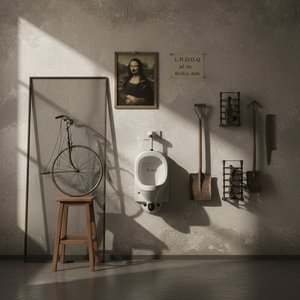
The Crucible of Chaos: World War I and the Genesis of Discontent
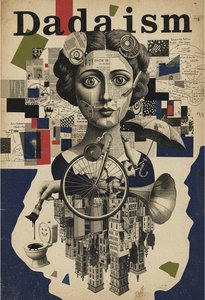 Dadaism Unveleid: The Radical Art Movement That Defied All Rules and Redefined Modernity
The Genesis of Chaos: Post-War Trauma and the Birth of Dada To understand the seismic shift that was Dadaism, one must first look toward the smoke-filled landscapes of early 20th-century Europe. The movement did not emerge from a desire for aesthetic...
To understand the fractured soul of Dadaism, one must first look toward the smoke-filled horizons of the early twentieth century. It was an era defined by a profound sense of disillusionment, where the traditional structures of society—logic, nationalism, and even the concept of progress—seemed to collapse under the weight of industrial warfare. As the senseless carnage of World War I ravaged Europe, a group of displaced intellectuals and artists found refuge in neutral Zurich, Switzerland. In this sanctuary of shadows, the seeds of rebellion were sown. They did not seek to create beauty; they sought to mirror the absurdity of a world that had lost its moral compass. The movement was born not from an aesthetic desire, but as a visceral, guttural scream against the very civilization that had permitted such devastation.
This period of intense trauma acted as a catalyst for a new kind of creative expression, one that rejected the polished aesthetics of the past in favor of something more raw and confrontational. The artists gathered in the Cabaret Voltaire were not merely reacting to war; they were reacting to the failure of reason itself. If logic had led to the trenches, then logic was an enemy to be dismantled. This atmosphere of profound discontent provided the fertile, albeit chaotic, ground necessary for a movement that would eventually spread from Zurich to Berlin, Paris, and New Serenity in New York, forever altering the trajectory of the avant-garde.
The Philosophy of Anti-Art: Rejecting Logic, Reason, and Tradition
--- title: Anti-art | Tate url: https://www.tate.org.uk/art/art-terms/a/anti-art hostname: tate.org.uk description: Tate glossary definition for anti-art: Art that challenges the existing accepted definitions of art sitename: Tate date: 2017-04-05 --...
Dadaism was, at its core, an anti-art movement. This term, famously associated with the provocations of Marcel Duchamp, does not imply a lack of creativity, but rather a deliberate challenge to the existing accepted definitions of what constitutes art. The Dadaists viewed the established bourgeois values and artistic dogmas as complicit in the societal decay of their time. To them, the traditional pursuit of aesthetic pleasure was a hollow endeavor, a mask worn by a culture that had abandoned its humanity. By embracing nonsense, chance, and irrationality, they sought to strip away these masks and expose the underlying absurdity of existence.
The principles of Dada were often codified through manifestos, such as those by Hugo Ball, which emphasized the destruction of language and the rejection of traditional composition. They utilized collage, photomontage, and found objects to create works that felt fragmented and ephemeral, much like the world they inhabited. This was a rebellion against the permanence and sanctity of the museum piece. By elevating the accidental and the mundane, Dadaism forced the viewer to confront the arbitrary nature of value. It was an intellectual insurrection that demanded a complete re-evaluation of the relationship between the creator, the object, and the observer.
Marcel Duchamp and the Readymade: Redefining Artistic Intention
 Fountain (Duchamp)
Fountain was a readymade sculpture attributed to Marcel Duchamp in 1917, consisting of a porcelain urinal signed "R. Mutt". The work is regarded by art historians and theorists of the avant-garde as a major landmark in 20th-century art. In April 1917...
No figure looms larger over the Dadaist landscape than Marcel Duchamp, a philosophical provocateur whose influence remains unparalleled in the twentieth century. While his early training at the Académie Julian provided him with a formidable command of traditional techniques—evident in the restrained elegance of works like his Portrait of Yvonne Duchamp—he would eventually abandon these established practices to embark on a path of radical experimentation. Duchamp’s most profound contribution was the invention of the readymade: ordinary, mass-produced objects that were elevated to the dignity of art through nothing more than the artist's act of choice.
The most infamous example remains Fountain (1917), a porcelain urinal submitted to the Society of Independent Artists under the pseudonym "R. Mutt." By simply selecting an everyday piece of plumbing, altering its orientation, and bestowing upon it a title, Duchamp bypassed the need for manual craftsmanship. He shifted the locus of art from the hand to the mind. This act of appropriation challenged the very notion of the artist as a skilled maker of beautiful things, proposing instead that the artist is a conceptual architect who recontextualicalizes reality. Through the readymade, the concept of "artistic intention" was irrevocably transformed, paving the way for the intellectual depth that would define much of modernism.
Beyond the Visual: The Intellectual Rebellion Against 'Retinal Art'
The readymades of Marcel Duchamp are ordinary manufactured objects that the artist selected and modified, as an antidote to what he called "retinal art". By simply choosing the object (or objects) and repositioning or joining, titling and signing it,...
Duchamp’s rebellion was specifically targeted at what he termed "retinal art"—art that was designed solely to please the eye. He found himself increasingly disillusioned with movements like Impressionism and Post-Impressionism, which, despite their brilliance, focused heavily on the sensory experience of light and color. For Duchamp, such an obsession with the visual was a limitation; it lacked the intellectual rigor required to address the complexities of a fractured age. He sought a method of expression that engaged the intellect rather than just the retina.
This pursuit of conceptual depth led him to explore themes of identity, gender, and language. His use of puns and wordplay, as seen in his creation of the female pseudonym Rrose Sélavy, demonstrates an interest in how meaning is constructed and manipulated. Even his later works, such as the Boîte-en-valise, reflect a desire to create portable, self-contained universes that demand active interpretation. By moving away from purely aesthetic concerns, Duchamp and his contemporaries forced art to become a medium for philosophical inquiry, ensuring that the viewer could no longer remain a passive observer of beauty, but must instead become an active participant in the decoding of meaning.
The Enduring Legacy: How Dadaism Forged the Path for Conceptualism
 Rrose Sélavy
Introduction to Marcel Duchamp Marcel Duchamp (July 28, 1887 – October 2, 1968) was a French-American painter, sculptor, chess player, and writer whose work is associated with Cubism, Dada, and conceptual art. He is commonly regarded as one of the th...
Though the original Dada movement eventually dissolved as its members moved into other avant-garde spheres like Surrealism, its impact on the history of art is immeasurable. The movement’s insistence on the primacy of the idea over the object laid the foundational stones for Conceptual Art. Every time a contemporary artist uses performance, installation, or found media to challenge social norms, they are operating within the lineage established by the Dadaists. They inherited the permission to be irreverent, to use irony as a weapon, and to question the very boundaries of the canvas.
<_p>The legacy of Dadaism is visible in the way we perceive the museum today—not merely as a repository for precious objects, but as a space for dialogue and provocation. It taught us that art can be found in the mundane, that meaning is fluid, and that the most powerful tool an artist possesses is not the brush, but the intellect. As we continue to navigate an era of rapid technological and social change, the spirit of Dada—the courage to find meaning within chaos—remains as vital and necessary as ever.At OriginalUniqueArt.com, we celebrate the profound history of the masters. While Dadaism challenged the very existence of the object, we honor the enduring power of the painted image. Our mission is to make fine art accessible to everyone through high-quality, hand-painted oil reproductions that capture the soul and texture of history's greatest works. Whether you are a student seeking to study the brushwork of the Old Masters or a collector looking to bring a piece of museum-grade history into your home, our artists specialize in recreating the profound beauty that has shaped our world. Explore our vast library of masterpieces and discover the art that continues to inspire.