Early Life & Academic Foundations: Parma and Initial Influences
 Wikipedia: Alberto Pasini
Alberto Pasini (3 September 1826 – 15 December 1899) was an Italian painter. He is best known for depicting Orientalist subjects in a late-Romantic style. == Biography == He was born in Busseto. His father was a commissioner for his district, a p...
Alberto Pasini, born in the idyllic town of Busseto in 1826, embarked on a journey that would see him become a celebrated chronicler of distant lands and atmospheric cityscapes. His early life was marked by a shift to Parma following his father’s untimely death, an event which propelled him into the structured world of the Academy of Fine Art at the age of seventeen. This period wasn't merely about technical training; it was about cultivating an eye for detail and a nascent appreciation for landscape—foundations that would later blossom in his evocative depictions of Persia, Istanbul, and Venice. Crucially, Pasini benefited from the guidance of his uncle, Antonio Pasini, a painter and manuscript illuminator who instilled within him a respect for craftsmanship and collaboration with established publishing houses like Giovanni Battista Bodoni’s. By 1852, even at this early stage, Pasini demonstrated ambition, exhibiting a series of lithographs showcasing regional castles—a testament to his burgeoning talent and observational skills. These weren't simply topographical renderings; they hinted at a deeper fascination with architecture and the stories embedded within stone walls.
The Allure of Paris: Barbizon School & Chassériau’s Guidance
Recognizing Pasini’s potential, artist Paolo Toschi encouraged him to seek further refinement in the artistic heart of Europe—Paris. This move proved pivotal. Initially joining the workshops of Pierre-Luc-Charles and Eugène Cicéri, associated with the Barbizon School, Pasini absorbed a new sensibility: an emphasis on direct observation from nature and a more realistic approach to landscape. However, it was his subsequent mentorship under Théodore Chassériau that truly shaped his artistic trajectory. Chassériau’s influence is palpable in Pasini's later works—a blend of Romantic drama with meticulous detail and a sophisticated use of color. The year 1853 marked a turning point when his lithograph, “The Evening,” gained him admittance to the prestigious Paris Salon, solidifying his position within the artistic community and opening doors to new opportunities.
Orientalist Travels: Persia, Istanbul, and the Shaping of a Style
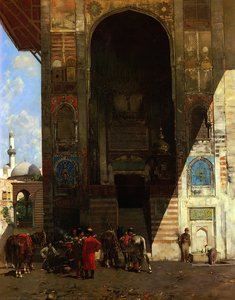 Halte A La Mosquee
Discover 'Halte A La Mosquee' by Alberto Pasini – a stunning Orientalist painting of Istanbul’s grand mosque. Explore its rich detail & Romantic style. #Orientalism #ArtHistory
The eruption of the Crimean War unexpectedly presented Pasini with an extraordinary commission. Recommended by Chassériau as a replacement for him on the entourage of French plenipotentiary minister Nicolas Prosper Bourée to Persia, he embarked on a series of expeditions that would define his artistic career. This wasn’t simply travel; it was immersion. Pasini journeyed through northern Persia and Armenia, eventually reaching Trebizond, meticulously documenting the landscapes, architecture, and cultures he encountered. Subsequent voyages took him to Egypt, the Red Sea, Arabia, and Istanbul—each location adding layers of richness and complexity to his artistic vision. He didn’t merely *see* these places; he absorbed their atmosphere, light, and textures, translating them into highly detailed paintings that captured the exotic allure of the Orient. This period saw him masterfully blend Romantic sensibilities with a commitment to accurate representation, establishing himself as a leading figure in Orientalist painting.
Venetian Vedute: Pasini's Late-Life Focus on Light and Architecture
 A Gondola Before A Venetian Palazzo
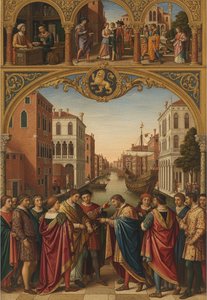
While his name became synonymous with Orientalism, Pasini’s artistic interests weren’t confined by geography. In 1865, he spent time in Cannes, capturing the landscapes of the Riviera, but it was Venice that ultimately captivated him in his later years. He turned his attention to *vedute*—detailed views of cityscapes—a genre steeped in tradition yet ripe for Pasini’s unique interpretation. His Venetian paintings are characterized by a masterful handling of light and shadow, capturing the ethereal quality of the lagoon city. He focused on iconic landmarks – bridges, canals, palazzi – but it wasn't simply about replicating these scenes; it was about conveying their atmosphere, their history, and their inherent beauty. Works depicting the Ponte dei Santi Apostoli, the Rio Marin, and the Canal Grande showcase his ability to imbue architecture with a sense of life and movement.
A Master of Detail: Technique, Brushwork, and Romantic Sensibility
Pasini’s enduring appeal lies in his exceptional technical skill. His paintings aren't merely impressions; they are meticulously crafted artworks that reward close examination. Visible brushstrokes lend texture and depth to his compositions, while a sophisticated understanding of color creates a sense of realism and atmosphere. He wasn’t afraid to embrace detail—intricate architectural elements, the folds of fabric, the expressions on faces—all contribute to the richness and complexity of his scenes. However, this technical prowess was always tempered by a Romantic sensibility. His paintings aren't cold or clinical; they are imbued with emotion, drama, and a sense of wonder. The self-portrait he sent to the Uffizi in 1888 offers a glimpse into the artist himself—a man deeply connected to his craft and driven by a passion for capturing the beauty of the world around him. Contemporary critics like Virgilio Colombo praised his ability to “faithfully reproduce the architectural accessories, which sparkle in the sun and bathe in the blue shadows,” highlighting his unrivaled ingenuity in creating expansive paintings within small canvases.
Pasini’s Legacy & Place in 19th-Century Painting
Alberto Pasini's contribution to 19th-century painting is significant. He successfully bridged the gap between Romanticism and Realism, creating a body of work that is both visually stunning and historically informative. His Orientalist paintings offered Western audiences a glimpse into distant cultures, while his Venetian *vedute* celebrated the beauty of Italy’s most iconic city. Though perhaps less widely recognized than some of his contemporaries, Pasini's meticulous technique, evocative atmosphere, and dedication to detail continue to captivate art enthusiasts today. His works serve as valuable historical documents, offering insights into the landscapes, architecture, and cultures he so passionately documented. At OriginalUniqueArt, we are proud to offer high-quality reproductions of Pasini’s masterpieces, allowing you to experience the beauty and artistry of this remarkable Italian painter firsthand. Explore our collection and discover the captivating world of Alberto Pasini—a testament to the power of observation, skill, and a lifelong pursuit of artistic excellence.