Eldzier Cortor portresi

Her Biri Benzersiz, En Ünlü 15 Eldzier Cortor Tablosu

Kasım 2026 tarihinde güncellendi · popülerlik puanımıza göre sıralanmıştır (her bir eser için aramalar, ziyaretler ve siparişler) · 15 eser Eldzier Cortor kataloğumuzda

Özetle

Figure Composition No. II (1982), Eldzier Cortor tarafından yapılan ve en çok ilgi çeken tablodur. Ardından göz, In These Troubled Times (1937) ve Compositional Study No. III, from the portfolio Impressions Our World, Volume I (1974) üzerine yoğunlaşır. Kataloğumuzdaki Eldzier Cortor imzalı 15 eser arasından seçilen bu 15 eser; yapıldığı yıl, sergilendiği müze ve zamana meydan okuma nedenleriyle birlikte sunulan en ünlü ve her biri eşsiz orijinal çalışmalardır.

1916 – 2015, Richmond Surrealism En çok eser: SCAD Museum of Art

Galerinin gözünden Eldzier Cortor tarafından yapılan en iyi 10 tablo

4
The Night Letter (1938) tarafından Eldzier Cortor

The Night Letter

1938 · Oil · SCAD Museum of Art, Savannah

The painting depicts a quiet, indoor scene centered around a dining table. Two female figures occupy the space. On the left, an older woman sits in a chair, her attention directed toward a book held in her hands. Opposite her, a younger girl is seated, her gaze turned away from the reader and toward the periphery of the frame. A lamp sits upon the table, casting light across the surface…

Eldzier Cortor'in ünlü tabloları, 11. ile 15. arası

Eldzier Cortor'ın ilgisini çeken konular

Bu orijinal eserlerde en sık karşılaşılan ve her biri en seçkin örneğine sahip olan dört konu.

Eldzier Cortor'in orijinal eserlerinin sergilendiği müzeler

Bu sayfadaki tabloların çoğuna ev sahipliği yapan 2 müze.

Müze Şehir Eldzier Cortor Eserleri Bu listedeki tablolar
SCAD Museum of Art, SavannahSCAD Museum of Art Savannah 2 The Night Letter, Composition with Three Women
İsrail Müzesi, Kudüsİsrail Müzesi Kudüs 1 Dance Composition No. 31

On yıllar boyunca Eldzier Cortor: her biri için eşsiz bir orijinal eser

On yıllara göre eserler

O dönemi tanımlayan orijinal eseri görmek için bir on yıl seçin.

Eldzier Cortor'in tabloları: galeri için sorular

Eldzier Cortor tarafından yapılmış en ünlü eser hangisidir?Cevabı göster

Figure Composition No. II (1982). Ardından In These Troubled Times (1937) ve Compositional Study No. III, from the portfolio Impressions Our World, Volume I (1974) geliyor.

Eldzier Cortor, Figure Composition No. II eserini kaç yaşında yarattı?Cevabı göster

66 yaşında: Figure Composition No. II 1982 yılına aittir ve Eldzier Cortor 1916 yılında doğmuştur.

Eldzier Cortor tarafından yapılmış en ünlü on tablo hangileridir?Cevabı göster

Figure Composition No. II, In These Troubled Times, Compositional Study No. III, from the portfolio Impressions Our World, Volume I, The Night Letter, Dance Composition No. 31, Trio Assemblage 1 Composition III, L'Abbatoire I, Figure Assemblage I, L'Abbatoire No. VI ve Classical Study No. 34. Yukarıdaki sıralama, her birinin yapım yılını ve bulunduğu müzeyi göstermektedir.

Eldzier Cortor tarafından yapılmış kaç eser bilinmektedir?Cevabı göster

Kataloğumuzda Eldzier Cortor tarafından 1937 ile 1982 tarihleri arasında üretilmiş 15 eser bulunmaktadır.

En ünlü Eldzier Cortor orijinalleri nerede görülebilir?Cevabı göster

Çoğunlukla SCAD Museum of Art (Savannah) ve İsrail Müzesi (Kudüs) bünyesinde yer almaktadır. Yukarıdaki müze tablosu tümünü listelemektedir.

Eldzier Cortor en bilinen tablolarını hangi dönemde yaptı?Cevabı göster

1960s döneminde: Bu sayfadaki 15 eserin 4 tanesi o dönemde yapılmıştır, bunların L'Abbatoire I tanesi ise L'Abbatoire I arasındadır.

Hangi ünlü Eldzier Cortor tablosu en eski, hangisi ise en yenidir?Cevabı göster

Bu sayfadaki en eski eser In These Troubled Times (1937), en yeni eser ise Figure Composition No. II (1982)'dir.

Eldzier Cortor eserleri hangi akıma aittir?Cevabı göster

bu sayfadaki orijinallerine bakılırsa Surrealism,

SCAD Museum of Art bünyesinde Eldzier Cortor imzalı hangi orijinal eserleri görebilirim?Cevabı göster

The Night Letter ve Composition with Three Women: SCAD Museum of Art, Savannah, bu sayfadaki eserlerden 2 tanesine ev sahipliği yapmaktadır.
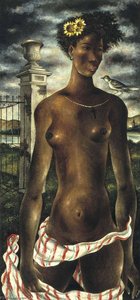
Eldzier Cortor: sanatçının bir portresi

A Life Immersed in Form and Identity

Eldzier Cortor, born in Richmond, Virginia, in 1916, emerged as a pivotal figure in American art, dedicated to portraying the richness and complexity of Black life with both profound sensitivity and innovative artistic vision. His journey began with the Great Migration, his family relocating to Chicago seeking opportunity—a move that indelibly shaped his perspective and fueled his commitment to representing urban African American experiences. Cortor’s early education at Englewood High School in Chicago brought him into contact with fellow artists like Charles Wilbert White and Margaret Burroughs, fostering a creative community that would nurture his developing talent. He continued his studies at the Art Institute of Chicago, graduating in 1936, where he absorbed European artistic traditions but found himself profoundly moved by an encounter with African sculptures at the Field Museum. This discovery proved transformative, instilling within him a fascination with the cylindrical forms and lyrical qualities that would become hallmarks of his style.

The WPA Years and the Gullah Influence

The 1940s marked a crucial period in Cortor’s artistic development. His involvement with the Works Progress Administration (WPA) provided him with invaluable experience documenting scenes of Bronzeville, a vibrant Black neighborhood in Chicago during the Depression era. This work wasn't merely documentation; it was an act of affirmation, capturing the dignity and resilience of a community often overlooked or misrepresented. Simultaneously, Cortor’s dedication to positive portrayals of African Americans was nurtured by his avid readership of *The Chicago Defender*, a newspaper dedicated to celebrating Black achievements. However, it was through two Rosenwald Foundation Fellowships in 1944 and 1945 that Cortor embarked on an experience that would profoundly alter the course of his art. These fellowships allowed him to live among the Gullah people on the Sea Islands of Georgia and South Carolina—a relatively isolated African diasporic culture retaining strong ties to its ancestral roots. Immersing himself in their traditions, Cortor found a powerful source of inspiration, incorporating elements of traditional African aesthetics into his work and deepening his exploration of Black identity.

Blending Surrealism with Ancestral Echoes

Cortor’s artistic style was characterized by a compelling fusion of realism and surrealist influences. He often distorted perspective not as an end in itself, but to emphasize the subject's role within society and to imbue his work with a sense of fantasy and symbolic depth. Central to his oeuvre was the representation of the Black female figure—a motif he considered embodying the essence of the Black race, conveying a feeling of eternity and continuity. He challenged prevailing beauty standards by portraying Black women with dignity, strength, and an unapologetic celebration of their unique features and cultural significance. This wasn’t simply portraiture; it was an act of reclaiming representation and asserting the inherent beauty within the Black community. His exploration extended beyond painting to encompass printmaking—lithography and etching becoming favored mediums—and assemblage, demonstrating a remarkable versatility in his artistic practice. The 1949 Guggenheim Fellowship further broadened his horizons, enabling him to travel to Jamaica, Cuba, and Haiti, where he studied Caribbean art and culture and taught at the Centre d’Art in Port-au-Prince.

Legacy of Representation and Resilience

Throughout his long and distinguished career, Eldzier Cortor received significant recognition for his contributions to American art. His work has been exhibited extensively, including solo shows at the Boston Psychoanalytic Society and Institute and the Indiana University Art Museum. Today, his paintings and prints are held in prestigious collections such as the Howard University Gallery of Art, the Smithsonian American Art Museum, and The Art Institute of Chicago—testaments to his enduring artistic legacy. Cortor’s historical significance lies not only in his technical skill but also in his pioneering role in challenging stereotypes and celebrating Black identity. He was among the first African American artists to consistently depict nude Black women as central subjects, a bold act that defied societal norms and paved the way for subsequent generations of artists exploring themes of race, gender, and cultural heritage. His ability to synthesize European surrealism with African artistic traditions created a unique aesthetic—a powerful visual language that continues to resonate today, reminding us of the enduring strength, beauty, and resilience of the Black spirit.