The Library of Trinity College Dublin
The Library of Trinity College Dublin (Irish: Leabharlann Choláiste na Tríonóide), informally known as the Old Library, is the main library that serves Trinity College, and is the largest library in Ireland. It is a legal deposit or “copyright library”, which means that publishers in Ireland must deposit a copy of all their publications there without charge. It is the only Irish library to also hold such rights for works published in the United Kingdom.
It is one of the most iconic landmarks of the university and a major tourist attraction housing numerous Irish artifacts and exhibits, including the Book of Kells since 1661. The Library is also the permanent home to the Brian Boru harp, a national symbol of Ireland, as well as a copy of the 1916 Proclamation of the Irish Republic.
One of the four volumes of the Book of Kells is on public display at any given time. The pages currently on view are from the Gospel of Luke.
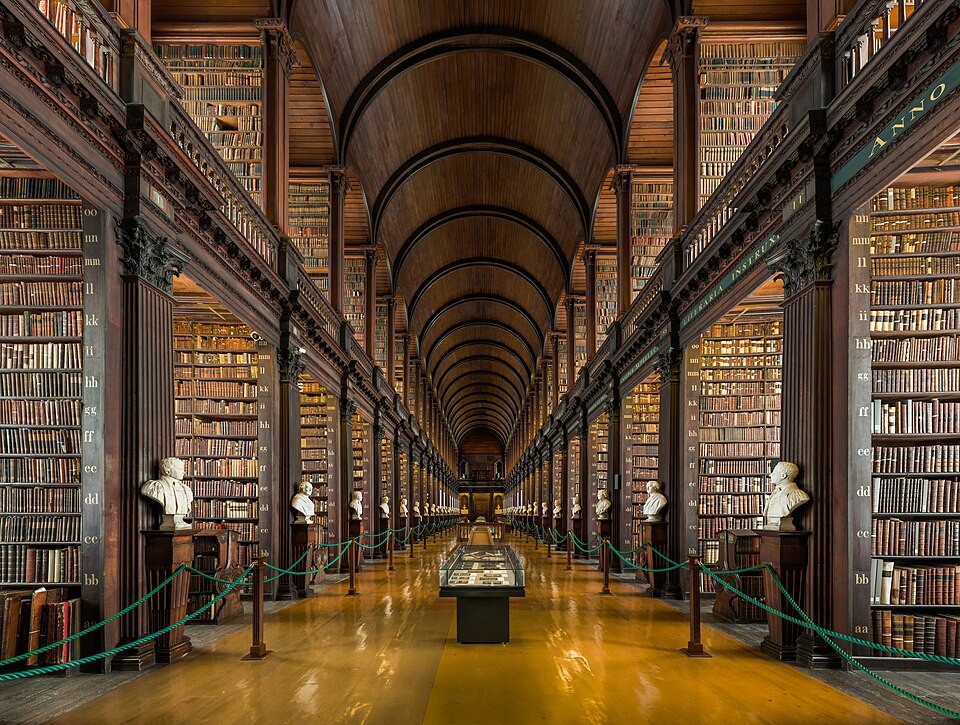
The Long Room, a magnificent two-story hall housing over 200,000 of the library’s oldest books in its oak bookcases. Towering shelves stretch towards arched ceilings, lined with ancient volumes that whisper tales of forgotten eras. Marble busts of prominent figures gaze down upon visitors, creating an atmosphere of awe and reverence.
Within this space also resides another national treasure: the Brian Boru Harp, a medieval Gaelic harp representing one of only three surviving examples from that period—a poignant symbol of Irish identity and musical heritage.
The Library’s significance extends far beyond its artistic treasures; it is deeply intertwined with pivotal moments in Irish history. A copy of the 1916 Proclamation of the Irish Republic, a document declaring Ireland's independence from British rule, resides within its walls—a powerful reminder of the nation’s struggle for freedom and self-determination.
The Library has not remained static throughout its long existence. While the Old Library stands as a testament to classical architecture, subsequent additions reflect evolving styles and needs. The Eavan Boland Library, originally constructed in 1967 and recently renamed in 2024 after the celebrated Irish poet, presents a striking Brutalist contrast.
Modern expansions like the Lecky Library and James Ussher Library offer contemporary study spaces while seamlessly integrating with the historic core of the complex. This architectural dialogue—between tradition and innovation—speaks to the Library’s enduring relevance and its commitment to serving both present and future generations.
What truly sets The Library of Trinity College Dublin apart is its dual role as an academic library *and* a national repository of Irish culture. Its legal deposit status, granted for both Ireland and the United Kingdom, ensures that the nation’s published works are preserved for posterity. This commitment to preservation extends beyond books; the Library also safeguards a vast collection of manuscripts, historical documents, maps, and other invaluable artifacts.
But preservation is not merely about storage; it's about accessibility. The Library actively strives to make its collections available to scholars, researchers, and the public alike, fostering a spirit of inquiry and promoting a deeper understanding of Ireland’s rich heritage. A visit here isn’t simply a tour—it’s an immersive journey through time, art, and the enduring power of knowledge; a place where history comes alive and inspiration awaits around every corner.
Furthermore, the Library’s architectural grandeur contributes to its allure. Built in 1732 by Thomas Burgh, it embodies Palladian ideals—symmetry, proportion, and classical ornamentation—creating a serene space for contemplation and scholarly pursuit. The Long Room itself is a masterpiece of craftsmanship, featuring soaring ceilings adorned with frescoes depicting biblical scenes.
The Library’s history stretches back to the medieval era when St Patrick's Cathedral was founded in Dublin. Over centuries, it has witnessed pivotal moments in Irish history—from the Reformation to independence—and served as a beacon of learning and culture throughout Ireland’s turbulent past.
Today, The Library of Trinity College Dublin continues to attract visitors from around the globe who come to marvel at its treasures and immerse themselves in Ireland's intellectual heritage. Its dedication to preserving knowledge and fostering creativity ensures that it remains a vital institution for generations to come.