


1


Uppdaterad november 2026 · rangordnad efter vår popularitetspoäng (sökningar, besök och beställningar för varje verk) · 6 verk av William Stokes Hulton i vår katalog
Kortfattat
Ur galleriets perspektiv är William Stokes Hultons mest kända målning View of Asolo (1894), vars original hänger på Attingham Park. On the Banks of the Ouse, Buckinghamshire (1900) och Interior of the Church of Sta Maria in Porto Fuori, Ravenna (1887) fullbordar trion som alla känner igen. Av de 6 verk av William Stokes Hulton i vår katalog presenterar galleriet nedan de 6 mest kända, var och en som ett original med sitt år, sitt museum och vad som gör det unikt.


De 3 museer som innehar flest av målningarna på denna sida.
| Museum | Stad | Verk av William Stokes Hulton | Målningar från denna lista |
|---|---|---|---|
 Attingham Park |
3 | View of Asolo, On the Banks of the Ouse, Buckinghamshire, The Coast of Brittany | |
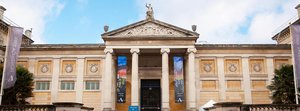 The Ashmolean Museum of Art and Archaeology |
Oxford | 2 | Interior of the Church of Sta Maria in Porto Fuori, Ravenna, Reginald Barratt |
 Bolton Museum And Art Gallery |
Bolton | 1 | Fruit Stall, Venice |
Välj ett decennium för att se originalverket som definierar det.
View of Asolo (1894), Attingham Park. On the Banks of the Ouse, Buckinghamshire (1900) och Interior of the Church of Sta Maria in Porto Fuori, Ravenna (1887) följer efter.
42 år gammal: View of Asolo är från 1894, och William Stokes Hulton föddes 1852.
Vår katalog innehåller 6 verk av William Stokes Hulton, daterade från 1887 till 1900.
Främst i Attingham Park, The Ashmolean Museum of Art and Archaeology (Oxford) och Bolton Museum And Art Gallery (Bolton). Museitabellen ovan listar alla.
Under 1900s: 3 av de 6 verk som finns på denna sida skapades då, varav On the Banks of the Ouse, Buckinghamshire.
På den här sidan är det tidigaste Interior of the Church of Sta Maria in Porto Fuori, Ravenna (1887) och det senaste On the Banks of the Ouse, Buckinghamshire (1900).
View of Asolo, On the Banks of the Ouse, Buckinghamshire och The Coast of Brittany: Attingham Park har 3 av verken på denna sida.
William Stokes Hulton remains a captivating figure in the annals of British art, a painter whose life and work bridged the gap between the scholarly traditions of England and the vibrant, sun-drenched landscapes of Italy. Born in 1852, Hulton was shaped by an upbringing steeped in intellectual rigor, being the son of the Reverend Campbell Basset Arthur Grey Hulton. His early education at Eton College and subsequent studies at Magdalene College, Cambridge, provided him with a profound foundation in the Classics. This classical grounding would later manifest in his art as a deep-seated respect for proportion, harmony, and the historical weight of his subjects, allowing him to approach even the most fleeting Impressionistic moments with a sense of structural permanence.
The trajectory of Hulton’s career was irrevocably altered by his connections to some of the most influential figures of his era. He moved within an elite circle of artists, sharing close friendships and painting excursions through Italy with luminaries such as John Singer Sargent, Regiment Barratt, and Walter Sickert. These relationships were not merely social; they were crucibles of creative exchange. Through these travels, Hulton’s palette expanded, moving away from the more somber tones of his English roots toward a luminous exploration of light and atmosphere. His marriage to Costanza, daughter of the scholar Linda White Mazini Villari, further anchored him to the Italian cultural landscape, as the family resided in the magnificent Palazzo Donà in Venice.
Hulton’s artistic development is best understood as a delicate dance between academic precision and the sensory immediacy of the Impressionist movement. While his classical training instilled a mastery of form, his encounters with the works of Monet and Sisley inspired him to capture the ephemeral qualities of light. This duality is perhaps most evident in his landscape paintings, where the serene, pastoral beauty of Buckinghamshire meets the evocative, atmospheric textures found in his depictions of the Coast of Brittany. He possessed a rare ability to render the stillness of an English riverbank with the same emotional depth as the bustling vitality of a Venetian fruit stall.
His most monumental achievement, however, lies in the realm of sacred art. Commissioned to undertake a massive fresco cycle for the Ravenna Cathedral, Hulton faced the daunting task of depicting scenes from the life of Saint Augustine. This project required him to synthesize his classical knowledge of Byzantine grandeur with modern painterly techniques. Working alongside architect Giuseppe Libera, he created a breathtaking panorama that utilized color and texture to convey profound spiritual depth. In these frescoes, the heavy weight of history meets the lightness of light, creating a visual language that is both intellectually stimulating and emotionally resonant.
The significance of William Stokes Hulton lies in his role as a cultural mediator. He was an artist who could navigate the solemnity of a cathedral's interior and the casual charm of a Mediterranean market with equal grace. His work serves as a vital record of a period of transition in European art, capturing the moment when the rigid structures of the 19th-century academy began to dissolve into the light-filled experimentation of the new century.
Though his life concluded in 1921, his artistic footprint remains visible in collections that celebrate the intersection of British sensibility and Continental flair. To study Hulton is to witness a master at work, balancing the following elements:
Through his landscapes, portraits, and monumental frescoes, Hulton continues to invite viewers into a world where history is not merely remembered, but vividly felt through every brushstroke.