Victor Vignon: A Quiet Master of Impressionist Landscape
Victor Alfred Paul Vignon (1847 – 1909) was a French Impressionist landscape painter and graphic artist whose serene depictions of rural scenes captivated audiences during his lifetime and continue to resonate with art historians today. Born in Paris, he possessed an early exposure to artistic appreciation thanks to his mother’s involvement as sculptor under the pseudonym “Claude Vignon,” who worked on the decoration of Hôtel de Ville de Paris in the 1850s—a project overseen by Gustave Eiffel and adorned with murals by puvis de chavannes. This formative environment instilled within him a profound connection to visual art from a young age, shaping his artistic sensibilities and guiding his lifelong pursuit of capturing the essence of nature’s beauty.- Early Training & Influences: Vignon began his artistic education with Camille Corot, whose meticulous observation of light and color profoundly impacted his technique. He further honed his skills under Adolphe Félix Cals, absorbing influences from Barbizon painters who championed plein air painting—a practice that prioritized working outdoors directly before the easel.
- Rural Landscapes & The Val-d’Oise Circle: Initially focused on the Val-d'Oise region near Paris, Vignon established a studio there and cultivated close relationships with fellow Impressionists like Camille Pissarro and Frédéric Bazille. This collaborative environment fostered experimentation and encouraged artists to push boundaries in their approach to portraying the natural world.
- Auvers-sur-Oise & Vincent van Gogh: A pivotal moment in Vignon’s artistic journey occurred when he moved to Auvers-sur-Oise, where he befriended Vincent van Gogh—a connection that proved transformative for both artists. Their shared passion for capturing the immediacy of experience and their mutual admiration fueled a creative dialogue that enriched Vignon's oeuvre.
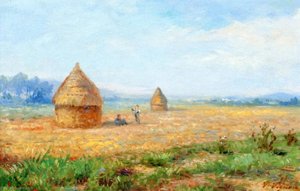
- Style & Technique: Vignon’s distinctive style characterized by soft brushstrokes, subtle tonal gradations, and harmonious color palettes—particularly blues and greens—reflected his unwavering commitment to conveying tranquility and capturing the fleeting effects of light on landscapes. He eschewed dramatic contrasts favored by some Impressionists, opting instead for a contemplative aesthetic that prioritized atmospheric perspective and textural nuances.
- Recognition & Legacy: Despite facing criticism from Monet and other prominent figures within the Impressionist movement—who questioned his adherence to traditional compositional conventions—Vignon persevered in his artistic endeavors. His work gained recognition through exhibitions at the Salon and subsequently enjoyed acclaim during retrospectives organized by Pierre Auguste Renoir and Julie Manet-Roulart, cementing his place as a significant contributor to French Impressionism’s canon. Today, Vignon's paintings are treasured for their serene beauty and masterful execution—testaments to his enduring vision of capturing the sublime grandeur of rural landscapes.
Notable Works
- Field of Wheat with Haystacks – This iconic painting exemplifies Vignon’s signature style, showcasing a luminous wheat field bathed in golden sunlight and punctuated by haystacks rendered with delicate textural detail.
- Landscape – A tranquil depiction of trees and water—executed in 1888—demonstrates Vignon's ability to evoke profound emotion through subtle color harmonies and atmospheric perspective.
Further Exploration
- Biblioteca Museu Víctor Balaguer: Explore Catalan art & literature housed in a Neo-Egyptian temple!
- Musée Victor Hugo: Discover the home & life of the famed author of Les Misérables.
- Chiesa di SS. Vittore e Carlo: Admire stunning sculptures by Algardi, paintings by Carlone & Parodi, and a rich history within this architectural gem.