Porträtt av Nicolai Abildgaard

De 100 mest kända målningarna av Nicolai Abildgaard, ett galleriselektion

Uppdaterad november 2026 · rangordnad efter vår popularitetspoäng (sökningar, besök och beställningar för varje verk) · 106 verk av Nicolai Abildgaard i vår katalog

Kortfattat

Av alla originalverk som Nicolai Abildgaard lämnade efter sig är det mest kända The Greek Poet Sappho and the Girl from Mytilene (1809), i samlingen hos Statens Museum for Kunst, Köpenhamn. Tätt efter följer Cupid Playing the Lyre. (1782) och Christian V Presents Danish Law 1683 (1784). Vår katalog innehåller 106 verk av Nicolai Abildgaard; galleriet har bevarat de 100 som världen beundrar mest, var och en presenterad med sitt datum, sitt museum och sin historia.

1743 – 1809, Köpenhamn Neoclassicism Flest verk: Statens Museum for Kunst

Nicolai Abildgaards 10 främsta målningar: galleriets utvalda verk

1
The Greek Poet Sappho and the Girl from Mytilene (1809) av Nicolai Abildgaard

The Greek Poet Sappho and the Girl from Mytilene

1809 · Acrylic On Canvas · Statens Museum for Kunst, Köpenhamn

Nicolai Abildgaard’s Sappho and Mytilene: A Vision of Romantic Idealism The painting “The Greek Poet Sappho and the Girl from Mytilene,” created by Nicolai Abraham Abildgaard in 1809, stands as a cornerstone of Danish neoclassical art and embodies the fervent spirit of Romantic idealism. More than just a depiction of two figures, it’s an exploration of beauty, longing, and the sublime—themes central to the artistic sensibilities of the era. Housed…

2
Cupid Playing the Lyre. (1782) av Nicolai Abildgaard

Cupid Playing the Lyre.

1782 · Oil On Canvas · Thorvaldsens Museum, Köpenhamn

In the quiet stillness of a mythological moment, Cupid Playing the Lyre. emerges from the shadows. This oil on canvas work, created by Nicolai Abildgaard around 1782, captures a solitary figure caught in a private, celestial act. The scene centers on a youthful, winged Cupid, whose presence brings a sense of soft grace to the composition. He leans toward a lyre that rests upon a stone pedestal, his delicate form…

3
Christian V Presents Danish Law 1683 (1784) av Nicolai Abildgaard

Christian V Presents Danish Law 1683

1784 · Oil On Canvas · Statens Museum for Kunst, Köpenhamn

Christian V Presents Danish Law 1683 is an oil painting by Nicolai Abildgaard. Created in 1784, this work functions as a history scene depicting a specific real event. The subject matter focuses on a Danish king presenting a body of law, capturing a moment of official legal or political significance. The scene is rendered in a documentary style that emphasizes the gravity of the proceedings.

4
Julia and Fulvia (1803) av Nicolai Abildgaard

Julia and Fulvia

1803 · Oil On Canvas · Statens Museum for Kunst, Köpenhamn

The oil on canvas painting titled Julia and Fulvia was executed by the artist Nicolai Abildgaard. This work depicts a literary scene or figure, focusing on the physical interaction between two female subjects. The composition centers on the tension between these figures within a classical setting.

6
Frederik II Builds Kronborg Castle at Elsinore (1782) av Nicolai Abildgaard

Frederik II Builds Kronborg Castle at Elsinore

1782 · Oil On Canvas · Statens Museum for Kunst, Köpenhamn

In this significant work of Danish history, Frederik II Builds Kronborg Castle at Elsinore, the artist Nicolai Abildgaard captures a moment of profound national construction. The painting centers on Frederick II of Denmark, depicted during the foundational stages of the Kronborg Castle at Elsinore. It is a scene that looks back at the 18th century through a lens of historical narrative, focusing on the architectural ambitions of the Danish monarchy.

7
Kulturens herredømme (1796) av Nicolai Abildgaard

Kulturens herredømme

1796 · Oil · Statens Museum for Kunst, Köpenhamn

The oil painting titled Kulturens herredømme, known in English as The supremacy of culture, was executed by the artist Nicolai Abildgaard. This work is identified by the accession number KMS1836. The composition features a monochromatic, black-and-white palette that emphasizes the play of light and shadow across the figures.

8
Christian VII Uniting the Ducal with the Royal Part of Holstein in 1767 (1790) av Nicolai Abildgaard

Christian VII Uniting the Ducal with the Royal Part of Holstein in 1767

1790 · Oil On Canvas · Statens Museum for Kunst, Köpenhamn

The composition centers on a seated male figure, identified as King Christian VII, positioned on the right side of the canvas. He is dressed in white and gold regalia, wearing a crown and holding a scepter. To his left, two female figures are positioned; one faces the viewer directly, while the other is seen in profile, gesturing toward the king. Above the central group, a dark eagle flies through a…

9
Magnus Stenbock Surrenders the Fortress of Tønningen to Frederik IV in 1714 (1785) av Nicolai Abildgaard

Magnus Stenbock Surrenders the Fortress of Tønningen to Frederik IV in 1714

1785 · Oil On Canvas · Statens Museum for Kunst, Köpenhamn

In the grand tapestry of European history, few moments capture the gravity of shifting power quite like the scene depicted in Nicolai Abraham Abildgaard’s 1785 masterpiece, Magnus Stenbock Surrenders the Fortress of Tønningen to Frederik IV in 1714. This evocative oil painting serves as a window into a pivotal era of military diplomacy and sovereign command. The composition is masterfully orchestrated, drawing the viewer into a crowded, dynamic tableau where…

10
The robber's housekeeper comforts the young girl by telling the myth of Amor and Psyche. Motif from Apulejus, The Golden Donkey (1808) av Nicolai Abildgaard

The robber's housekeeper comforts the young girl by telling the myth of Amor and Psyche. Motif from Apulejus, The Golden Donkey

1808 · Oil On Canvas · Statens Museum for Kunst, Köpenhamn

The robber's housekeeper comforts the young girl by telling the myth of Amor and Psyche. Motif from Apulejus, The Golden Donkey is an oil on canvas work created about 1808. This piece captures a quiet, narrative moment between two figures, framed by the presence of a donkey in the shadows. The scene draws its inspiration from the literary motifs found in Apuleius's writings.

Urvalet av Nicolai Abildgaard fortsätter, 11 till 100

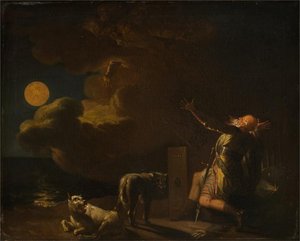
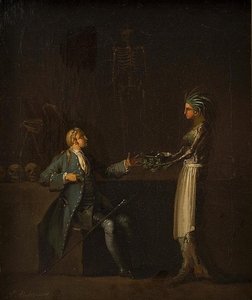
11Apollo charging the Parcae to visit Ceres, who has fled from the Earth (1809) av Nicolai AbildgaardApollo charging the Parcae to visit Ceres, who has fled from the Earth1809 · Statens Museum for Kunst 12Christian III Succouring Denmark (1780) av Nicolai AbildgaardChristian III Succouring Denmark1780 · Statens Museum for Kunst 13Christian III Succouring Denmark (1780) av Nicolai AbildgaardChristian III Succouring Denmark1780 · Statens Museum for Kunst 14The Construction of Copenhagen´s Dock in the Reign of Christian VI (1786) av Nicolai AbildgaardThe Construction of Copenhagen´s Dock in the Reign of Christian VI1786 · Statens Museum for Kunst 15The Prayers of the Potuans at the Feast of the Unfathomable God (1785) av Nicolai AbildgaardThe Prayers of the Potuans at the Feast of the Unfathomable God1785 · Statens Museum for Kunst 16A farewell scene (1783) av Nicolai AbildgaardA farewell scene1783 · Nivaagaards Malerisamling 17Rome as Ruler of the World (1784) av Nicolai AbildgaardRome as Ruler of the World1784 · Statens Museum for Kunst 18The Triumph of a Potuan, whose Reform Proposal has been Approved (1785) av Nicolai AbildgaardThe Triumph of a Potuan, whose Reform Proposal has been Approved1785 · Statens Museum for Kunst 19Absolute Monarchy Assigned to Frederik III in 1660 (1783) av Nicolai AbildgaardAbsolute Monarchy Assigned to Frederik III in 16601783 · Statens Museum for Kunst 20The Establishment of Schools (1781) av Nicolai AbildgaardThe Establishment of Schools1781 · Statens Museum for Kunst 21Asiatic Trade (1782) av Nicolai AbildgaardAsiatic Trade1782 · Statens Museum for Kunst 22Niels Klim thinks he hears the Deacon when he is awakened by a Bull (1785) av Nicolai AbildgaardNiels Klim thinks he hears the Deacon when he is awakened by a Bull1785 · Statens Museum for Kunst 23Standardization of Weights and Measures in 1683 (1784) av Nicolai AbildgaardStandardization of Weights and Measures in 16831784 · Statens Museum for Kunst 24The Foundation of the Royal Library (1783) av Nicolai AbildgaardThe Foundation of the Royal Library1783 · Statens Museum for Kunst 25Richard III wakes up from his nightmare in his tent in Bosworth (1785) av Nicolai AbildgaardRichard III wakes up from his nightmare in his tent in Bosworth1785 · Statens Museum for Kunst 26Alexander's messenger at the Persian philosopher (1785) av Nicolai AbildgaardAlexander's messenger at the Persian philosopher1785 27Alexander the Great and an officer visit Diogenes. (1785) av Nicolai AbildgaardAlexander the Great and an officer visit Diogenes.1785 28The Prince Royal Frederik awakens the sleeping Fama with the help of Clio. Study. (1783) av Nicolai AbildgaardThe Prince Royal Frederik awakens the sleeping Fama with the help of Clio. Study.1783 · The Museum of National History at Frederiksborg Castle 29Richard III Before the Battle of Bosworth (1780) av Nicolai AbildgaardRichard III Before the Battle of Bosworth1780 · Randers Kunstmuseum 30The Archangel Michael and Satan Disputing about the Body of Moses (1785) av Nicolai AbildgaardThe Archangel Michael and Satan Disputing about the Body of Moses1785 · ARoS Aarhus Kunstmuseum 31Niels Klim Receives the Homage of the Quamites. (1787) av Nicolai AbildgaardNiels Klim Receives the Homage of the Quamites.1787 · Statens Museum for Kunst 32King Priam Pleading with Achilles for the Corpse of Hector (1794) av Nicolai AbildgaardKing Priam Pleading with Achilles for the Corpse of Hector1794 · Statens Museum for Kunst 33The Foundation of the Copenhagen Fire Insurance (1786) av Nicolai AbildgaardThe Foundation of the Copenhagen Fire Insurance1786 · Statens Museum for Kunst 34Mercury by the Seashore (1794) av Nicolai AbildgaardMercury by the Seashore1794 · Statens Museum for Kunst 35Richard III (1787) av Nicolai AbildgaardRichard III1787 36Achilles and the Centaur Cheiron (1796) av Nicolai AbildgaardAchilles and the Centaur Cheiron1796 · Statens Museum for Kunst 37Thetis Immersing her Infant Son Achilles in the River Styx to Make him Invulnerable (1796) av Nicolai AbildgaardThetis Immersing her Infant Son Achilles in the River Styx to Make him Invulnerable1796 · Statens Museum for Kunst 38The Death of Achilles (1796) av Nicolai AbildgaardThe Death of Achilles1796 · Statens Museum for Kunst 39Philosophy. Allegorical figure. (1800) av Nicolai AbildgaardPhilosophy. Allegorical figure.1800 · Statens Museum for Kunst 40The Slave Davus and the Maid Mysis. From Terence´s Andria. (1804) av Nicolai AbildgaardThe Slave Davus and the Maid Mysis. From Terence´s Andria.1804 · Statens Museum for Kunst 41Christian I Raising the Province of Holstein to the State of a Duchy in 1460 (1778) av Nicolai AbildgaardChristian I Raising the Province of Holstein to the State of a Duchy in 14601778 · Statens Museum for Kunst 42Jurisprudence. Allegorical Figure (1800) av Nicolai AbildgaardJurisprudence. Allegorical Figure1800 · Statens Museum for Kunst 43Achilles and the Daughters of Lycomedes (1796) av Nicolai AbildgaardAchilles and the Daughters of Lycomedes1796 · Statens Museum for Kunst 44Theology. Allegorical figure (1800) av Nicolai AbildgaardTheology. Allegorical figure1800 · Statens Museum for Kunst 45Simo and his former slave Sosia. From Terence´s Andria. (1803) av Nicolai AbildgaardSimo and his former slave Sosia. From Terence´s Andria.1803 · Statens Museum for Kunst 46Julia and Fulvia (1800) av Nicolai AbildgaardJulia and Fulvia1800 · Nationalmuseet i Oslo 47Portrait of the artist's son Marcus Aurelius Abildgaard. (1797) av Nicolai AbildgaardPortrait of the artist's son Marcus Aurelius Abildgaard.1797 48Fingal gives his weapons to Oscar. (1796) av Nicolai AbildgaardFingal gives his weapons to Oscar.1796 · Kunsten Museum of Modern Art Aalborg 49Allegory of Philosophy (1800) av Nicolai AbildgaardAllegory of Philosophy1800 50Allegory of Protestantism (1809) av Nicolai AbildgaardAllegory of Protestantism1809 · Ribe Kunstmuseum 51The Catholic Worldview, Allegory (1809) av Nicolai AbildgaardThe Catholic Worldview, Allegory1809 · Ribe Kunstmuseum 52The Oath of Fealty in 1660 (1806) av Nicolai AbildgaardThe Oath of Fealty in 16601806 · Statens Museum for Kunst 53Odysseus Takes Counsel with Teiresias. From Homer´s Odyssey (1809) av Nicolai AbildgaardOdysseus Takes Counsel with Teiresias. From Homer´s Odyssey1809 · Statens Museum for Kunst 54Fotis sees her Lover Lucius Transformed into an Ass. Motif from Apeleius' The Golden Ass (1809) av Nicolai AbildgaardFotis sees her Lover Lucius Transformed into an Ass. Motif from Apeleius' The Golden Ass1809 · Statens Museum for Kunst 55Tarquin and the Sibyl (1809) av Nicolai AbildgaardTarquin and the Sibyl1809 · Statens Museum for Kunst 56Hierarchy at its Peak at the time of the Crusades (1784) av Nicolai AbildgaardHierarchy at its Peak at the time of the Crusades1784 · Statens Museum for Kunst 57The Revival of Learning, the Invention of Printing and Gunpowder and the Discovery of America (1784) av Nicolai AbildgaardThe Revival of Learning, the Invention of Printing and Gunpowder and the Discovery of America1784 · Statens Museum for Kunst 58Papirius and his Mother (1809) av Nicolai AbildgaardPapirius and his Mother1809 · Statens Museum for Kunst 59Alexander the Great and Diogenes. (1809) av Nicolai AbildgaardAlexander the Great and Diogenes.1809 · Kunsten Museum of Modern Art Aalborg 60Fotis sees her Lover Lucius Transformed into an Ass. Motif from Apeleius' The Golden Ass (1809) av Nicolai AbildgaardFotis sees her Lover Lucius Transformed into an Ass. Motif from Apeleius' The Golden Ass1809 · Statens Museum for Kunst 61Tibullus Lamenting outside the Door of his Beloved (1808) av Nicolai AbildgaardTibullus Lamenting outside the Door of his Beloved1808 · Statens Museum for Kunst 62Christian IV Aboard his Flagship "The Trinity" (1782) av Nicolai AbildgaardChristian IV Aboard his Flagship "The Trinity"1782 · Statens Museum for Kunst 63Two Young Men Confessing to Alexander the Great their Conspiracy against Him (1800) av Nicolai AbildgaardTwo Young Men Confessing to Alexander the Great their Conspiracy against Him1800 · Statens Museum for Kunst 64Niels Klim Attends the Sentencing of the Deceased Potuan Prince. (1785) av Nicolai AbildgaardNiels Klim Attends the Sentencing of the Deceased Potuan Prince.1785 · Statens Museum for Kunst 65The Abolition of Adscription in 1788 (1790) av Nicolai AbildgaardThe Abolition of Adscription in 17881790 · Statens Museum for Kunst 66Frederik V as Patron of Science and Arts (1787) av Nicolai AbildgaardFrederik V as Patron of Science and Arts1787 · Statens Museum for Kunst 67The Midwife Taking Leave of the Girl from Andros (from Terence's Andria ) (1801) av Nicolai AbildgaardThe Midwife Taking Leave of the Girl from Andros (from Terence's Andria )1801 · Statens Museum for Kunst 68Nature Untamed (1784) av Nicolai AbildgaardNature Untamed1784 · Statens Museum for Kunst 69Hamlet Delivering a Letter Written by Himself to the Queen of Scotland (1776) av Nicolai AbildgaardHamlet Delivering a Letter Written by Himself to the Queen of Scotland1776 · Statens Museum for Kunst 70From Ludvig Holbergs´s The Journey of Niels Klim to The World Underground (1785) av Nicolai AbildgaardFrom Ludvig Holbergs´s The Journey of Niels Klim to The World Underground1785 · Statens Museum for Kunst 71Frederik II Builds Kronberg Castle at Elsinore (1781) av Nicolai AbildgaardFrederik II Builds Kronberg Castle at Elsinore1781 · Statens Museum for Kunst 72The Dying Messalina and Her Mother (1797) av Nicolai AbildgaardThe Dying Messalina and Her Mother1797 · Statens Museum for Kunst 73The Greek Poet Anacreon and Bathyll (1808) av Nicolai AbildgaardThe Greek Poet Anacreon and Bathyll1808 · Statens Museum for Kunst 74Christian I Elevates Holstein to a Duchy in 1474 (1778) av Nicolai AbildgaardChristian I Elevates Holstein to a Duchy in 14741778 · Statens Museum for Kunst 75Socrates in Prison (1784) av Nicolai AbildgaardSocrates in Prison1784 · Ny Carlsberg Glyptotek 76Niels Klim in Potu (1785) av Nicolai AbildgaardNiels Klim in Potu1785 · Statens Museum for Kunst 77Allegory on the Right of Citizenship (1790) av Nicolai AbildgaardAllegory on the Right of Citizenship1790 · Statens Museum for Kunst 78Fingal Sees the Ghosts of his Forefathers by Moonlight (1782) av Nicolai AbildgaardFingal Sees the Ghosts of his Forefathers by Moonlight1782 · Statens Museum for Kunst 79Male Figure after Michelangelo's 'Last Judgement' in the Sistine Chapel (1774) av Nicolai AbildgaardMale Figure after Michelangelo's 'Last Judgement' in the Sistine Chapel1774 · Statens Museum for Kunst 80Ismene and Antogone Plead with Theseus (1799) av Nicolai AbildgaardIsmene and Antogone Plead with Theseus1799 · Statens Museum for Kunst 81Hamlet and His Mother (1778) av Nicolai AbildgaardHamlet and His Mother1778 · Statens Museum for Kunst 82Richard III terrified by nightmarish visions. Shakespeare, Act 5, Scene 9 av Nicolai AbildgaardRichard III terrified by nightmarish visions. Shakespeare, Act 5, Scene 9Nivaagaards Malerisamling 83Amor and Psyche embracing each other av Nicolai AbildgaardAmor and Psyche embracing each otherNivaagaards Malerisamling 84Two Roman warriors watching a seated man embracing a child av Nicolai AbildgaardTwo Roman warriors watching a seated man embracing a child 85Scenes from 'Niels Klim's Subterranean Journey' av Nicolai AbildgaardScenes from 'Niels Klim's Subterranean Journey'Hamburger Kunsthalle 86Audhumla av Nicolai AbildgaardAudhumlaStatens Museum for Kunst 87The Doctor's Wife Reveals Her Husband's Intention of Anatomising Niels Klim (1787) av Nicolai AbildgaardThe Doctor's Wife Reveals Her Husband's Intention of Anatomising Niels Klim1787 · Statens Museum for Kunst 88The Finding of the Infant Moses av Nicolai AbildgaardThe Finding of the Infant MosesStatens Museum for Kunst 89Adam and Eve (1780) av Nicolai AbildgaardAdam and Eve1780 · Nationalmuseum 90Catullus, and Lesbia Seeking Comfort in his Arms for the Death of her Sparrow (1809) av Nicolai AbildgaardCatullus, and Lesbia Seeking Comfort in his Arms for the Death of her Sparrow1809 · Nivaagaards Malerisamling 91A view of Schie Church in Sweden av Nicolai AbildgaardA view of Schie Church in SwedenSorø Art Museum 92Adrastos Slays Himself on Atys' Tomb av Nicolai AbildgaardAdrastos Slays Himself on Atys' TombARoS Aarhus Kunstmuseum 93Lover Pamfilus in conversation with his forslagne serve Davus av Nicolai AbildgaardLover Pamfilus in conversation with his forslagne serve DavusStatens Museum for Kunst 94Portrait of Nicolai Abraham Abildgaard av Nicolai AbildgaardPortrait of Nicolai Abraham Abildgaard 95Ossian's swansong av Nicolai AbildgaardOssian's swansongStatens Museum for Kunst 96Hamlet Shows His Mother the Ghost of His Father av Nicolai AbildgaardHamlet Shows His Mother the Ghost of His Father 97Fingal Sees the Ghosts of His Ancestors in the Moonlight av Nicolai AbildgaardFingal Sees the Ghosts of His Ancestors in the Moonlight 98Jupiter Weighing the Fate of Man av Nicolai AbildgaardJupiter Weighing the Fate of ManRibe Kunstmuseum 99Sitting male nude with the face partly covered by his raised arms av Nicolai AbildgaardSitting male nude with the face partly covered by his raised arms 100The Wounded Philoctetes (1775) av Nicolai AbildgaardThe Wounded Philoctetes1775 · Nationalgalleriet i Danmark

Nicolai Abildgaards berömda målningar, period för period

Motiven som fångade Nicolai Abildgaards blick

De fyra motiv som återkommer oftast i dessa originalverk, var och ett med sitt främsta exempel.

Museerna som förvarar Nicolai Abildgaards originalverk

De 8 museer som innehar flest av målningarna på denna sida.

Museum Stad Verk av Nicolai Abildgaard Målningar från denna lista
Statens Museum for Kunst, KöpenhamnStatens Museum for Kunst Köpenhamn 70 The Greek Poet Sappho and the Girl from Mytilene, Christian V Presents Danish Law 1683, Julia and Fulvia
Nivaagaards Malerisamling, NibeNivaagaards Malerisamling Nibe 4 A farewell scene, Richard III terrified by nightmarish visions. Shakespeare, Act 5, Scene 9, Amor and Psyche embracing each other
Ribe Kunstmuseum, EsbjergRibe Kunstmuseum Esbjerg 3 Allegory of Protestantism, The Catholic Worldview, Allegory, Jupiter Weighing the Fate of Man
ARoS Aarhus Kunstmuseum, AarhusARoS Aarhus Kunstmuseum Aarhus 2 The Archangel Michael and Satan Disputing about the Body of Moses, Adrastos Slays Himself on Atys' Tomb
Kunsten Museum of Modern Art Aalborg, AalborgKunsten Museum of Modern Art Aalborg Aalborg 2 Fingal gives his weapons to Oscar., Alexander the Great and Diogenes.
The Museum of National History at Frederiksborg Castle, HillerødThe Museum of National History at Frederiksborg Castle Hillerød 2 The Prince Royal Frederik awakens the sleeping Fama with the help of Clio. Study.
Nationalmuseum, StockholmNationalmuseum Stockholm 2 Adam and Eve
Sorø Art Museum, SorøSorø Art Museum Sorø 2 A view of Schie Church in Sweden

Nicolai Abildgaard decennium för decennium: originalen som definierar varje era

Verk per decennium

Välj ett decennium för att se originalverket som definierar det.

Samlarfrågor om Nicolai Abildgaards målningar

Vilket verk är Nicolai Abildgaard mest känd för?Visa svaret

The Greek Poet Sappho and the Girl from Mytilene (1809), Statens Museum for Kunst, Köpenhamn. Cupid Playing the Lyre. (1782) och Christian V Presents Danish Law 1683 (1784) följer efter.

Hur gammal var Nicolai Abildgaard när The Greek Poet Sappho and the Girl from Mytilene skapades?Visa svaret

66 år gammal: The Greek Poet Sappho and the Girl from Mytilene är från 1809, och Nicolai Abildgaard föddes 1743.

Vilka är de tio mest kända målningarna av Nicolai Abildgaard?Visa svaret

The Greek Poet Sappho and the Girl from Mytilene, Cupid Playing the Lyre., Christian V Presents Danish Law 1683, Julia and Fulvia, The Potuans are Surprised to see Niels Klim Genuflect in front of the Wise Prince., Frederik II Builds Kronborg Castle at Elsinore, Kulturens herredømme, Christian VII Uniting the Ducal with the Royal Part of Holstein in 1767, Magnus Stenbock Surrenders the Fortress of Tønningen to Frederik IV in 1714 och The robber's housekeeper comforts the young girl by telling the myth of Amor and Psyche. Motif from Apulejus, The Golden Donkey. Rankingen ovan visar varje verks årtal och museum.

Hur många målningar lämnade Nicolai Abildgaard efter sig?Visa svaret

Vår katalog innehåller 106 verk av Nicolai Abildgaard, daterade från 1774 till 1809.

I vilka museer hänger Nicolai Abildgaards mästerverk?Visa svaret

Främst i Statens Museum for Kunst (Köpenhamn), Nivaagaards Malerisamling (Nibe) och Ribe Kunstmuseum (Esbjerg). Museitabellen ovan listar alla.

Under vilka år målade Nicolai Abildgaard sina mest kända verk?Visa svaret

Under 1780s: 40 av de 100 verk som finns på denna sida skapades då, varav Cupid Playing the Lyre..

Vilka är de första och sista kända originalverken av Nicolai Abildgaard?Visa svaret

På den här sidan är det tidigaste Male Figure after Michelangelo's 'Last Judgement' in the Sistine Chapel (1774) och det senaste The Greek Poet Sappho and the Girl from Mytilene (1809).

Vilka motiv valde Nicolai Abildgaard oftast?Visa svaret

Man (35), Woman (33) och Drapery (20), fördelat på 100 verk på denna sida.

Vilken teknik använde Nicolai Abildgaard mest?Visa svaret

Oil On Canvas, för 53 av de 100 verk som finns på denna sida.

Vilken konstinriktning tillhör Nicolai Abildgaard?Visa svaret

Neoclassicism, om man dömer efter originalen på denna sida.

Vilka verk av Nicolai Abildgaard finns utställda på Statens Museum for Kunst?Visa svaret

The Greek Poet Sappho and the Girl from Mytilene, Christian V Presents Danish Law 1683 och Julia and Fulvia: Statens Museum for Kunst, Köpenhamn har 70 av verken på denna sida.

Nicolai Abildgaard: liv och verk

Tidigt liv och konstnärliga grunder

Nicolai Abraham Abildgaard, född i Köpenhamn den 11 september 1743, växte upp i en familj djupt förankrad i konstens och vetenskapens värld. Hans far, Søren Abildgaard, var en respekterad antikvarisk tecknare, vilket gav den unge Nicolai en tidig uppskattning för klassiska former och noggrann observation. Denna familjära påverkan blev grundläggande när Abildgaard påbörjade sin konstnärliga resa, där han först fick utbildning av en lokal måstare innan han formellt skrevs in vid Det Kongelige Danske Kunstakademi år 1764. Hans talang blev snart uppenbar; från lagren 1764 till 1767 erhöll han konsekvent utmärkelser och medaljer som erkände hans växande skicklighet. Dessa tidiga framgångar kulminerade i ett resebidrag som tilldelades år 1767 – en avgörande möjlighet som skulle forma kursen för hans konstnärliga utveckling, även om det dröjde fem år innan han slutligen kunde nyttja det. Under dessa formativa år vid Akademien drog Abildgaard nytta av undervisningen från Johan Edvard Mandelberg och Johannes Wiedewelt, där han absorberade deras tekniker och perspektiv samtidigt som han formade sin egen unika väg.

Den romerska uppvaknandet: Ett skifte i perspektiv

År 1772 förverkligade Nicolai Abildandom slutligen sin långväntade dröm om att resa till Rom. Denna femåriga vistelse visade sig vara transformativ och markerade en avgörande vändpunkt i hans konstnärliga evolution. Nedsänkt i antikens hjärta ägnade han sig inte bara åt studier av skulptur, utan även arkitektur, dekoration och de magnifika fresker som prydde Palazzo Farnese. Ett besök i Neapel 1776 tillsammans med konstnärskollegan Jens Juel vidgade ytterligare hans horisonter. Rom var inte enbart en plats för tekniska studier; det var ett intellektuellt uppvaknande. Abildgaard fördjupade sig i historiemåleriet och strävade efter att bemästra dess komplexitet och narrativa kraft. Han fann inspiration hos mästarna – Annibale Carracci, Rafael, Tizian och Michelangelo – och absorberade deras kompositionsstrategier, dramatiska ljusbehandling och djupa förståelse för den mänskliga anatomin. Hans exponering var dock inte begränsad till strikt klassicism. Påverkan från konstnärer som Johan Tobias Sergel och Johann Heinrich Füssli började subtilt förändra hans estetiska sinnen och introducerade en begynnande romantisk känsla i hans verk. Samtidigt odlade Abildgaard en djup uppskattning för litteraturen och fann inspiration i verken av Shakespeare, Homer och Ossian – berättelser som senare skulle genomströmma hans dukar med lager av mening och emotionell resonans.

Kungliga uppdrag och nationella narrativ

Vid hemkomsten till Köpenhamn i december 1777 erkändes Abildgaard omedelbart som en stigande stjärna. Han säkrade snabbt en professur vid Akademien år 1778 och kort därefter, omkring 1780, steg han till den prestigefyllda positionen som kunglig historiemålare. Denna utnämning förde med sig ett monumentalt uppdrag från den danska regeringen: att skapa en serie målningar som skildrade Danmarks historia för Riddersalen på Christiansborg Slot. Detta projekt kom att bli det definierande arbetet i hans karriär. Det rörde sig inte bara om historiska illustrationer; de var noggrant konstruerade narrativ utformade för att förhärliga monarkin och ingjuta en känsla av nationell stolthet. Abildgaard kombinerade mästerligt exakta historiska skildringar med allegoriska element och mytologiska referenser, vilket skapade visuellt slående och intellektuellt stimulerande kompositioner. Han samarbetade även med Johan Edvard Mandelberg kring dekorativa scheman för Fredensborg Slot, vilket ytterligare befäste hans position som Danmarks främsta konstnärliga gestalt.

En syntes av stilar: Neoklassicism och romantik

Nicolai Abildgaards konstnärliga stil representerar en fascinerande syntes av neoklassisk stringens och framväxande romantiska känslor. Även om hans verk var förankrade i principerna för klassisk komposition, klarhet och anatomisk precision, är de genomströmmade av dramatisk ljussättning, rika färgpaletter och en noggrann detaljrikedom som antyder en djupare emotionell underström. Framstående målningar som ”Christian I upphöjer Holstein till hertigdöme år 1474” exemplifierar denna blandning – en ståtlig historisk scen framställd med klassisk precision, men ändå genomdränkt av en känsla av storhet och teatralitet. Andra verk, som den kusliga ”Mardrömmen”, demonstrerar hans vilja att utforska mörkare psykologiska teman, vilket förebådar den fullbordade romantik som snart skulle dominera den europeiska konsten. Hans utforskande sträckte sig bortom historiemåleriet; ”Culmins spöke visar sig för sin mor” uppvisar hans skicklighet i att porträttera övernaturliga händelser med dramatisk intensitet, medan verk som ”Den sårade Philoktetes” avslöjar en känslighet för mänskligt lidande och sårbarhet. Han kopierade inte blott historiska eller mytologiska scener; han tolkade dem genom sin egen konstnärliga vision och gav dem lager av symbolisk betydelse som var tillgängliga för en bildad publik. Hans bildallegori blev ett kännetecken för hans stil, där symboler användes som ett visuellt kortfattat språk för komplexa idéer och känslor.

Arv och bestående inflytande

Abildgaard tjänstgjorde som direktor för Akademien under 1789–1791 och återigen från 1801 fram till sin död i Köpenhamn den 14 november 1809. Under hela sin karriär fostrade han en generation av talangfulla konstnärer, däribland Asmus Jacob Carstens, Bertel Thorvaldsen, J. L. Lund och kanske mest betydelsefullt, Christoffer Wilhelm Eckersberg. Eckersberg, som ofta hyllas som ”det danska måleriets fader”, skulle lägga grunden för den danska guldåldern genom att bygga vidare på de principer som Abildgaard hade ingjutit i honom. Abildgaards inflytande sträckte sig bortom hans direkta elever; han formade fundamentalt det konstnärliga landskapet i Danmark genom att överbrygga klyftan mellan neoklassicism och romantik. Hans arbete återspeglade inte bara sin tids kulturella värden utan förutspådde även framtida konstnärliga trender, vilket bidrog betydande till utvecklingen av nordisk romantik och lämnade ett outplånligt märke på den danska konsthistorien. Han förblir en central gestalt för att förstå övergången från upplysningens ideal till 1800-talets emotionella intensitet.