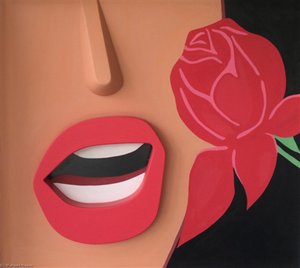
Marjorie Strider: konstnären
A Pioneer of Pop & Beyond: The Life and Art of Marjorie Strider
Marjorie Virginia Strider, born in Guthrie, Oklahoma, in 1931, emerged as a vital force in the American art landscape, challenging conventions with a boldness that resonated through the Pop Art movement and beyond. Her childhood spent amidst the rural landscapes of Oklahoma instilled within her an observant eye and a sensibility that would later inform her artistic explorations. This foundation was solidified by formal training at the Kansas City Art Institute, where she honed her technical skills and absorbed diverse artistic influences. Even before fully embracing her identity as a fine artist, Strider demonstrated a creative flair working on window displays for the Robinson Shoe Company in Kansas City—an early indication of her ability to capture attention and translate vision into compelling visual statements. This practical experience foreshadowed her later mastery of three-dimensional form and spatial engagement.
Subverting the Gaze: Strider’s Emergence in the 1960s
The early 1960s marked a pivotal shift as Strider relocated to New York City, then a crucible of artistic innovation. It was here that she found her distinctive voice, quickly gaining recognition for paintings that dared to confront prevailing representations of women. Her signature works featured voluptuous female figures—often depicted in bikinis—rendered with exaggerated curves and a playful yet unsettling energy. These weren’t mere celebrations of the feminine form; they were deliberate subversions of the objectifying gaze prevalent in popular culture. Strider didn't shy away from the imagery, but rather amplified it, transforming passive objects into assertive presences that demanded attention and challenged viewers to reconsider their own perceptions. Her participation in the groundbreaking “First International Girlie Show” at Pace Gallery in 1964 cemented her place among a generation of artists—including Rosalyn Drexler, Roy Lichtenstein, Andy Warhol, and Tom Wesselmann—who were redefining the boundaries of art and society. Girl with Radish, exhibited at this show, became an iconic image, encapsulating the exhibition’s provocative spirit and Strider's unique artistic vision. Critics noted her masterful use of color and form to convey emotion and challenge conventional notions of beauty. Subsequent solo exhibitions at Pace Gallery in 1965 and 1966 further showcased her evolving style and thematic concerns, establishing her as a significant voice within the burgeoning Pop Art scene.
From Sculpture to Happenings: Expanding Artistic Boundaries
Around the late 1960s and early 1970s, Strider’s artistic trajectory took an exciting turn towards soft sculpture installations. This transition wasn't a departure but rather a natural extension of her earlier explorations of form and space. Influenced by friendships with Claes Oldenburg and Patty Oldenburg, she began creating site-specific works using polyurethane foam—a material that allowed for organic shapes and a sense of unrestrained energy. These weren’t contained objects; they spilled out of windows, cascaded down architectural structures, and interacted directly with their surroundings, blurring the lines between art and environment. Artists like Oldenburg championed Strider's innovative approach to sculpture, recognizing her ability to transform everyday materials into powerful statements about perception and materiality. Her collaborative projects underscored a shared desire to disrupt established artistic conventions and engage audiences in unexpected ways.
Later Years & Lasting Legacy
From the 1980s onward, Strider’s work continued to evolve, incorporating elements of abstract expressionism while retaining her signature tactile surfaces and expressive brushstrokes. She explored themes of memory and identity through layered canvases infused with vibrant hues and gestural marks—a stylistic shift that reflected her ongoing engagement with artistic experimentation. A retrospective of her career toured museums across the United States from 1982 to 1985, solidifying her place in art history and introducing her work to a wider audience. Strider’s unwavering commitment to pushing artistic boundaries ensured that her legacy would endure beyond her lifetime. Her pioneering use of polyurethane foam—a material previously unexplored by sculptors—transformed the sculptural landscape and inspired countless artists to embrace unconventional materials and techniques. Marjorie Strider passed away on August 27, 2014, leaving behind a substantial body of work that continues to provoke dialogue and inspire artists today. Her contributions to Pop Art and the development of soft sculpture are recognized for their innovative use of materials, provocative engagement with social issues—particularly concerning gender representation—and unwavering commitment to artistic exploration. Strider’s influence extends beyond her individual achievements; she fundamentally altered how artists approached form, materiality, and conceptual ideas, shaping the trajectory of contemporary art.