Porträtt av Ludwig Passini

De 16 mest kända målningarna av Ludwig Passini, ett galleriselektion

Uppdaterad november 2026 · rangordnad efter vår popularitetspoäng (sökningar, besök och beställningar för varje verk) · 16 verk av Ludwig Passini i vår katalog

Kortfattat

Av alla originalverk som Ludwig Passini lämnade efter sig är det mest kända The young Comtessa with an ermine scarf on New Year's Eve (1847). Tätt efter följer Emperor Joseph II Riding (1850) och Princess Rospigliosi and Baroness Baude (1863). Vår katalog innehåller 16 verk av Ludwig Passini; galleriet har bevarat de 16 som världen beundrar mest, var och en presenterad med sitt datum, sitt museum och sin historia.

1832 – 1903, Vienna Academicism Flest verk: National Gallery of Art

Ludwig Passinis 10 främsta målningar: galleriets utvalda verk

1
The young Comtessa with an ermine scarf on New Year's Eve (1847) av Ludwig Passini

The young Comtessa with an ermine scarf on New Year's Eve

1847 · Watercolor

In "The young Comtessa with an ermine scarf on New Year's Eve" by Ludwig Passini, we are presented with an intimate bust-length portrait of a young woman. The subject is positioned facing forward, occupying most of the frame in a way that demands a quiet, direct encounter. While she is centered vertically, there is a subtle, intentional off-centering horizontally that lends a naturalism to her pose. She looks directly at…

2
Emperor Joseph II Riding (1850) av Ludwig Passini

Emperor Joseph II Riding

1850 · Oil On Panel

In the artwork Emperor Joseph II Riding by Ludwig Passini, the composition is centered on the figure of the Emperor mounted upon a white horse. The subject is positioned in profile, facing toward the left side of the frame. This central figure is set against a landscape composed of earthy tones, specifically browns, greens, and ochres. The stark white of the horse provides a high-contrast element against the dark, formal…

3
Princess Rospigliosi and Baroness Baude (1863) av Ludwig Passini

Princess Rospigliosi and Baroness Baude

1863 · Oil

In this formal portrait, titled Princess Rospigliosi and Baroness Baude, the artist Ludwig Passini captures two women of high social standing. Painted about 1863, the work presents a quiet moment of aristocratic composure. The subjects are arranged within an interior setting, their presence defined by a sense of dignity and established status.

4
A shared confidence (1870) av Ludwig Passini

A shared confidence

1870 · Oil On Canvas

The scene unfolds in A shared confidence, a work painted by Ludwig Passini around 1870. Within this quiet moment, the artist captures a private exchange that feels as though it is happening right now, just beyond the reach of the viewer. The figures exist in a space defined by their own unspoken understanding, frozen in a singular instance of connection.

5
On the Riva Dei Schiavoni a procession in Venice (1873) av Ludwig Passini

On the Riva Dei Schiavoni a procession in Venice

1873 · Oil On Canvas

On the Riva Dei Schiavoni a procession in Venice is a work by Ludwig Passini. Painted about 1873, the scene captures a religious procession moving through the waterfront of Venice, Italy. The movement of the crowd follows the curve of the Riva dei Schiavoni, where the city meets the water.

6
Figures on a Venetian canal (1893) av Ludwig Passini

Figures on a Venetian canal

1893 · Oil On Canvas

The scene unfolds along a stone canal in Venice, where the composition is defined by a long, horizontal perspective. A stone bridge occupies the central background, providing a structural anchor that leads the eye toward the receding water. In the foreground and middle ground, various figures occupy the space. Some individuals stand on stone steps, while others are positioned on the canal bank or observe the activity from the bridge…

7
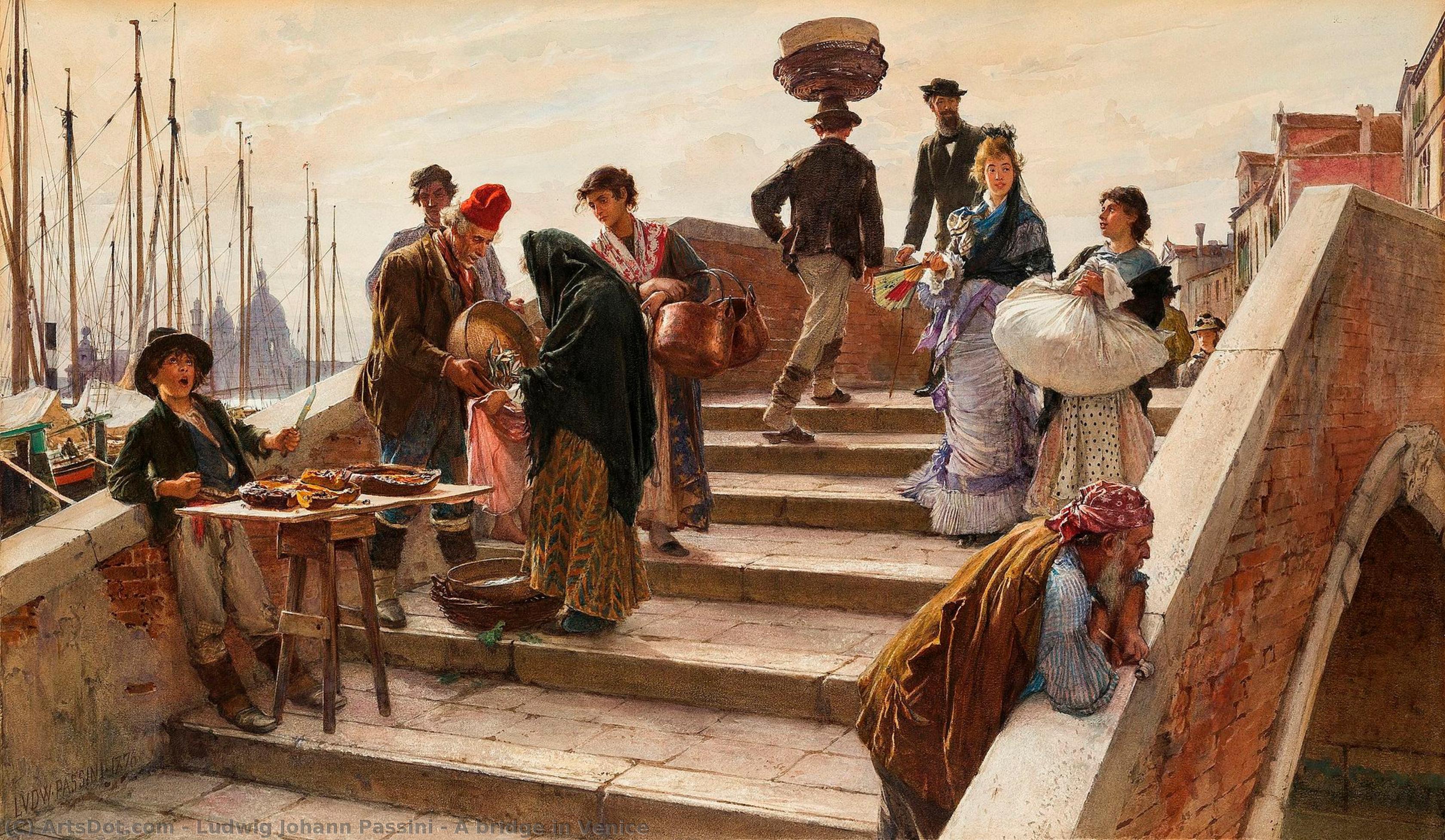
A bridge in Venice (1876) av Ludwig Passini

A bridge in Venice

1876

Ludwig Johann Passini’s “A Bridge in Venice,” painted in 1876, offers a captivating snapshot of daily life within the iconic Italian city. This horizontal canvas transports viewers to a bustling scene on one of Venice’s famed bridges, capturing a moment brimming with activity and character. More than just a depiction of architecture, it's a window into the vibrant social fabric of 19th-century Venetian society.

9
Monks Buying Fish before the Portal of the Madonna della Misericordia (1855) av Ludwig Passini

Monks Buying Fish before the Portal of the Madonna della Misericordia

1855 · Acrylic On Canvas · National Gallery of Art, Washington

Ludwig Johann Passini's “Monks Buying Fish before the Portal of the Madonna della Misericordia,” painted in 1855, isn’t merely a depiction of a marketplace scene; it’s a carefully constructed tableau brimming with quiet spirituality and the everyday rhythms of Venetian life. The painting transports us to a sun-drenched corner of the city, where the mundane act of purchasing fish becomes imbued with a profound sense of reverence. Passini, a master…

Urvalet av Ludwig Passini fortsätter, 11 till 16

Motiven som fångade Ludwig Passinis blick

De fyra motiv som återkommer oftast i dessa originalverk, var och ett med sitt främsta exempel.

Museerna som förvarar Ludwig Passinis originalverk

Museet som innehar flest av målningarna på denna sida.

Museum Stad Verk av Ludwig Passini Målningar från denna lista
National Gallery of Art, WashingtonNational Gallery of Art Washington 1 Monks Buying Fish before the Portal of the Madonna della Misericordia

Ludwig Passini decennium för decennium: originalen som definierar varje era

Verk per decennium

Välj ett decennium för att se originalverket som definierar det.

Samlarfrågor om Ludwig Passinis målningar

Vilket verk är Ludwig Passini mest känd för?Visa svaret

The young Comtessa with an ermine scarf on New Year's Eve (1847). Därefter följer Emperor Joseph II Riding (1850) och Princess Rospigliosi and Baroness Baude (1863).

Hur gammal var Ludwig Passini när The young Comtessa with an ermine scarf on New Year's Eve skapades?Visa svaret

15 år gammal: The young Comtessa with an ermine scarf on New Year's Eve är från 1847, och Ludwig Passini föddes 1832.

Vilka är de tio mest kända målningarna av Ludwig Passini?Visa svaret

The young Comtessa with an ermine scarf on New Year's Eve, Emperor Joseph II Riding, Princess Rospigliosi and Baroness Baude, A shared confidence, On the Riva Dei Schiavoni a procession in Venice, Figures on a Venetian canal, A bridge in Venice, The Basilica of San Marco in Venice, Monks Buying Fish before the Portal of the Madonna della Misericordia och Young Venetian woman at the fountain. Rankingen ovan visar varje verks årtal och museum.

Hur många målningar lämnade Ludwig Passini efter sig?Visa svaret

Vår katalog innehåller 16 verk av Ludwig Passini, daterade från 1847 till 1893.

I vilka museer hänger Ludwig Passinis mästerverk?Visa svaret

Främst i National Gallery of Art (Washington). Museitabellen ovan listar alla.

Under vilka år målade Ludwig Passini sina mest kända verk?Visa svaret

Under 1870s: 3 av de 16 verk som finns på denna sida skapades då, varav A shared confidence.

Vilka är de första och sista kända originalverken av Ludwig Passini?Visa svaret

På den här sidan är det tidigaste The young Comtessa with an ermine scarf on New Year's Eve (1847) och det senaste Figures on a Venetian canal (1893).

Vilka motiv valde Ludwig Passini oftast?Visa svaret

19th century society (2), Historical figures (2) och People (2), fördelat på 16 verk på denna sida.

Vilken teknik använde Ludwig Passini mest?Visa svaret

Oil On Canvas, för 3 av de 16 verk som finns på denna sida.

Vilken konstinriktning tillhör Ludwig Passini?Visa svaret

Academicism, om man dömer efter originalen på denna sida.

Ludwig Passini: liv och verk

The Venetian Soul: The Life and Art of Ludwig Johann Passini

In the golden light of the nineteenth century, few artists captured the rhythmic pulse of Mediterranean life with as much tenderness and precision as Ludwig Johann Passini. Born in Vienna on July 9, 1832, Passini was a man of dual heritage, an Austrian by birth whose artistic soul became irrevocably entwined with the canals and cobblestones of Italy. His journey began under the watchful eye of his father, Johann Nepomuk Passini, a skilled engraver who provided the young artist with a foundational mastery of line and visual craftsmanship. This early exposure to the meticulous world of printmaking would later manifest in the exquisite detail and narrative clarity that define his most celebrated works.

The trajectory of Passini’s life was shaped by movement and cosmopolitan discovery. Following his family's relocation to Trieste in 1850, he was exposed to a melting pot of cultures that would broaden his artistic horizons far beyond the borders of his native Austria. His formal training at the prestigious Vienna Academy of Art brought him into the orbit of masters such as Joseph von Führich and Leopold Kupelwieser, where he refined a classical sensibility. Yet, it was the encouragement of Führich that propelled him toward Leipzig and eventually to the heart of Italy, setting the stage for a career defined by the pursuit of light, atmosphere, and the human condition.

A Mastery of Genre and the Venetian Spirit

Passini’s artistic evolution is a testament to his ability to adapt his technique to the spirit of his surroundings. During his years in Rome between 1853 and 1870, his work took on a profound narrative quality. He focused intensely on the human figure, placing characters within rich architectural settings and interior spaces that whispered stories of daily existence. It was during this period that he mastered the art of the genre scene—paintings that do not merely depict a moment, but breathe life into the social fabric of the era.

< p>However, it was his permanent move to Venice in 1873 that unlocked his most enduring creative period. Settling for three decades in the magnificent Palazzo Vendramin Calergi, Passini became a cornerstone of an illustrious artist colony. Alongside contemporaries such as Henry Woods and August von Pettenkofen, he participated in a vibrant intellectual exchange that pushed the boundaries of realism. His Venetian oeuvre is a breathtaking collection of watercolors and oils that serve as a visual chronicle of the city. Whether capturing the bustling activity on a bridge or the quiet, spiritual reverence of monks purchasing fish near a cathedral portal, Passini possessed a rare ability to find the extraordinary within the ordinary.

Technique, Legacy, and Artistic Significance

The brilliance of Passini’s work lies in his seamless blend of realism and poetic atmosphere. His technique was characterized by a meticulous attention to detail—the texture of sun-drenched brickwork, the subtle shimmer of water, and the intricate folds of period clothing—all rendered with a sensitivity that avoids the coldness of mere documentation. In his watercolors, he achieved a luminous quality that captured the fleeting effects of light, while his oil paintings, such as the evocative A Bridge in Venice, utilized masterful composition to draw the viewer into the heart of the scene.

Beyond his technical prowess, Passini’s historical significance rests in his role as a bridge between classical tradition and the burgeoning interest in modern, everyday life. He did not seek the grandiosity of historical epics; instead, he sought the truth in a child's play or a merchant's trade. His legacy is preserved in the way he immortalized a vanishing way of life, providing future generations with a window into the vibrant, social tapestry of 19th-century Italy. Today, his works remain cherished for their ability to evoke nostalgia and a profound sense of human connection, ensuring that the name Ludwig Johann Passini remains synonymous with the timeless beauty of the Venetian spirit.