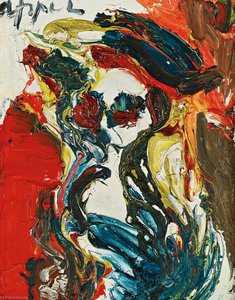
Karel Appel: ett porträtt av konstnären
A Life Painted in Bold Strokes: The World of Karel Appel
Christiaan Karel Appel, known affectionately as ‘Kik’ from childhood, burst onto the post-war art scene like a vibrant explosion of color and energy. Born in Amsterdam in 1921, his early life was steeped in the everyday rhythms of working-class Holland – his father a barber, his lineage tracing back to French Huguenots through his mother. This grounding, however, would soon be superseded by an irrepressible artistic drive that defied convention and ultimately reshaped the landscape of European art. A pivotal moment arrived at age fourteen with his first painting, a still life of fruit, followed shortly after by a paint set and easel gifted by his uncle Karel Chevalier, who also provided early instruction. These gifts weren’t merely tools; they were keys unlocking a world where imagination reigned supreme. The shadow of the Second World War loomed large over Appel’s formative years. Studying at the Rijksakademie van Beeldende Kunsten in Amsterdam during the German occupation proved challenging, yet it was there he forged lifelong bonds with fellow artists Corneille and Constant, friendships that would prove crucial to his artistic evolution. Facing opposition from his parents regarding his chosen path and fearing forced labor under Nazi rule, Appel bravely left home, choosing a life dedicated to art over conformity.
Early Life and Artistic Beginnings
Karel Appel’s childhood was marked by a profound connection to the tangible world—the bustling streets of Amsterdam, the routines of his father's barbershop, and the heritage of Huguenot ancestry passed down through his mother. This formative experience instilled in him a sensitivity to texture and form that would become central to his artistic practice. At fourteen, he embarked on his artistic journey with a simple still life depicting fruit—a deliberate choice reflecting an interest in capturing the essence of everyday objects. Crucially, this moment was accompanied by a transformative gift: a paint set and easel from his uncle Karel Chevalier, who recognized Appel’s innate talent and nurtured his burgeoning creativity. This bequest wasn't simply material assistance; it represented access to a realm where instinctual expression superseded academic constraints—a path that would ultimately define Appel’s artistic trajectory.
The CoBrA Revolution: Spontaneity and the Childlike Vision
Appel’s artistic breakthrough arrived in 1948 with the formation of CoBrA – an acronym derived from Copenhagen, Brussels, and Amsterdam – representing the movement's core cities. Alongside Corneille, Constant, Jan Nieuwenhuys, and Christian Dotremont, Appel spearheaded a radical departure from established artistic norms. CoBrA wasn’t merely a style; it was a philosophy rooted in spontaneity, experimentation, and a profound embrace of the untamed creativity found in children's art and primitive cultures. Influenced by masters like Pablo Picasso and Henri Matisse, as well as the raw energy of Jean Dubuffet, Appel rejected rigid formalism in favor of intuitive expression. He began sculpting in 1947, utilizing assemblage techniques – constructing works from found materials painted in a bold palette of white, red, yellow, blue, and black. This period saw him involved with the Experimentele Groep, further solidifying his commitment to artistic innovation. The controversial fresco "Questioning Children" (1949), commissioned for Amsterdam City Hall, exemplified CoBrA’s provocative spirit but also sparked public outcry, ultimately leading to its being covered up – a testament to the movement's challenging nature. Appel drew inspiration from Danish and Nordic mythology, weaving these ancient narratives into his increasingly abstract compositions.
International Horizons: From Paris to New York and Beyond
Facing resistance to CoBrA’s uncompromising vision in the Netherlands, Appel relocated to Paris in 1950, a city that offered greater artistic freedom and recognition. This marked the beginning of an expansive period of international travel and exposure. He explored Mexico, the USA, Yugoslavia, and Brazil, absorbing diverse cultural influences that enriched his artistic vocabulary. His time in New York City and Florence further broadened his horizons, allowing him to connect with a wider network of artists and collectors. A pivotal moment arrived in 1954 with his first American gallery exhibition at Martha Jackson Gallery, followed by the inclusion of "Child and Beast II" (1951) in the influential Museum of Modern Art exhibition “The New Decade” in 1955. Appel’s murals became increasingly prominent during this period, showcasing his ability to translate his dynamic style onto a larger scale. Despite initial setbacks, his work experienced a resurgence in popularity in the Netherlands after 1990, with major exhibitions organized by Rudy Fuchs in Amsterdam and Brussels, solidifying his legacy within his homeland.
Legacy and Influence
Karel Appel’s contribution to post-war European art is undeniable. He established the Karel Appel Foundation to safeguard his artworks and promote public awareness of his oeuvre, ensuring that future generations could appreciate the depth and breadth of his artistic vision. The foundation continues to champion Appel's legacy as an artist who dared to challenge conventions and embrace spontaneity—a spirit that resonates powerfully with contemporary artists striving for authentic expression. His work remains a significant testament to CoBrA’s revolutionary ethos and serves as inspiration for those pursuing artful innovation today.