Porträtt av John Ruskin

De 95 mest kända målningarna av John Ruskin, ett galleriselektion

Uppdaterad november 2026 · rangordnad efter vår popularitetspoäng (sökningar, besök och beställningar för varje verk) · 95 verk av John Ruskin i vår katalog

Kortfattat

Av alla originalverk som John Ruskin lämnade efter sig är det mest kända Trevi Fountain (1841). Tätt efter följer Ravine at Maglans, Valley of Cluse (1849) och Aiguille Charmoz, Chamounix (1849). Vår katalog innehåller 95 verk av John Ruskin; galleriet har bevarat de 95 som världen beundrar mest, var och en presenterad med sitt datum, sitt museum och sin historia.

1819 – 1900, London Romanticism Flest verk: Birmingham Museum and Art Gallery

John Ruskins 10 främsta målningar: galleriets utvalda verk

1
Trevi Fountain (1841) av John Ruskin

Trevi Fountain

1841 · Drawing

In this evocative depiction of the Trevi Fountain, we are transported to the heart of Rome during a pivotal moment in the nineteenth century. The painting captures the monumental Baroque masterpiece not merely as a static architectural feat, but as a living, breathing entity. Through John Ruskin’s observant eye, the fountain emerges from its stone surroundings with a sense of profound vitality. The composition is anchored by the majestic presence…

2
Ravine at Maglans, Valley of Cluse (1849) av John Ruskin

Ravine at Maglans, Valley of Cluse

1849 · Painting

The painting Ravine at Maglans, Valley of Cluse presents a dramatic mountainous landscape characterized by rugged, rocky terrain. The composition is defined by a sense of movement and dynamism, guiding the viewer's eye through the expansive scenery. Within this natural setting, a large bird is depicted in the foreground, appearing to fly over the mountains, while several smaller birds are scattered throughout the scene, providing a sense of depth.

3
Aiguille Charmoz, Chamounix (1849) av John Ruskin

Aiguille Charmoz, Chamounix

1849 · Watercolor

The watercolor depicts the rugged terrain of the Aiguille Charmoz in the Chamounix region. Snow-capped mountain peaks rise into a pale sky, their jagged edges defined by varying shades of white and grey. Below these summits, the slopes are populated by numerous figures, at least thirteen in total, scattered across the incline. These individuals appear in various positions, some situated in the foreground and others positioned further up the mountain…

4
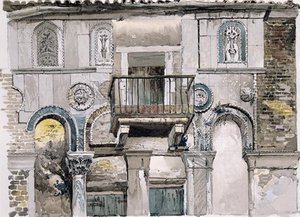
The Casa Loredan, Venice (1850) av John Ruskin

The Casa Loredan, Venice

1850 · Ink On Paper · Isabella Stewart Gardner Museum, Boston

In this detailed architectural study, titled The Casa Loredan, Venice, we encounter the precise hand of John Ruskin. Created about 1850, the work captures a specific moment of observation during the artist's engagement with the Venetian landscape. It is a focused examination of Venetian Gothic architectural details, rendered with a clarity that speaks to a deep interest in the structural nuances of the city.

5
Architectural Notebook ‘Door Book’ (p21) (1850) av John Ruskin

Architectural Notebook ‘Door Book’ (p21)

1850 · Watercolor

Architectural Notebook ‘Door Book’ (p21) by John Ruskin is a detailed study of Venetian architectural features. Created about 1850, the work represents a meticulous record of observations made during the artist's travels. It functions as a primary source for the research that would eventually inform his influential writings on the architecture of Venice.

6
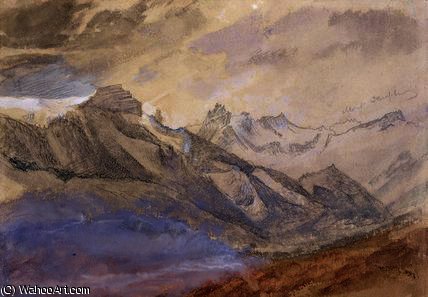
Mont Dauphiny, near Chartreuse av John Ruskin

Mont Dauphiny, near Chartreuse

In this landscape, we encounter Mont Dauphiny, near Chartreuse, a work by the English polymath John Ruskin. The composition focuses on a mountainous terrain, capturing the rugged essence of the peaks that define this specific region. It is a quiet study of geological form and the scale of the natural world.

8
North West Porch of St Mark (1877) av John Ruskin

North West Porch of St Mark

1877

Ruskin’s largest and most famous architectural watercolour, this was the most important product of his stay in Venice over the winter of 1876-77. If the Ducal Palace was to him “the central building of the world,” then the basilica of St Mark came as close as it stands in reality, “the most magical and most mysterious of churches.” It provided the subject for dozens of drawings in connection with The…

9
The Walls of Lucerne (1866) av John Ruskin

The Walls of Lucerne

1866 · Watercolor · Nationalmuseet i Warszawa, Warszawa

In the delicate interplay of light and pigment that defines The Walls of Lucerne, we encounter the profound mastery of John Ruskin at the height of his creative powers. Created in 1866, this watercolor serves as a breathtaking window into the heart of Switzerland, capturing not merely a landscape, but a fleeting moment of atmospheric perfection. The composition centers on the imposing architectural grandeur of the town walls, where the…

10
Ca d (1845) av John Ruskin

Ca d

1845 · Drawing

In the delicate, precise lines of John Ruskin’s 1845 work, Ca d'Oro, we find more than just a depiction of Venetian architecture; we encounter a poignant eulogy for a fading era. Created during a transformative and turbulent period in Venice, this piece captures the Casa d’Oro at a moment of profound vulnerability. As Ruskin traversed the canals in 1845, he was not merely an observer of beauty but a witness…

Urvalet av John Ruskin fortsätter, 11 till 95

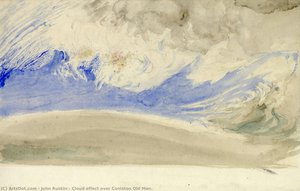
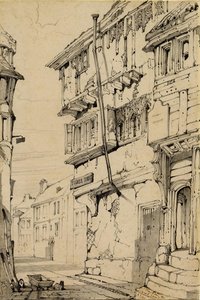
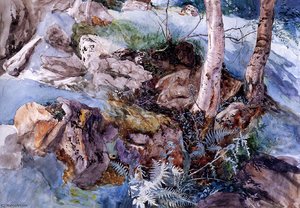
11St. Sauveur (1848) av John RuskinSt. Sauveur1848 12Dumbarton Castle (1838) av John RuskinDumbarton Castle1838 · Birmingham Museum and Art Gallery 13Coal Merchant's House in Market Street, Croydon (1835) av John RuskinCoal Merchant's House in Market Street, Croydon1835 · Birmingham Museum and Art Gallery 14Merton College and Magpie Lane (1838) av John RuskinMerton College and Magpie Lane1838 15View on the upper reach of the Grand Canal, Venice, with the Palazi Tron and Duodo (1876) av John RuskinView on the upper reach of the Grand Canal, Venice, with the Palazi Tron and Duodo1876 16View of the Bay of Naples and Vesuvius (1840) av John RuskinView of the Bay of Naples and Vesuvius1840 · Birmingham Museum and Art Gallery 17Studies of Alpine Peaks - High Elevation View Of Alpine Mountains, Annotated With Names Of Corresponding Peaks. (1845) av John RuskinStudies of Alpine Peaks - High Elevation View Of Alpine Mountains, Annotated With Names Of Corresponding Peaks.1845 · Birmingham Museum and Art Gallery 18Vevey, Lake Geneva (1846) av John RuskinVevey, Lake Geneva1846 · Birmingham Museum and Art Gallery 19An Alpine Valley, the Matterhorn in the Distance (1846) av John RuskinAn Alpine Valley, the Matterhorn in the Distance1846 · Birmingham Museum and Art Gallery 20Alpine Scene (1846) av John RuskinAlpine Scene1846 · Birmingham Museum and Art Gallery 21Old Bridge over a Mountain Torrent (1846) av John RuskinOld Bridge over a Mountain Torrent1846 · Birmingham Museum and Art Gallery 22Coast Scene near Dunbar (1847) av John RuskinCoast Scene near Dunbar1847 · Birmingham Museum and Art Gallery 23Tower of the Cathedral at Sens c. (1845) av John RuskinTower of the Cathedral at Sens c.1845 24The Garden of San Miniato near Florence (1845) av John RuskinThe Garden of San Miniato near Florence1845 25Part of the Facade of San Miniato al Monte, Florence (1846) av John RuskinPart of the Facade of San Miniato al Monte, Florence1846 26Vevay (1846) av John RuskinVevay1846 27Entrance to the Domodossola Valley (2) (1845) av John RuskinEntrance to the Domodossola Valley (2)1845 28Street scene Naples (1841) av John RuskinStreet scene Naples1841 29Houses in Naples (1841) av John RuskinHouses in Naples1841 30Pompeii (1841) av John RuskinPompeii1841 31Tomb of Ilaria del Caretto, Lucca Cathedral: Head of Ilaria (1874) av John RuskinTomb of Ilaria del Caretto, Lucca Cathedral: Head of Ilaria1874 32Church Tower of Courmayeur, with the Heights of the Mont Blanc Range beyond / Church and Buildings - In The Foreground, On The Left, Is A Church Tower ... (1849) av John RuskinChurch Tower of Courmayeur, with the Heights of the Mont Blanc Range beyond / Church and Buildings - In The Foreground, On The Left, Is A Church Tower ...1849 · Birmingham Museum and Art Gallery 33Folkstone, Hillside and Church from Pavilion Hotel (1849) av John RuskinFolkstone, Hillside and Church from Pavilion Hotel1849 · Birmingham Museum and Art Gallery 34Aiguilles of Chamonix (1849) av John RuskinAiguilles of Chamonix1849 · Birmingham Museum and Art Gallery 35Cascade de la Folie, Chamonix (1849) av John RuskinCascade de la Folie, Chamonix1849 · Birmingham Museum and Art Gallery 36Venice, Byzantine Capitals, Concave Group. (1853) av John RuskinVenice, Byzantine Capitals, Concave Group.1853 37Architectural Notebook - ‘N Book’ (p. 45) (1850) av John RuskinArchitectural Notebook - ‘N Book’ (p. 45)1850 38The Stones of Venice worksheet: Upper arcade of Doge’s Palace, November 1849 (1849) av John RuskinThe Stones of Venice worksheet: Upper arcade of Doge’s Palace, November 18491849 39Old Houses on the Rhône Island, Geneva (1862) av John RuskinOld Houses on the Rhône Island, Geneva1862 · Birmingham Museum and Art Gallery 40Lauffenburg on the Rhine (1863) av John RuskinLauffenburg on the Rhine1863 · Birmingham Museum and Art Gallery 41Sketch by a Clerk of the Works (2) (1860) av John RuskinSketch by a Clerk of the Works (2)1860 42Storm Clouds, Mont Cenis (1857) av John RuskinStorm Clouds, Mont Cenis1857 43Bernese Oberland (1866) av John RuskinBernese Oberland1866 · Indianapolis konstmuseum 44Panoramic of the Jura (1866) av John RuskinPanoramic of the Jura1866 45Self Portrait (1874) av John RuskinSelf Portrait1874 46Detail of Carved Pillar from East Door, Baptistery, Pisa (1882) av John RuskinDetail of Carved Pillar from East Door, Baptistery, Pisa1882 · Birmingham Museum and Art Gallery 47Cloud Study over Coniston Water (1880) av John RuskinCloud Study over Coniston Water1880 48Cloud effect over Coniston Old Man. (1880) av John RuskinCloud effect over Coniston Old Man.1880 49The Pope And The Emperor av John RuskinThe Pope And The Emperor 50Rosslyn Chapel (1838) av John RuskinRosslyn Chapel1838 51Salerno (1841) av John RuskinSalerno1841 52John Ruskin (1850) av John RuskinJohn Ruskin1850 53Doge (1852) av John RuskinDoge1852 54St. Wulfran, Abbeville, from the River (1868) av John RuskinSt. Wulfran, Abbeville, from the River1868 55Fisher Street, Carlisle. (1837) av John RuskinFisher Street, Carlisle.1837 56Mount Pilatus, Lake of Lucerne (2) (1846) av John RuskinMount Pilatus, Lake of Lucerne (2)1846 57View on the upper reach of the Grand Canal, Venice with the Palazzi Corner and Pesaro (1876) av John RuskinView on the upper reach of the Grand Canal, Venice with the Palazzi Corner and Pesaro1876 58Exterior Of Ducal Palace, Venice av John RuskinExterior Of Ducal Palace, Venice 59Fondaco Dei Turchi, Venice av John RuskinFondaco Dei Turchi, Venice 60Mountainous landscape av John RuskinMountainous landscape 61Champagnole av John RuskinChampagnole 62The Rocky Bank Of A River av John RuskinThe Rocky Bank Of A River 63Stilted archivolts av John RuskinStilted archivolts 64Garden At San Miniato av John RuskinGarden At San Miniato 65Aiguilles de Chamonix av John RuskinAiguilles de Chamonix 66A Gothic Stairway In Chester Cathedral av John RuskinA Gothic Stairway In Chester Cathedral 67Study Of Gneiss Rock av John RuskinStudy Of Gneiss Rock 68Study of Oak Leaves av John RuskinStudy of Oak Leaves 69Lpine Valley av John RuskinLpine Valley 70St. Mark's, Southern Portico av John RuskinSt. Mark's, Southern Portico 71Palazzo Agostini, Pisa av John RuskinPalazzo Agostini, Pisa 72Arabian Windows av John RuskinArabian Windows 73Velvet crab av John RuskinVelvet crab 74Torcello, Capital of Nave Pillar and St. Mark's av John RuskinTorcello, Capital of Nave Pillar and St. Mark's 75Sunset At Herne Hill Through The Smoke Of London av John RuskinSunset At Herne Hill Through The Smoke Of London 76Study of foliage av John RuskinStudy of foliage 77The Ducal Palace av John RuskinThe Ducal Palace 78The Ducal Palace, Twentieth Capital av John RuskinThe Ducal Palace, Twentieth Capital 79Chestnut leaves av John RuskinChestnut leaves 80Study of Two Shells av John RuskinStudy of Two Shells 81Kapelbrucke, lucerne av John RuskinKapelbrucke, lucerne 82Mountain Landscape, Macugnaga av John RuskinMountain Landscape, Macugnaga 83View of Fribourg, Switzerland av John RuskinView of Fribourg, Switzerland 84Head of Lake Geneva av John RuskinHead of Lake Geneva 85Lake lugano av John RuskinLake lugano 86Moonlight, chamonix av John RuskinMoonlight, chamonix 87The Dream Of St. Ursula av John RuskinThe Dream Of St. Ursula 88Study of the Rocks and Ferns Crossmouth av John RuskinStudy of the Rocks and Ferns Crossmouth 89View From Bonneville av John RuskinView From Bonneville 90Shell Study av John RuskinShell Study 91Dawn, Coniston av John RuskinDawn, ConistonAbbot Hall Art Gallery 92Palazzo Dario (1846) av John RuskinPalazzo Dario1846 93The av John RuskinThe 94Spiral Relief, North Transept Door, Rouen Cathedral (1882) av John RuskinSpiral Relief, North Transept Door, Rouen Cathedral1882 95Chamouni, Rocks and Vegetation av John RuskinChamouni, Rocks and VegetationAbbot Hall Art Gallery

John Ruskins berömda målningar, period för period

Motiven som fångade John Ruskins blick

De fyra motiv som återkommer oftast i dessa originalverk, var och ett med sitt främsta exempel.

Museerna som förvarar John Ruskins originalverk

De 5 museer som innehar flest av målningarna på denna sida.

Museum Stad Verk av John Ruskin Målningar från denna lista
Birmingham Museum and Art Gallery, BirminghamBirmingham Museum and Art Gallery Birmingham 16 Dumbarton Castle, Coal Merchant's House in Market Street, Croydon, View of the Bay of Naples and Vesuvius
Abbot Hall Art Gallery, KendallAbbot Hall Art Gallery Kendall 2 Dawn, Coniston, Chamouni, Rocks and Vegetation
Isabella Stewart Gardner Museum, BostonIsabella Stewart Gardner Museum Boston 1 The Casa Loredan, Venice
Nationalmuseet i Warszawa, WarszawaNationalmuseet i Warszawa Warszawa 1 The Walls of Lucerne
Indianapolis konstmuseum, IndianapolisIndianapolis konstmuseum Indianapolis 1 Bernese Oberland

John Ruskin decennium för decennium: originalen som definierar varje era

Verk per decennium

Välj ett decennium för att se originalverket som definierar det.

Samlarfrågor om John Ruskins målningar

Vilket verk är John Ruskin mest känd för?Visa svaret

Trevi Fountain (1841). Därefter följer Ravine at Maglans, Valley of Cluse (1849) och Aiguille Charmoz, Chamounix (1849).

Hur gammal var John Ruskin när Trevi Fountain skapades?Visa svaret

22 år gammal: Trevi Fountain är från 1841, och John Ruskin föddes 1819.

Vilka är de tio mest kända målningarna av John Ruskin?Visa svaret

Trevi Fountain, Ravine at Maglans, Valley of Cluse, Aiguille Charmoz, Chamounix, The Casa Loredan, Venice, Architectural Notebook ‘Door Book’ (p21), Mont Dauphiny, near Chartreuse, Fribourg, North West Porch of St Mark, The Walls of Lucerne och Ca d. Rankingen ovan visar varje verks årtal och museum.

Hur många målningar lämnade John Ruskin efter sig?Visa svaret

Vår katalog innehåller 95 verk av John Ruskin, daterade från 1835 till 1882.

I vilka museer hänger John Ruskins mästerverk?Visa svaret

Främst i Birmingham Museum and Art Gallery (Birmingham), Abbot Hall Art Gallery (Kendall) och Isabella Stewart Gardner Museum (Boston). Museitabellen ovan listar alla.

Under vilka år målade John Ruskin sina mest kända verk?Visa svaret

Under 1840s: 28 av de 95 verk som finns på denna sida skapades då, varav Trevi Fountain.

Vilka är de första och sista kända originalverken av John Ruskin?Visa svaret

På den här sidan är det tidigaste Coal Merchant's House in Market Street, Croydon (1835) och det senaste Detail of Carved Pillar from East Door, Baptistery, Pisa (1882).

Vilka motiv valde John Ruskin oftast?Visa svaret

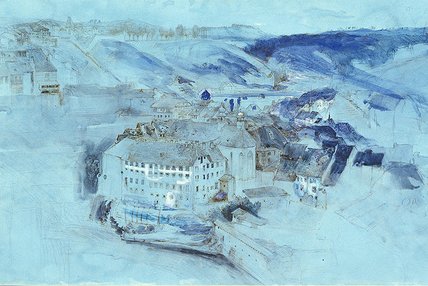
Landscape (8), Mountains (6) och People (4), fördelat på 95 verk på denna sida.

Vilken teknik använde John Ruskin mest?Visa svaret

Drawing, för 3 av de 95 verk som finns på denna sida.

Vilken konstinriktning tillhör John Ruskin?Visa svaret

Romanticism, om man dömer efter originalen på denna sida.

Vilka verk av John Ruskin finns utställda på Birmingham Museum and Art Gallery?Visa svaret

Dumbarton Castle, Coal Merchant's House in Market Street, Croydon och View of the Bay of Naples and Vesuvius: Birmingham Museum and Art Gallery, Birmingham har 16 av verken på denna sida.

John Ruskin: liv och verk

A Polymath of Vision: The Life and Legacy of John Ruskin

John Ruskin, born in London on February 8, 1819, was far more than simply an art critic; he was a Victorian polymath whose influence permeated the realms of aesthetics, social reform, political economy, and environmentalism. His life was shaped by a fascinating duality – the pragmatic commercial world of his father, John James Ruskin, a successful sherry merchant, and the fervent evangelical piety of his mother, Margaret Cock. This contrasting upbringing instilled in him both a keen observational eye for detail and a deeply moral sensibility that would define his entire oeuvre. From an early age, Ruskin’s education was meticulously curated at home, steeped in biblical study and exposure to Romantic literature, particularly the works of Byron and Walter Scott. These formative influences laid the groundwork for a mind that would relentlessly seek connections between beauty, truth, and ethical living. His academic journey continued at Christ Church, Oxford, where he began to articulate his burgeoning ideas about art and its relationship to society.

The Dawn of an Art Historian: Early Writings and Influences

Ruskin’s emergence as a significant voice in the art world began with *Modern Painters* (1843-1860), a monumental five-volume work initially conceived as a defense of J.M.W. Turner against what Ruskin perceived as unjust criticism. However, *Modern Painters* quickly evolved into something far more profound – a comprehensive treatise on the nature of art itself. He argued passionately for “truth to nature,” emphasizing that great art wasn’t merely about skillful representation but about an artist's sincere and empathetic engagement with the natural world. This concept was revolutionary at the time, challenging prevailing academic standards and paving the way for new artistic sensibilities. Ruskin didn’t just analyze technique; he delved into the spiritual and moral qualities of art, believing that true beauty reflected a virtuous soul. His meticulous descriptions of landscapes, rocks, and botanical details reveal not only his keen observational skills but also his profound reverence for nature as a manifestation of divine creation. This early work established Ruskin as a formidable critic and set the stage for his later explorations into architecture and social issues. He was deeply influenced by the Pre-Raphaelite Brotherhood, championing their commitment to detailed observation and rejection of academic conventions. They shared a belief that art should aspire to moral elevation and capture the essence of genuine experience—a conviction that would permeate Ruskin’s subsequent endeavors.

Beyond Aesthetics: Social Commentary and The Guild of St. George

As Ruskin matured, his interests expanded beyond the purely aesthetic realm. Deeply troubled by the social injustices he witnessed during the Industrial Revolution, he began to apply his critical lens to the economic and political structures of Victorian England. *Unto This Last* (1860), a series of essays originally published in *The Cornhill Magazine*, marked a turning point in his career. In this work, Ruskin vehemently critiqued utilitarian economics and advocated for a more humane and equitable social order based on principles of fellowship and craftsmanship. He argued that the dignity of labor was essential to a flourishing society and that true wealth lay not in material possessions but in the quality of human relationships. This conviction led him to establish *Fors Clavigera* (1871-1884), a monthly series of letters addressed “To the Workmen and Labourers of Great Britain,” where he expounded his social and political ideas with characteristic fervor. From these writings emerged the Guild of St. George, founded in 1871, an organization dedicated to promoting craftsmanship, rural industries, and education among working-class communities. The Guild aimed to create a model society based on Ruskin’s ideals, fostering artistic skill, ethical labor practices, and a harmonious relationship with nature—a vision that anticipated many of the concerns confronting us today.

Notable Works & Further Exploration

  • Modern Painters (1843-1860): Ruskin’s foundational work, defending Turner and establishing his theories of art.
  • The Stones of Venice (1851-1853): A detailed analysis of Venetian architecture, exploring its historical, social, and artistic significance.
  • Unto This Last (1860): A powerful critique of Victorian economics and a call for social reform.
  • Fors Clavigera (1871-1884): A series of letters addressing the working class, outlining Ruskin’s vision for a more equitable society.
  • Dawn, Coniston: A breathtaking watercolor capturing the serene beauty of Coniston Water and demonstrating Ruskin's unparalleled ability to convey emotion through observation.
To delve deeper into the life and work of John Ruskin, resources are available at: