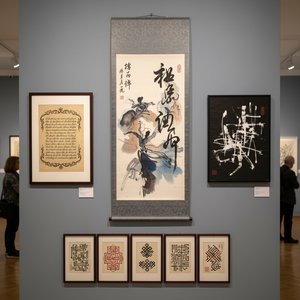
Shakir Hassan Al Said: A Pioneer of Modern Iraqi Art
Early Life and Education
Born: 1925 in Samawah, Iraq.
Shakir Hassan Al Said was a multifaceted artist – painter, sculptor, writer, philosopher, art critic, and historian.
He received his degree in Social Science from the Higher Institute of Teachers in Baghdad (1948).
Furthered his artistic training with a diploma in painting from the Institute of Fine Arts in Baghdad (1954).
Continued studies at the École Nationale Supérieure des Beaux-Arts in Paris until 1959, broadening his exposure to international art movements.
Artistic Development and Influences
Upon returning to Baghdad, Al Said immersed himself in the study of Yahya ibn Mahmud al-Wasiti’s work, a significant figure in Islamic miniature painting.
Sufism, with its mystical and philosophical underpinnings, profoundly influenced his artistic vision.
The poetry and philosophy of Mansur al-Hallaj, a controversial Sufi mystic, also played a crucial role in shaping his aesthetic sensibilities.
His early style was initially figurative but gradually transitioned towards an emphasis on Arabic calligraphy as a central artistic element.
Founding of Art Groups and Collaborative Efforts
Jama'et Baghdad lil Fann al-Hadith (The Baghdad Modern Art Group) – Co-founded in 1951, this group aimed to synthesize modern artistic approaches with Iraq’s rich cultural heritage.
Al Bu'd al Wahad (The One Dimension Group) – Established in 1971, this collective explored the expressive potential of Arabic script within a contemporary art context. It championed the Hurufiyya movement.
Key Artistic Contributions and Style
Notable Works: Include “Quaternary Rhythm” (ibrahimi collection, Amman, Jordan), demonstrating his unique blend of modernity and tradition; “Woman in Profile (turned to the left)”, showcasing stylistic experimentation.
Al Said’s work is characterized by a distinctive fusion of abstract forms, calligraphic elements, and symbolic imagery.
He often employed earthy tones and textured surfaces, evoking a sense of history and cultural depth.
Legacy and Historical Significance
Al Said’s theoretical writings and artistic practice charted a new course for Arabic art aesthetics.
He advocated for evaluating regional art through uniquely Arabic lenses, challenging Western-centric perspectives.
His contributions had a profound impact on the modern Iraqi art movement and continue to inspire artists today.
His work is held in collections such as The Museum Ruskin Library (Lancaster, United States).
Died in 2004, leaving behind a lasting legacy as a pivotal figure in the development of modern art in Iraq and beyond.
Av OriginalUniqueArt.com redaktionella team
Konstquiz
Det finns endast ett korrekt svar på varje fråga.
Fråga 1:
Shakir Hassan Al Said is renowned for bridging which two seemingly disparate artistic elements?
Fråga 2:
Al Said co-founded 'Jama'et Baghdad lil Fann al-Hadith'. What was the primary aim of this group?
Fråga 3:
Which philosophical and spiritual tradition significantly influenced Al Said's artistic development?
Fråga 4:
The 'One Dimension Group' (al bu'd al wahad), co-founded by Al Said, primarily explored the artistic potential of…?
Fråga 5:
Al Said's work often reflects an engagement with the writings and ideas of which controversial mystic?
Explore the profound beauty of calligraphy art. From the fluid running script of Chinese masters to historical ink masterpieces, discover how the elegance of line transforms spaces with timeless grace and scholarly sophistication.
Embark on a profound journey through the soul of Chinese calligraphy. Explore the historical mastery of ink, brush, and script, from ancient Zhuanshu to elegant running script, and discover how this timeless art form reflects the enduring spirit of classical East Asian aesthetics.
Explore the profound elegance of ink on paper. From the rhythmic running script of the Ming Dynasty to Zen-inspired haiku, discover the history, technique, and meditative mastery behind the world's most timeless calligraphic traditions.