Porträtt av Robert Tatin

Robert Tatins målningar: De 100 mest kända, ur ett galleris perspektiv

Uppdaterad november 2026 · rangordnad efter vår popularitetspoäng (sökningar, besök och beställningar för varje verk) · 100 verk av Robert Tatin i vår katalog

Kortfattat

Ur galleriets perspektiv är Robert Tatins mest kända målning Maryvonne Fille de Lune. Les Mystères de la Femme och Le Cirque fullbordar trion som alla känner igen. Av de 100 verk av Robert Tatin i vår katalog presenterar galleriet nedan de 100 mest kända, var och en som ett original med sitt år, sitt museum och vad som gör det unikt.

1902 – 1983, Laval Expressionism

Galleriets 10 främsta målningar av Robert Tatin

1
Maryvonne Fille de Lune av Robert Tatin

Maryvonne Fille de Lune

Oil

This piece moves away from the depiction of a literal place, opting instead to map an internal experience. The circular motifs hint at cycles of life and the rhythmic nature of existence, turning a landscape into a visual expression of the psyche. It carries the energy of expressionism, focusing on subjective feeling rather than the external world. The colors and textures work together to create a sense of mystery, as…

2
Les Mystères de la Femme av Robert Tatin

Les Mystères de la Femme

Oil On Canvas

Les Mystères de la Femme presents a dense, surreal landscape characterized by an otherworldly atmosphere. The composition is dominated by an enormous, luminous circle at the center that radiates a soft glow across the scene. This central orb contains stylized figures and serves as the primary light source for the surrounding elements. Below this orb, the canvas is filled with a multitude of small, organic shapes, including circles, ovals, and…

3
Le Cirque av Robert Tatin

Le Cirque

Oil On Canvas

The scene erupts within a circular frame, a swirling vortex of energy that pulls the eye toward a central, dark figure. This rider, perched atop a horse, exists at the heart of a chaotic dance, surrounded by a flurry of abstract forms and faces that seem to spin outward. The composition feels enclosed, almost theatrical, as if the viewer is peering into a private, dreamlike arena where the laws of…

4
Arcane VI av Robert Tatin

Arcane VI

Acrylic On Canvas

is an abstract landscape characterized by a dense layering of swirling patterns and organic forms. The composition is complex and chaotic, utilizing a repetition of circular motifs and interconnected lines to create a sense of harmony. The color palette is exceptionally rich, featuring a wide range of hues including greens, blues, purples, yellows, oranges, pinks, and browns, which produce an almost iridescent effect.

Robert Tatins målningar, rankade 11 till 100

11La Belle Epoque av Robert TatinLa Belle Epoque 12Arcane 7 av Robert TatinArcane 7 13Maüa av Robert TatinMaüa 14La Vache Bretonne av Robert TatinLa Vache Bretonne 15Homme au Camélia av Robert TatinHomme au Camélia 16Ile de la Cité av Robert TatinIle de la Cité 17Hommes av Robert TatinHommes 18Etude pour la toile Le Cirque av Robert TatinEtude pour la toile Le Cirque 19Portrait profil av Robert TatinPortrait profil 20Brésil 3 av Robert TatinBrésil 3 21Solange av Robert TatinSolange 22Les Hommes av Robert TatinLes Hommes 23Permanence des Sources av Robert TatinPermanence des Sources 24Paysan bigouden av Robert TatinPaysan bigouden 25Etude de Nus av Robert TatinEtude de Nus 26Naïssou de l'Eté av Robert TatinNaïssou de l'Eté 27Faubourg Saint Antoine av Robert TatinFaubourg Saint Antoine 28Itacolomi av Robert TatinItacolomi 29Têtes de Bretons av Robert TatinTêtes de Bretons 301976.2 Les Oiseaux av Robert Tatin1976.2 Les Oiseaux 31Croquis à l'Huile 2 av Robert TatinCroquis à l'Huile 2 32Guinguette av Robert TatinGuinguette 331976.1 Les Oiseaux et les Mains av Robert Tatin1976.1 Les Oiseaux et les Mains 34Lettre Fenêtre av Robert TatinLettre Fenêtre 35Time Square ou 14 Juillet av Robert TatinTime Square ou 14 Juillet 36Le Bateau av Robert TatinLe Bateau 37Christiane av Robert TatinChristiane 38Danses av Robert TatinDanses 39La Ville av Robert TatinLa Ville 4021 Juin 1972 av Robert Tatin21 Juin 1972 41Maryvonne ou le Blé av Robert TatinMaryvonne ou le Blé 42Vent av Robert TatinVent 43L'Oeil av Robert TatinL'Oeil 44La Vache au Piquet av Robert TatinLa Vache au Piquet 45La Frénouse av Robert TatinLa Frénouse 46Train de Maüa av Robert TatinTrain de Maüa 47Brésil N 2 av Robert TatinBrésil N 2 48Lune av Robert TatinLune 49Ma soeur Madeleine et le tonton Henri av Robert TatinMa soeur Madeleine et le tonton Henri 50Signes av Robert TatinSignes 51Nuit étoilée ou Initiation av Robert TatinNuit étoilée ou Initiation 52Racines av Robert TatinRacines 53Me et Dr Le Basser av Robert TatinMe et Dr Le Basser 54Chatou av Robert TatinChatou 55Sao Vincent Santos av Robert TatinSao Vincent Santos 56Coup de Tête av Robert TatinCoup de Tête 57Les Trois Pêches av Robert TatinLes Trois Pêches 58Men Dü av Robert TatinMen Dü 59Les Orangers de Maüa av Robert TatinLes Orangers de Maüa 60Etude pour la Toile Amida av Robert TatinEtude pour la Toile Amida 61Chacara Maüa Bresil av Robert TatinChacara Maüa Bresil 62Lunaison av Robert TatinLunaison 631970 1971 av Robert Tatin1970 1971 64Portrait n 2 ou Etude pour Les Trois Pêches av Robert TatinPortrait n 2 ou Etude pour Les Trois Pêches 65Rubis av Robert TatinRubis 66Macumba av Robert TatinMacumba 67Picasso av Robert TatinPicasso 68Etude pour la Toile Orphée av Robert TatinEtude pour la Toile Orphée 69Lettre X av Robert TatinLettre X 70Concours de Pêche à Nuillé sur Vicoin av Robert TatinConcours de Pêche à Nuillé sur Vicoin 71Saint Germain des Prés av Robert TatinSaint Germain des Prés 72Croquis à l'Huile 1 av Robert TatinCroquis à l'Huile 1 73Etude au Dindon av Robert TatinEtude au Dindon 74Les Pêchers av Robert TatinLes Pêchers 75Fleur de Lotus av Robert TatinFleur de Lotus 76Le Printemps en Mayenne av Robert TatinLe Printemps en Mayenne 77Sabots av Robert TatinSabots 78Jean Dubuffet av Robert TatinJean Dubuffet 79Quai de Bercy av Robert TatinQuai de Bercy 80La Lune bleue av Robert TatinLa Lune bleue 81Jardins du Luxembourg av Robert TatinJardins du Luxembourg 82Fleuve av Robert TatinFleuve 83Ca Voir av Robert TatinCa Voir 84Etude pour la Toile Fleur de Lotus av Robert TatinEtude pour la Toile Fleur de Lotus 85Bateau av Robert TatinBateau 86Les Peupliers d'Août av Robert TatinLes Peupliers d'Août 87Sinaï ou Fleur de Lys av Robert TatinSinaï ou Fleur de Lys 88Maüa ocres av Robert TatinMaüa ocres 89Rio av Robert TatinRio 90Eglise de Carapicuiba av Robert TatinEglise de Carapicuiba 91Saladier de Fruits av Robert TatinSaladier de Fruits 92Le Cri av Robert TatinLe Cri 93Jeu n 1 av Robert TatinJeu n 1 94Renoncules av Robert TatinRenoncules 95Favellas à Maüa av Robert TatinFavellas à Maüa 96Les Peupliers av Robert TatinLes Peupliers 97Maüa Cannes à sucre av Robert TatinMaüa Cannes à sucre 98Domador av Robert TatinDomador 99Maisons à Carapicuiba av Robert TatinMaisons à Carapicuiba 100Ebauche inachevée av Robert TatinEbauche inachevée

Robert Tatins berömda målningar, period för period

Motiven som fångade Robert Tatins blick

De fyra motiv som återkommer oftast i dessa originalverk, var och ett med sitt främsta exempel.

Robert Tatins målningar: galleriets svar

Vilken av Robert Tatins målningar är den mest kända av alla?Visa svaret

Maryvonne Fille de Lune. Därefter följer Les Mystères de la Femme och Le Cirque.

Vilka är Robert Tatins 10 främsta målningar?Visa svaret

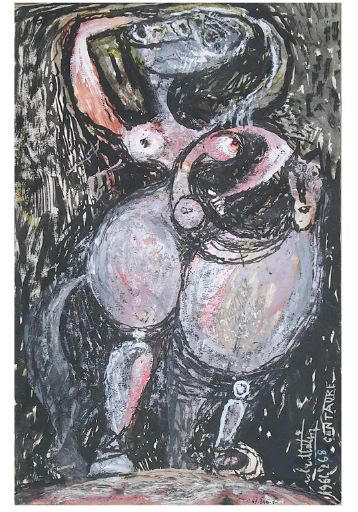
Maryvonne Fille de Lune, Les Mystères de la Femme, Le Cirque, Arcane VI, Centaure, St Jean de Luz Porte Roses, Silence, Autoportrait, Carnaval de Rio och Café de Flore. Rankingen ovan visar varje verks årtal och museum.

Hur många verk skapade Robert Tatin?Visa svaret

Vår katalog innehåller 100 verk av Robert Tatin.

Vilka motiv återkom Robert Tatin till mest?Visa svaret

Portraits (3), French countryside (3) och Landscape (2), fördelat på 100 verk på denna sida.

Vilket medium arbetade Robert Tatin främst med?Visa svaret

Oil On Canvas, för 2 av de 100 verk som finns på denna sida.

Vilken konstinriktning förknippas Robert Tatin med?Visa svaret

Expressionism, om man dömer efter originalen på denna sida.

Robert Tatin: konstnären

Robert Tatin: A Surrealist Vision of the Rural and the Primitive

Born in Laval, Mayenne, in 1902, Robert Tatin’s life was a remarkable confluence of seemingly disparate passions – construction, carpentry, ceramics, painting, sculpture, and architecture. He wasn't merely an artist; he was a builder of worlds, both tangible and imagined, driven by a profound desire to translate the rhythms of nature and the echoes of ancient myths into a singular, deeply personal visual language. His story is one of quiet revolution, a rejection of academic constraints in favor of intuitive creation, and ultimately, the establishment of a unique artistic sanctuary – his ‘Maison des Champs’ – that continues to bewilder and enchant visitors today.

Tatin's early years were shaped by a modest upbringing. His father was a Dreyfusard, deeply committed to his beliefs, while his mother practiced Catholicism. This duality—a tension between tradition and faith—likely fostered within him a sense of questioning and an independent spirit. He began his career as a house painter and carpenter, skills that would prove invaluable in the ambitious construction projects he undertook later in life. Crucially, he enrolled at the École des Beaux-Arts in Paris, immersing himself in classical techniques but quickly recognizing their limitations for expressing his own vision. This period laid the groundwork for his distinctive style – a blend of meticulous detail and dreamlike imagery.

The Years in South America: A Crucible of Creativity

A pivotal moment arrived in 1950 when Tatin, seeking inspiration and new techniques, embarked on an extended journey to Brazil and throughout South America. This period proved transformative. He spent years working alongside scientists at a ceramics research facility in Belo Horizonte, delving into the properties of cement and experimenting with innovative construction methods. He was deeply influenced by indigenous cultures, particularly their reverence for nature and their intricate symbolic systems. The vibrant colors, geometric patterns, and mythological narratives found in pre-Columbian art became integral to his own artistic vocabulary. It wasn’t simply observation; he actively engaged with these communities, learning from their traditions and incorporating them into his work.

Returning to France in 1955, Tatin settled in Vence on the French Riviera for a few years before ultimately returning to his native Mayenne. This move wasn’t about abandoning his artistic pursuits; rather, it was a homecoming—a desire to reconnect with his roots and create a space where he could fully realize his creative ambitions.

The Construction of ‘Maison des Champs’: A Personal Cosmology

In 1962, at the age of sixty, Tatin purchased an old farmhouse in Cossé-le-Vivien. What followed was not merely a renovation but a decades-long architectural and artistic undertaking – the creation of ‘Maison des Champs,’ a sprawling complex that defies easy categorization. He began by building a monumental stone structure resembling a temple, its entranceway shaped like a colossal dragon’s mouth, leading to a labyrinthine garden filled with sculptures, symbolic constructions, and painted walls. The house itself was expanded incrementally over twenty-one years, driven by Tatin's boundless imagination and his wife Lise’s unwavering support.

The ‘Maison des Champs’ is not simply a museum; it’s an immersive environment—a personal cosmology expressed through art. Each room is meticulously decorated with paintings depicting scenes of rural life, mythical figures, and abstract compositions. The sculptures are monumental, often exceeding eight feet in height, and imbued with symbolic meaning. The garden itself is a carefully orchestrated landscape, featuring twelve months represented by miniature structures, a central pond surrounded by symbolic elements, and a long, winding road lined with oversized statues of historical and artistic figures – a testament to Tatin’s fascination with the past.

A Legacy of Surrealism and Naive Art

Robert Tatin's work is often categorized as belonging to the realms of surrealism and naive art, though he resisted rigid labels. His paintings are characterized by their dreamlike quality, intricate detail, and symbolic imagery—a direct reflection of his experiences in South America and his deeply personal worldview. His sculptures, similarly, possess a raw, almost primitive energy, conveying a sense of timelessness and primal emotion. He was profoundly influenced by the work of artists like Paul Klee and Giorgio de Chirico, but he developed a unique style that is entirely his own.

Today, ‘Maison des Champs’ stands as a testament to Tatin's extraordinary vision—a surrealist sanctuary where art, architecture, and nature converge in a harmonious and unforgettable whole. It remains open to the public, offering visitors a rare glimpse into the mind of an artist who dared to create his own world, inviting us to contemplate the mysteries of life, myth, and the enduring power of imagination.