


1


Uppdaterad oktober 2026 · rangordnad efter vår popularitetspoäng (sökningar, besök och beställningar för varje verk) · 44 verk av Robert Hope i vår katalog
Kortfattat
Ur galleriets perspektiv är Robert Hopes mest kända målning The Presentation by King James III and Queen Margaret of the Banner Known as the Blue Blanket to the Craftsmen in the Year 1482 (1912). Kilmeny och Edinburgh from Craiglockhart fullbordar trion som alla känner igen. Av de 44 verk av Robert Hope i vår katalog presenterar galleriet nedan de 40 mest kända, var och en som ett original med sitt år, sitt museum och vad som gör det unikt.


In the quiet intimacy of 1924, Robert Hope captured a scene of profound serenity that transcends the mere depiction of a person. Glints of Gold (Miss Dorothy Salvesen) is more than a portrait; it is an invitation into a private sanctuary of thought and repose. The painting presents a woman draped in a luminous yellow dress, reclining gracefully upon a bed with her head resting softly against a pillow. As…


 Portrait of a Lady with a Motoring Veil1915 · Harris Museum - Art Gallery
12
 A Victorian Debutante1922
13
 A Pageant of the Sea1929
14
 Alderman Eaton1944
15
 Lord Leverhulme and Alderman R. Williams, Mayor of Bebington1945
16
 Melrose
17
 Idle Hours
18
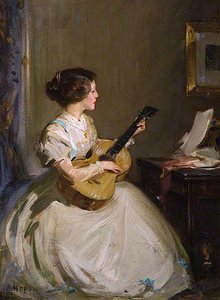 The Guitar Lesson
19
 The Fountain, Princes Street Gardens, EdinburghMcmanus: Dundee's Art Galleries And Museums
20
 A Quiet Pool, Evening
21
 Edinburgh from the ArboretumCity Art Centre
22
 Melrose
23
 The Guitar Lesson
24
 The Blue Veil
25
 Stream in Galloway
26
 An Old Herd
27
 No.8 Howard Place, Edinburgh, 1914
28
 Back of Standing Female NudeEdinburgh College of Art
29
 The Silken Gown
30
 The Glee Maiden
31
 Willows, East LintonJohn Muir House
32
 The Charm
33
 Before the Looking GlassThe Stirling Smith Art Gallery - Museum
34
 The Vanity GlassThe National Trust For Scotland
35
 The Return of the Sardine Fishers, Concarneau
36
 Swanston Cottage, Edinburgh
37
 The Green Door, CulrossThe Stewartry Museum
38
 The Remnant Stall
39
 Woman with BasketJohn Muir House
40
 Workers in a Hay FieldThe Stewartry Museum
De fyra motiv som återkommer oftast i dessa originalverk, var och ett med sitt främsta exempel.
De 8 museer som innehar flest av målningarna på denna sida.
| Museum | Stad | Verk av Robert Hope | Målningar från denna lista |
|---|---|---|---|
 City Art Centre |
Edinburgh | 2 | Edinburgh from Craiglockhart, Edinburgh from the Arboretum |
 John Muir House |
Haddington | 2 | Willows, East Linton, Woman with Basket |
 The Stewartry Museum |
Cairns | 2 | The Green Door, Culross, Workers in a Hay Field |
 Borders Textile Townhouse |
Hawick | 1 | Kilmeny |
 Royal Scottish Academy of Art - Architecture |
Edinburgh | 1 | Glints of Gold (Miss Dorothy Salvesen) |
 Paisley Art Institute Collection |
Paisley | 1 | The Golden Apple |
 Harris Museum - Art Gallery |
Preston | 1 | Portrait of a Lady with a Motoring Veil |
 Mcmanus: Dundee's Art Galleries And Museums |
Dundee | 1 | The Fountain, Princes Street Gardens, Edinburgh |
Välj ett decennium för att se originalverket som definierar det.
In the quiet intimacy of 1924, Robert Hope captured a scene of profound serenity that transcends the mere depiction of a person. Glints of Gold (Miss Dorothy Salvesen) is more than a portrait; it is an invitation into a private sanctuary of thought and repose. The painting presents a woman draped in a luminous yellow dress, reclining gracefully upon a bed with her head resting softly against a pillow. As…
The Presentation by King James III and Queen Margaret of the Banner Known as the Blue Blanket to the Craftsmen in the Year 1482 (1912). Därefter följer Kilmeny och Edinburgh from Craiglockhart.
43 år gammal: The Presentation by King James III and Queen Margaret of the Banner Known as the Blue Blanket to the Craftsmen in the Year 1482 är från 1912, och Robert Hope föddes 1869.
The Presentation by King James III and Queen Margaret of the Banner Known as the Blue Blanket to the Craftsmen in the Year 1482, Kilmeny, Edinburgh from Craiglockhart, Glints of Gold (Miss Dorothy Salvesen), Inverkeithing, Inverkeithing, The Fountain, Princes Street Gardens, Edinburgh, The Glee Maiden, The Golden Apple och Swanston Farm, Edinburgh. Rankingen ovan visar varje verks årtal och museum.
Vår katalog innehåller 44 verk av Robert Hope, daterade från 1905 till 1929.
Främst i City Art Centre (Edinburgh), John Muir House (Haddington) och The Stewartry Museum (Cairns). Museitabellen ovan listar alla.
Under 1910s: 3 av de 40 verk som finns på denna sida skapades då, varav The Presentation by King James III and Queen Margaret of the Banner Known as the Blue Blanket to the Craftsmen in the Year 1482.
På den här sidan är det tidigaste Inverkeithing (1905) och det senaste A Pageant of the Sea (1929).
Elegant woman (3), Victorian era (3) och Scottish landscape (2), fördelat på 40 verk på denna sida.
Academic realism och Impressionism, om man dömer efter originalen på denna sida.
Edinburgh from Craiglockhart och Edinburgh from the Arboretum: City Art Centre, Edinburgh har 2 av verken på denna sida.

