


1


Uppdaterad november 2026 · rangordnad efter vår popularitetspoäng (sökningar, besök och beställningar för varje verk) · 60 verk av Peter Jacob Horemans i vår katalog
Kortfattat
Av alla originalverk som Peter Jacob Horemans lämnade efter sig är det mest kända Portrait of Frau Heigl (1738), i samlingen hos Bavarian State Painting Collections, München. Tätt efter följer Kitchen Still Life with Coffee Drinker (1765) och Musical Still Life with Horn Player (1765). Vår katalog innehåller 60 verk av Peter Jacob Horemans; galleriet har bevarat de 58 som världen beundrar mest, var och en presenterad med sitt datum, sitt museum och sin historia.


 The Smoker1764 · Bavarian State Painting Collections
12
 Hunting Still Life with Hunter1765 · Bavarian State Painting Collections
13
 Hunting Still Life with Hunter1765 · Bavarian State Painting Collections
14
 Kitchen Interior with Beer Drinker1765 · Bavarian State Painting Collections
15
 Kitchen Still Life with Female Figure Counting Money and Parrot1760 · Bavarian State Painting Collections
16
 Still Life with Violinist1763 · Bavarian State Painting Collections
17
 The Tailor's Workshop1759
18
 Still life with a distinguished gentleman1762 · Bavarian State Painting Collections
19
 Fruit still life with a female figure drinking wine1764 · Bavarian State Painting Collections
20
 Kitchen still life with female figure and parrot (An allegory of feeling)1760 · Bavarian State Painting Collections
21
 Shoemakers-shop1759
22
 Still Life with Female Figure1770 · Bavarian State Painting Collections
23
 Kitchen Still Life with Female Figure and Parrot1771 · Bavarian State Painting Collections
24
 Court Musician Felix Reiner with Bassoon1774 · Bavarian State Painting Collections
25
 Court Musician with Violin (Johann Georg Holzbogen)1774 · Bavarian State Painting Collections
26
 Still Life "The Treasurer"1773 · Bavarian State Painting Collections
27
 Kitchen Still Life with Female Figure and Parrot1771 · Bavarian State Painting Collections
28
 Portrait of District Administrator Josef Heigl1768 · Bavarian State Painting Collections
29
 Spring (Johanna de Lasence Having Coffee in the Garden)1767 · Bavarian State Painting Collections
30
 Self-portrait in the artist's atelier1766 · Bavarian State Painting Collections
31
 Bildnis eines Silberdieners1772 · Bavarian State Painting Collections
32
 Portrait of court sculptor Roman Anton Boos (1730-1810) in his studio next to a bust of elector Maximilian III1766 · Bavarian State Painting Collections
33
 Hunting a wild boar1773 · Nationalmuseet i Warszawa
34
 Hunting with falcons1773 · Nationalmuseet i Warszawa
35
 Picnic in the park1776 · Lenbachhaus
36
 Concert in the garden1776 · Lenbachhaus
37
 Still Life with Plucked Chicken1764 · Bavarian State Painting Collections
38
 Still Life with Pork Knuckle and Squirrel1765 · Bavarian State Painting Collections
39
 Still Life with Dead Partridge1764 · Bavarian State Painting Collections
40
 Still Life with Fish1765 · Bavarian State Painting Collections
41
 Still Life with Pork Knuckle and Parrot1765 · Bavarian State Painting Collections
42
 Still Life with Fruit1765 · Bavarian State Painting Collections
43
 Still Life with Dead Lamb1765 · Bavarian State Painting Collections
44
 Still Life with Dead Hare1764 · Bavarian State Painting Collections
45
 Still Life with Fruit1765 · Bavarian State Painting Collections
46
 Still Life with Kitchen Utensils and Plucked Chicken1765 · Bavarian State Painting Collections
47
 Still Life with Kitchen Utensils and Dead Partridge1765 · Bavarian State Painting Collections
48
 Still Life with Lobster1765 · Bavarian State Painting Collections
49
 Still Life with Lobster1766 · Bavarian State Painting Collections
50
 Still Life with Grapes and Apples1768 · Bavarian State Painting Collections
51
 Fruit Still Life1770 · Bavarian State Painting Collections
52
 Still Life with Crabs1766 · Bavarian State Painting Collections
53
 Fruit Still Life1768 · Bavarian State Painting Collections
54
 Fruit Snack1770 · Bavarian State Painting Collections
55
 Still Life with Fruit and Dead Birds1771 · Bavarian State Painting Collections
56
 Still Life with Fruit and Dead Birds1771 · Bavarian State Painting Collections
57
 A Musical Gathering at the Court of the Elector Karl Albrecht of Bavaria1730 · Metropolitan Museum of Art
58
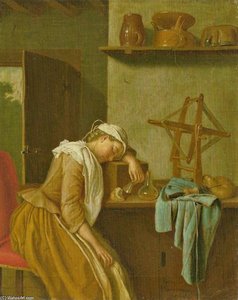 Schlafendes KüchenmädchenBavarian State Painting Collections
De 4 museer som innehar flest av målningarna på denna sida.
| Museum | Stad | Verk av Peter Jacob Horemans | Målningar från denna lista |
|---|---|---|---|
 Bavarian State Painting Collections |
München | 51 | Portrait of Frau Heigl, Kitchen Still Life with Coffee Drinker, Musical Still Life with Horn Player |
 Nationalmuseet i Warszawa |
Warszawa | 2 | Hunting a wild boar, Hunting with falcons |
 Lenbachhaus |
München | 2 | Picnic in the park, Concert in the garden |
 Metropolitan Museum of Art |
New York | 1 | A Musical Gathering at the Court of the Elector Karl Albrecht of Bavaria |
Välj ett decennium för att se originalverket som definierar det.

Portrait of Frau Heigl (1738), Bavarian State Painting Collections, München. Kitchen Still Life with Coffee Drinker (1765) och Musical Still Life with Horn Player (1765) följer efter.
38 år gammal: Portrait of Frau Heigl är från 1738, och Peter Jacob Horemans föddes 1700.
Portrait of Frau Heigl, Kitchen Still Life with Coffee Drinker, Musical Still Life with Horn Player, Still Life with Female Figure with Flowers, Still Life with Elegant Lady, Still Life with Fruit and Female Figure, The Soup Eater, Still Life with Female Figure with Beer Glass, Still Life with Female Figure och Musical Still Life with Male Figure. Rankingen ovan visar varje verks årtal och museum.
Vår katalog innehåller 60 verk av Peter Jacob Horemans, daterade från 1730 till 1776.
Främst i Bavarian State Painting Collections (München), Nationalmuseet i Warszawa (Warszawa) och Lenbachhaus (München). Museitabellen ovan listar alla.
Under 1760s: 36 av de 58 verk som finns på denna sida skapades då, varav Kitchen Still Life with Coffee Drinker.
På den här sidan är det tidigaste A Musical Gathering at the Court of the Elector Karl Albrecht of Bavaria (1730) och det senaste Picnic in the park (1776).
Portrait of Frau Heigl, Kitchen Still Life with Coffee Drinker och Musical Still Life with Horn Player: Bavarian State Painting Collections, München har 51 av verken på denna sida.