Porträtt av Pedro Figari

De 56 mest kända Pedro Figari-målningarna, varje ett unikt konstverk

Uppdaterad november 2026 · rangordnad efter vår popularitetspoäng (sökningar, besök och beställningar för varje verk) · 56 verk av Pedro Figari i vår katalog

Kortfattat

Tertulia at the inn before eating. The inn (1919) är den målning av Pedro Figari som drar till sig flest blickar; originalet finns på National Museum of Fine Arts, Buenos Aires. Därefter dras blicken till Candombe carnival (1932) och Lavanderas En Los Medanos O Los Amigos. Bland de 56 verk av Pedro Figari i vår katalog är dessa 56 de mest kända, var och en ett unikt original presenterat med sitt år, sitt museum och anledningen till dess tidlösa betydelse.

1861 – 1938, Montevideo Impressionism Flest verk: National Museum of Fine Arts

Topp 10 målningar av Pedro Figari, ur galleriets perspektiv

4
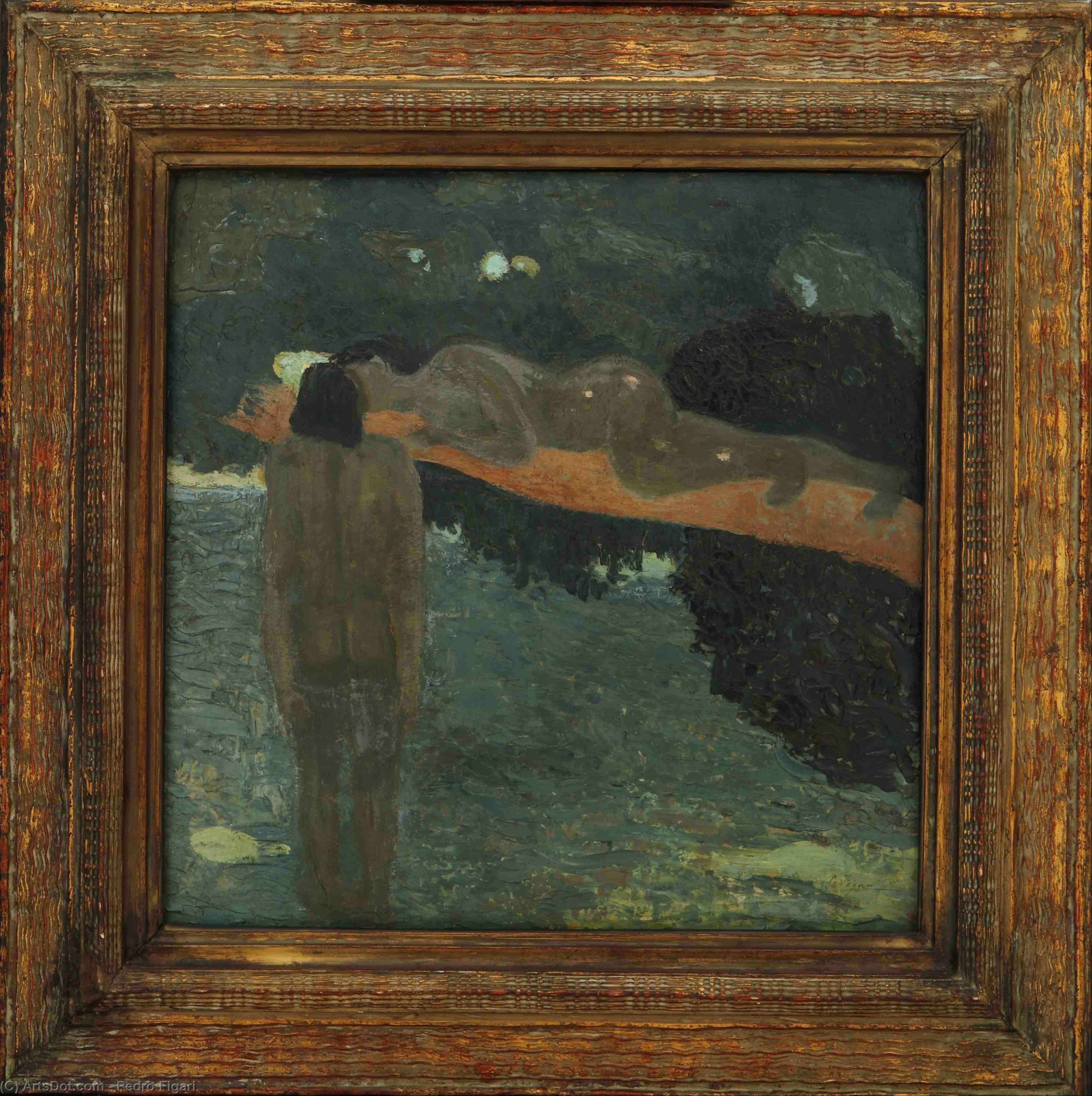
El Beso av Pedro Figari

El Beso

Oil On Canvas · National Museum of Fine Arts, Buenos Aires

El Beso is an oil painting on canvas by Pedro Figari. Born in Montevideo in 1861, the artist lived until 1938, a period that saw him transition from a career in law and politics to a dedicated practice in the visual arts. His later years were defined by a shift toward a unique, intuitive approach to painting, often reconstructing scenes from memory rather than direct observation.

Pedro Figaris berömda målningar, nummer 11 till 56

11La Vida av Pedro FigariLa Vida 12El Requiebro av Pedro FigariEl Requiebro 13El Patio O Patio Unitario av Pedro FigariEl Patio O Patio UnitarioNational Museum of Fine Arts 14El Gaucho Candioti av Pedro FigariEl Gaucho CandiotiNational Museum of Fine Arts 15Negras En La Puerta O Negras En Zaguán av Pedro FigariNegras En La Puerta O Negras En ZaguánNational Museum of Fine Arts 16The Dance (Bailongo) (1925) av Pedro FigariThe Dance (Bailongo)1925 17Creole Dance (1925) av Pedro FigariCreole Dance1925 18Peeling the pava (1925) av Pedro FigariPeeling the pava1925 · National Museum of Fine Arts 19Off for the Honeymoon (1925) av Pedro FigariOff for the Honeymoon1925 20Double Wedding (1930) av Pedro FigariDouble Wedding1930 21Idilio campero (1935) av Pedro FigariIdilio campero1935 · Inter-American Development Bank 22Natt (1918) av Pedro FigariNatt1918 · Colección de Arte Amalia Lacroze de Fortabat 23A Request to Rosas av Pedro FigariA Request to Rosas 24Mass departure av Pedro FigariMass departureNational Museum of Fine Arts 25The pampas or return of the dance av Pedro FigariThe pampas or return of the danceNational Museum of Fine Arts 26Injuria av Pedro FigariInjuria 27La Diligancia av Pedro FigariLa Diligancia 28Damas Antiguas av Pedro FigariDamas Antiguas 29Rincón De Negros av Pedro FigariRincón De Negros 30Las Visitas av Pedro FigariLas Visitas 31La Media Caña av Pedro FigariLa Media Caña 32Pericón - av Pedro FigariPericón -National Museum of Fine Arts 33Jardín Bajo La Luna O Quietud En La Quinta av Pedro FigariJardín Bajo La Luna O Quietud En La QuintaNational Museum of Fine Arts 34El Pericón av Pedro FigariEl Pericón 35Negros Y Mulatas av Pedro FigariNegros Y Mulatas 36Patio av Pedro FigariPatioNational Museum of Fine Arts 37Cuestión De Razas av Pedro FigariCuestión De Razas 38Alevosía av Pedro FigariAlevosía 39Works Of Pedro Figari av Pedro FigariWorks Of Pedro Figari 40Los miriñaques av Pedro FigariLos miriñaques 41Reunión Colonial av Pedro FigariReunión Colonial 42Pampa av Pedro FigariPampaNational Museum of Fine Arts 43Deliberando av Pedro FigariDeliberando 44Hacia La Fiesta av Pedro FigariHacia La Fiesta 45Cuarteleras av Pedro FigariCuartelerasNational Museum of Fine Arts 46Confidencia av Pedro FigariConfidenciaNational Museum of Fine Arts 47Camelias Blancas av Pedro FigariCamelias Blancas 48Las Vecinas av Pedro FigariLas VecinasNational Museum of Fine Arts 49Candombe av Pedro FigariCandombeNational Museum of Fine Arts 50Candombe O Candombe Bajo La Luna av Pedro FigariCandombe O Candombe Bajo La LunaNational Museum of Fine Arts 51Lamento av Pedro FigariLamentoNational Museum of Fine Arts 52Cancha De Bochas av Pedro FigariCancha De BochasNational Museum of Fine Arts 53Pericón av Pedro FigariPericónNational Museum of Fine Arts 54Baile En El Rancho av Pedro FigariBaile En El RanchoNational Museum of Fine Arts 55Una Diligencia av Pedro FigariUna DiligenciaNational Museum of Fine Arts 56Tertulia av Pedro FigariTertuliaNational Museum of Fine Arts

Pedro Figaris berömda målningar, period för period

Motiven som fångade Pedro Figaris blick

De fyra motiv som återkommer oftast i dessa originalverk, var och ett med sitt främsta exempel.

Museerna som förvarar Pedro Figaris originalverk

De 3 museer som innehar flest av målningarna på denna sida.

Museum Stad Verk av Pedro Figari Målningar från denna lista
National Museum of Fine Arts, Buenos AiresNational Museum of Fine Arts Buenos Aires 25 Tertulia at the inn before eating. The inn, Candombe carnival, Lavanderas En Los Medanos O Los Amigos
Inter-American Development Bank, Washington, D.C.Inter-American Development Bank Washington, D.C. 1 Idilio campero
Colección de Arte Amalia Lacroze de Fortabat, Buenos AiresColección de Arte Amalia Lacroze de Fortabat Buenos Aires 1 Natt

Pedro Figari genom decennierna: ett unikt original för varje era

Verk per decennium

Välj ett decennium för att se originalverket som definierar det.

Pedro Figaris målningar: frågor till galleriet

Vilket är Pedro Figaris mest kända verk?Visa svaret

Tertulia at the inn before eating. The inn (1919), National Museum of Fine Arts, Buenos Aires. Candombe carnival (1932) och Lavanderas En Los Medanos O Los Amigos följer efter.

Vid vilken ålder skapade Pedro Figari Tertulia at the inn before eating. The inn?Visa svaret

58 år gammal: Tertulia at the inn before eating. The inn är från 1919, och Pedro Figari föddes 1861.

Vilka tio målningar av Pedro Figari är de mest kända?Visa svaret

Tertulia at the inn before eating. The inn, Candombe carnival, Lavanderas En Los Medanos O Los Amigos, El Beso, While the Ball Rolls, El Maturrango, Encuentro En El Camino, Carreta, La Amita och Preparando El Candombe. Rankingen ovan visar varje verks årtal och museum.

Hur många verk av Pedro Figari är kända?Visa svaret

Vår katalog innehåller 56 verk av Pedro Figari, daterade från 1918 till 1935.

Var kan de mest kända originalen av Pedro Figari ses?Visa svaret

Främst i National Museum of Fine Arts (Buenos Aires), Inter-American Development Bank (Washington, D.C.) och Colección de Arte Amalia Lacroze de Fortabat (Buenos Aires). Museitabellen ovan listar alla.

Under vilken period skapade Pedro Figari sina mest kända målningar?Visa svaret

Under 1920s: 4 av de 56 verk som finns på denna sida skapades då, varav The Dance (Bailongo).

Vilket av de kända verken av Pedro Figari är det tidigaste respektive det senaste?Visa svaret

På den här sidan är det tidigaste Natt (1918) och det senaste Idilio campero (1935).

Vilka motiv föredrog Pedro Figari?Visa svaret

Social gathering (4), Uruguayan culture (3) och Uruguayan art (3), fördelat på 56 verk på denna sida.

Vilken konstinriktning tillhör Pedro Figaris verk?Visa svaret

Impressionism och Modernism, om man dömer efter originalen på denna sida.

Vilka original av Pedro Figari kan jag se på National Museum of Fine Arts?Visa svaret

Tertulia at the inn before eating. The inn, Candombe carnival och Lavanderas En Los Medanos O Los Amigos: National Museum of Fine Arts, Buenos Aires har 25 av verken på denna sida.

Pedro Figari: ett porträtt av konstnären

A Life Imbued with Uruguayan Essence

Pedro Figari, a name now inextricably linked to the heart of Latin American modernism, was far more than simply a painter; he was a complex and deeply engaged intellectual – a lawyer, writer, politician, and ultimately, an artist who dedicated his entire life to capturing the very essence of Uruguay. Born in Montevideo in 1861, Figari’s artistic journey wasn't one of immediate, deliberate pursuit. Initially drawn to the structured world of law, he earned his degree in 1886, a profession that profoundly shaped his understanding of society’s intricacies and injustices – experiences which would later find powerful expression through his art. His early career as a defense attorney for the marginalized and impoverished exposed him intimately to the realities faced by many Uruguayans, fostering a deep empathy and social consciousness that permeated his work. A marriage in the same year led to travels across Europe, particularly France, where he encountered the burgeoning world of post-impressionism – an encounter that subtly yet significantly influenced his artistic direction, introducing him to new techniques and perspectives without entirely eclipsing his own unique vision. However, it was in 1921, at the remarkable age of sixty, that Figari truly embraced painting as a vocation, marking a dramatic shift and unleashing a torrent of creativity that would forever alter the landscape of Latin American art.

From Legal Chambers to Artistic Visions

For decades prior, Figari had maintained a delicate balance between his legal and political commitments and sporadic artistic endeavors. He was deeply involved in Uruguayan public life, serving as a respected member of Parliament, directing the Escuela Nacional de Artes y Oficios (National School of Arts and Crafts), and contributing significantly to intellectual discourse through his writings on law, education, aesthetics, and even utopian ideals – exploring concepts of social reform and artistic expression. This diverse background wasn’t a distraction from his art; rather, it served as a rich source of inspiration, informing his perspective and deepening the layers of meaning within his paintings. His legal training instilled in him a keen observational skill and an acute sensitivity to human dynamics, while his literary pursuits honed his ability to articulate complex ideas with nuance and clarity. The move to Buenos Aires in 1921 proved to be a pivotal moment, acting as a catalyst for the full flowering of his artistic talent. It was there that he shed the constraints of earlier, more academically-influenced styles – styles rooted in European traditions – and began to forge a truly distinctive and uniquely Uruguayan voice. He abandoned meticulous realism, opting instead for a more intuitive approach—painting not what he *saw* with literal accuracy, but rather what he *remembered*, distilling the essence of his experiences into vibrant, emotionally resonant images.

A Pioneer’s Palette: Style and Subject Matter

Figari's artistic style is immediately recognizable for its bold color palettes, expressive brushstrokes, and a seemingly naive simplicity that belies profound depth. He wasn’t interested in creating illusions of photographic realism or elaborate detail; instead, he treated his canvases as studies in color and form—reconstructing scenes from the fragmented memories of his past. His subjects were drawn almost exclusively from the world he knew intimately – the gauchos (cowboys) roaming the vast pampas grasslands, lively carnival celebrations bursting with music and dance, the quiet rituals and daily life of Montevideo’s black community, and the intimate beauty of colonial patios bathed in golden light. These weren't merely picturesque depictions; they were poignant reflections on Uruguayan identity, social customs, and a disappearing way of life – a sense of nostalgia for a fading past. He captured fleeting moments—a dance in progress, a gathering of friends, a street scene teeming with activity—with an immediacy that felt both timeless and deeply rooted in place. His technique, often employing *impasto* (thickly applied paint) with visible brushstrokes, further emphasized the expressive power of color and texture, creating paintings that pulsated with energy and emotion. The use of bright, saturated colors was particularly striking, reflecting the vibrancy and warmth of Uruguayan culture.

Breaking with Tradition: A Latin American Voice

Pedro Figari emerged during a crucial period in Latin American art history – a time when artists were actively seeking to break free from European artistic dominance and define their own unique aesthetic identities. Traditional academic painting often focused on historical or religious subjects, prioritizing technical skill over genuine emotional expression. Figari challenged this convention by embracing a more direct, unpretentious style that allowed him to subtly critique social norms and celebrate the richness of Uruguayan culture. He believed in the power of art to connect with the everyday experiences of ordinary people, rejecting elitism in favor of authenticity. His work resonated deeply with a growing sense of national pride and a desire to reclaim indigenous roots – a sentiment particularly relevant during a period of significant social and political change in Latin America. He wasn’t alone in this endeavor—artists like Diego Rivera and Tarsila do Amaral were also forging new paths, but Figari's unique blend of memory, color, and social commentary established him as a pivotal figure in the development of Latin American modernism. His paintings weren’t simply representations of Uruguayan life; they *were* Uruguay—its colors, its rhythms, its soul—preserved on canvas for generations to come.

Legacy and Enduring Influence

Pedro Figari's legacy extends far beyond his individual artistic achievements. He is remembered as one of the first Latin American painters to successfully forge a distinctly regional style, prioritizing feeling and essence over strict realism. His work continues to inspire artists and art lovers alike with its vibrant energy, emotional depth, and unwavering commitment to capturing the spirit of Uruguay. He demonstrated that true modernity wasn’t about imitating European trends but about finding one's own voice—a lesson that resonated throughout Latin America and beyond. He died in 1938, leaving behind a body of work that stands as a testament to his artistic vision, intellectual curiosity, and enduring love for his homeland. His paintings are not merely representations of Uruguayan life; they *are* Uruguay – its colors, its rhythms, its soul – preserved on canvas for generations to come.